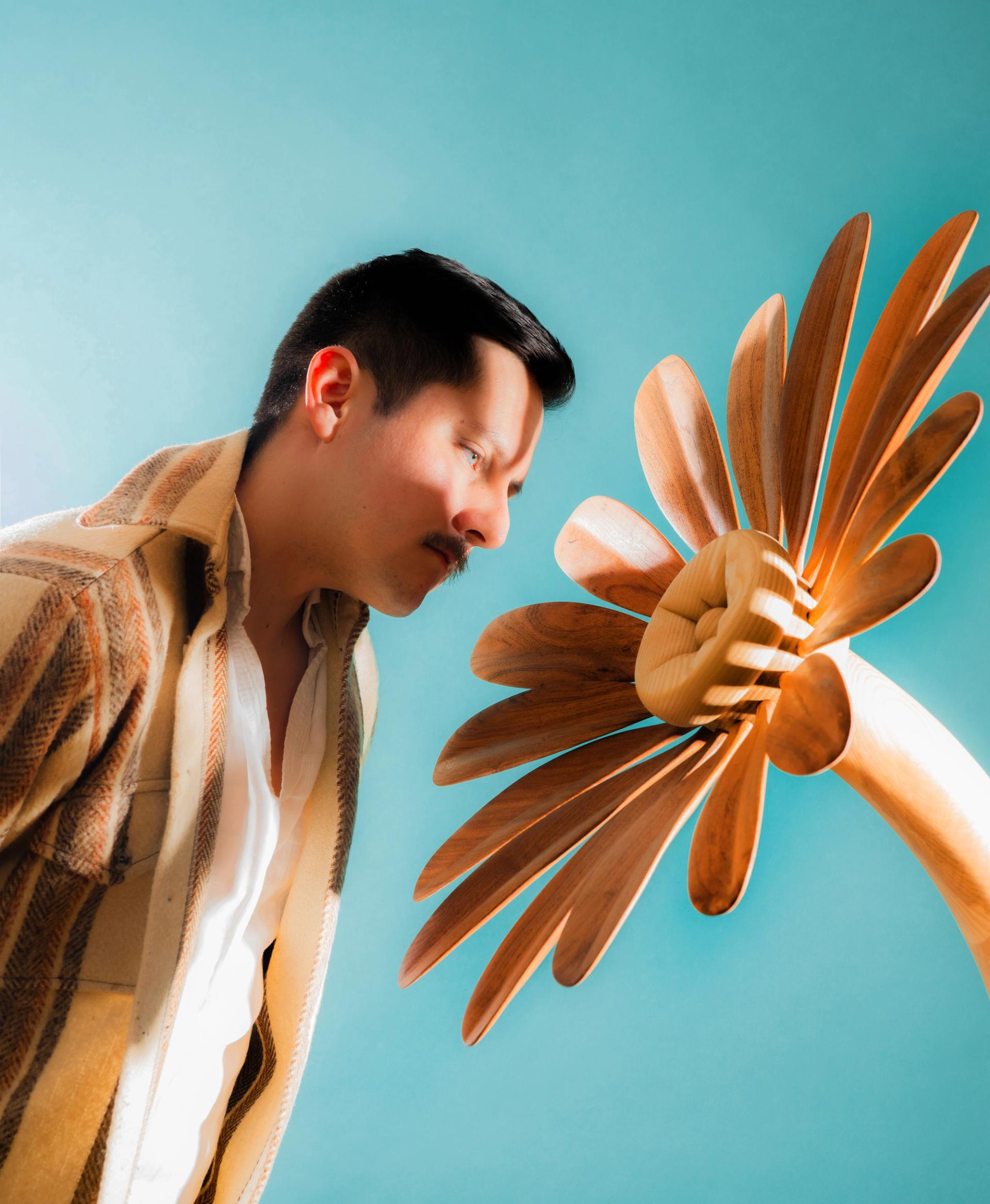
Raul De Lara’s Damianita
The Mexican American artist sculpted a larger-than-life flower that imagines a world beyond borders. All it took was several hundred pounds of wood, a VR headset—and a Christmas sled.
May 18, 2026
Raul De Lara grew up surrounded by wooden santos, Mexican devotional figures said to carry special powers. The carvings adorned his childhood homes in Torreón, a small town in central Mexico, and later Austin, Texas, and inspired an early understanding of art making as transfiguration. “I grew up watching people carving branches into saints,” he said. His Catholic upbringing and the rich history of ritual, folklore, and supernatural beliefs in his Mexican heritage stirred up what he describes as a “spiritual connection” to wood, one that would eventually draw him to sculpture and inform his own practice. When his father, an architect, introduced him to woodworking, the process took on new meaning, and a question stayed with him: “At what point in the carving process does the piece of wood become a saint?”
That charge extends to his subjects: the prickly cactus, with its bristling armor of needles, and the monstera leaf, with its broad, sun-hungry sprawl, recur throughout his work. While working on a commission for The Contemporary Austin, which hosted a solo exhibition for him in 2025, De Lara became preoccupied with ideas around plant heritage, wanting to understand why plants, but not people, could be native to two places. He once asked a scientist how long it took plants to be considered native. “He said that it’s not about time, it’s about who has the power to call you invasive,” De Lara recalled.
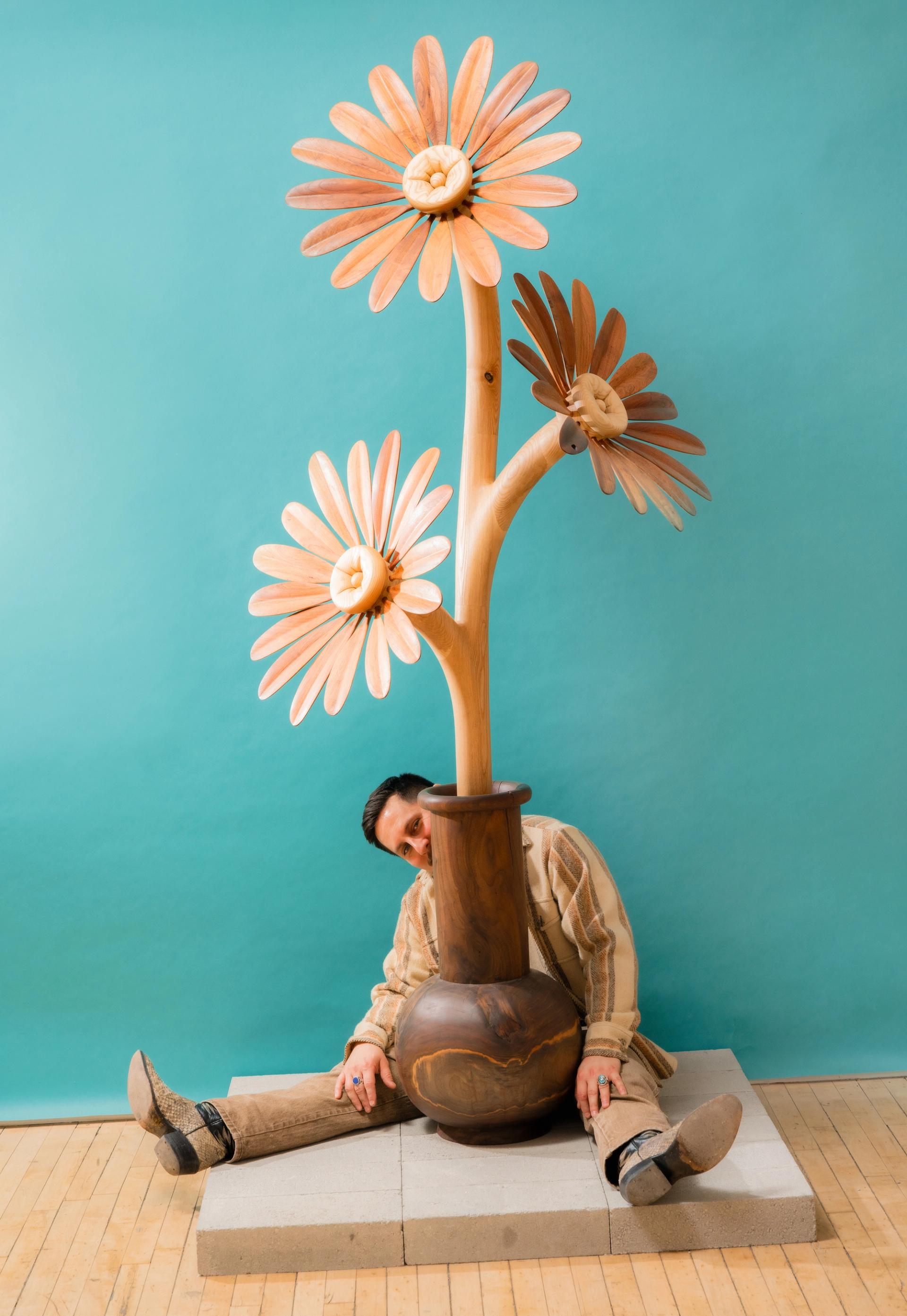
Raul De Lara with “Damianita” (2025).
This resonated with the artist, a DACA recipient whose residence in the US is precarious. At a garden center in Austin, De Lara studied three wildflowers native to both Texas and Mexico: the damianita, the lazy daisy, and the firewheel, all of which would inspire sculptures. Damianita (2025)—named for the bright yellow, daisy-like plant—stands seven and a half feet tall, with a whimsical charm that belies the labor and poignancy behind it.
The piece, which resembles an enlarged, potted flower with three blooms, is made from three kinds of wood: dark, striated walnut for the base, with its spherical bottom and long, lipped neck; ash for the stems and the flowers’ cushion-like centers; and mesquite for the petals—harvested and milled just outside Austin, grounding the work directly in the land where it would first be shown. De Lara drew on elements of Mexican and American craftsmanship to create a moving monument to the union—not the separation—of both cultures. “I don’t get too caught up in whether something’s American or Mexican,” he said. “Structurally, I’m trying to make something sound, so it won’t fall apart.”
He made the sculpture at a human-like scale, he said, because it is a “stand-in for the human experience,” representing his story, and the stories of others in his position. But making a piece of this size demanded unusual logistical and manual feats.
Courtesy of Raul De Lara
The wood dehydrated and shrank, creating the cracks that remain in the finished sculpture. These “gnarly, drastic” fractures, De Lara said, evoke a “state of fragility and uncertainty” related to the feeling of limbo that accompanies tenuous immigration status. He left the wood’s knots, too—the dark marks where branches once grew—letting the imperfections amplify a sense of vulnerability.
It took two months for him to finish the pot—one of three made from the wood he sourced upstate, each intended for a different wildflower. Then he turned to what it would contain. For the past two years, the artist has used a virtual reality headset app to conceptualize his sculptures, which retain the appearance of larger-than-life animations. With VR, he said, “You can walk around your doodles, see them in real space.” He “doodled” the damianita that would emerge from his walnut pot, adjusting the scale and finding an ideal composition. His self-described playful, exploratory spirit runs through the work’s artistic lineage as well: De Lara’s sculptures owe a debt to Robert Gober’s uncanny objects, Ray and Charles Eames’s lively approach to plywood, and Martin Puryear’s spare, monumental forms. “I don’t strive to replicate reality,” De Lara said. “I work with a more abstract language. Flowers need to look flower-ish.”
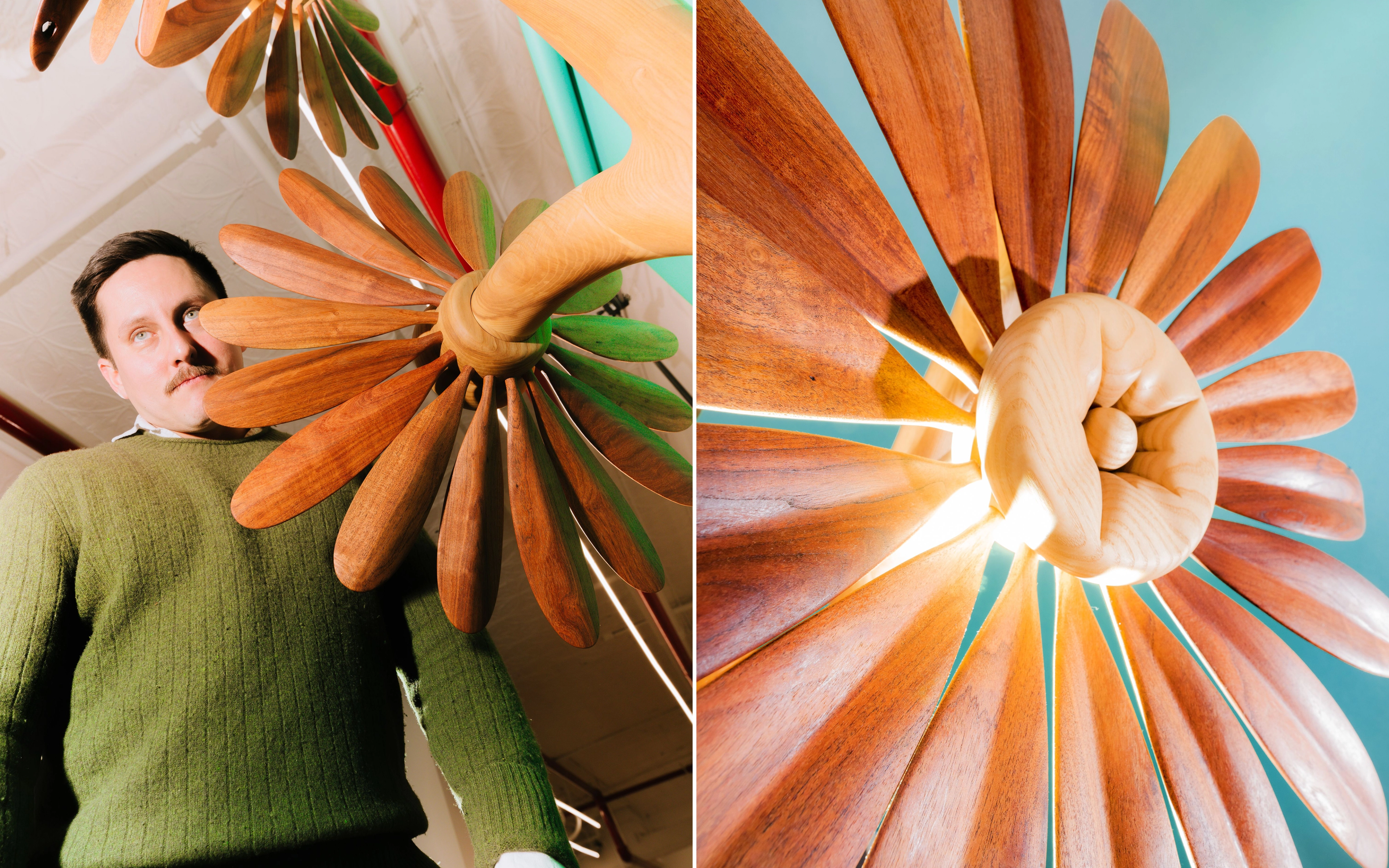
He constructed his flowers using woodworking techniques he calls “as old as time itself.” A close look at their stems reveals shifts in wood grain along smooth vertical and horizontal lines—evidence of “laminating” two pieces of wood together via end-grain or side-grain joinery. The latter technique runs the grain from two different pieces parallel, making the end product stronger and anticipating the ways it might move over time. De Lara also used internal dowels to further connect different sections; without them the pieces would never fully hold.
De Lara’s work is rigorous, requiring a high level of finesse while also embracing elements of surprise. To pull it off, he said, he has to feel in conversation with his material—like he’s in dialogue with his work, not dominating it and bending it to his will. “This kind of making requires endurance,” he said. “It’s a dance. You’re carving and moving in a way that’s gentle and fluid, instead of yakking away.”
The sculptures are also modular—each bloom, stem, and vase can be disassembled and packed separately—a practical necessity that became something more. Because De Lara cannot always travel freely, he has long designed his work to go where he cannot. “From early on, I started thinking of modularity as a way of existing,” he said. “A way of resistance, a way of adaptability. How do you live under new conditions?”