Xanthe Somers Weaves a Complex History with Clay
Racing to finish a body of work before she gives birth, the Zimbabwe-born ceramicist Xanthe Somers makes vibrant testaments to invisible labor, racial injustice, and the craft traditions of the women who came before her.
May 27, 2026
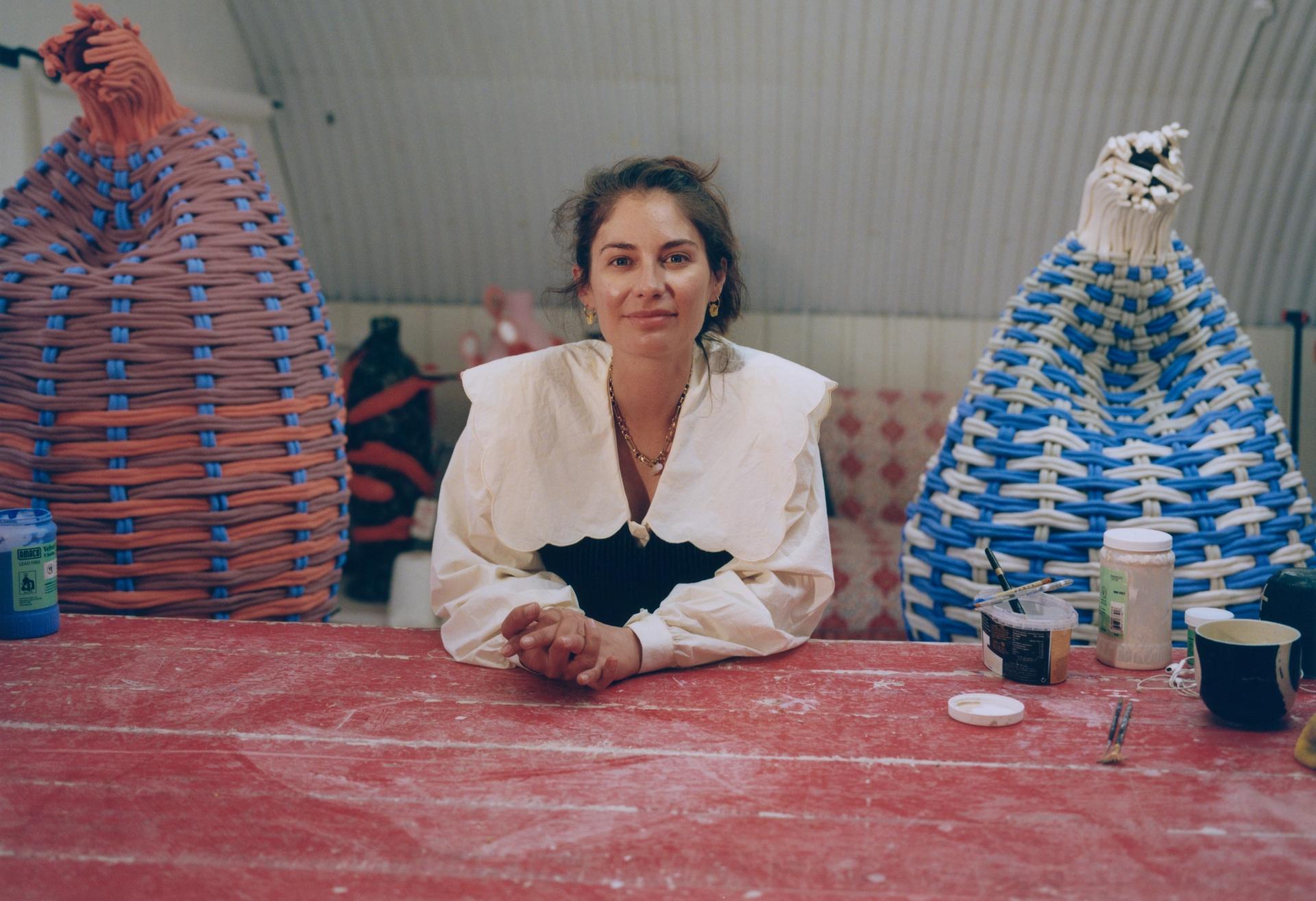
Xanthe Somers’s vessels look like they’re about to give way. Coiled ribbons of clay bend, balloon, and slouch. They are buoyant and commanding, but also warped, slumping as if under some invisible weight. That tension is at the heart of her practice: The exaggerated, misshapen vessels embody both the cultural vibrancy of her Zimbabwean heritage and the abiding weight of inequality.
When I visited Somers’s studio, nestled beneath a set of railway arches in South London, the space was filled with works in progress, which she’s racing to finish for an exhibition at London’s October Gallery in July. Another deadline also looms: She’s due to give birth in June. “I’ve made this whole body of work while pregnant,” she said with a smile. It’s a powerful symmetry—the artist among her voluminous ceramic vessels, both steadily approaching completion and still marked with her fingerprints. Fittingly, the show will be titled “Cleaner, Carer, Mother, Maker.”
The self-taught ceramicist’s work draws on traditional women-led crafts like basketry, weaving, and pottery. She has earned global acclaim for her distinct blend of color, craft, and commentary. Her work has been exhibited internationally and is held in the collection of the Victoria and Albert Museum, London, and this year she was a finalist for the Loewe Craft Prize, which celebrates innovation and excellence in contemporary craft practices.
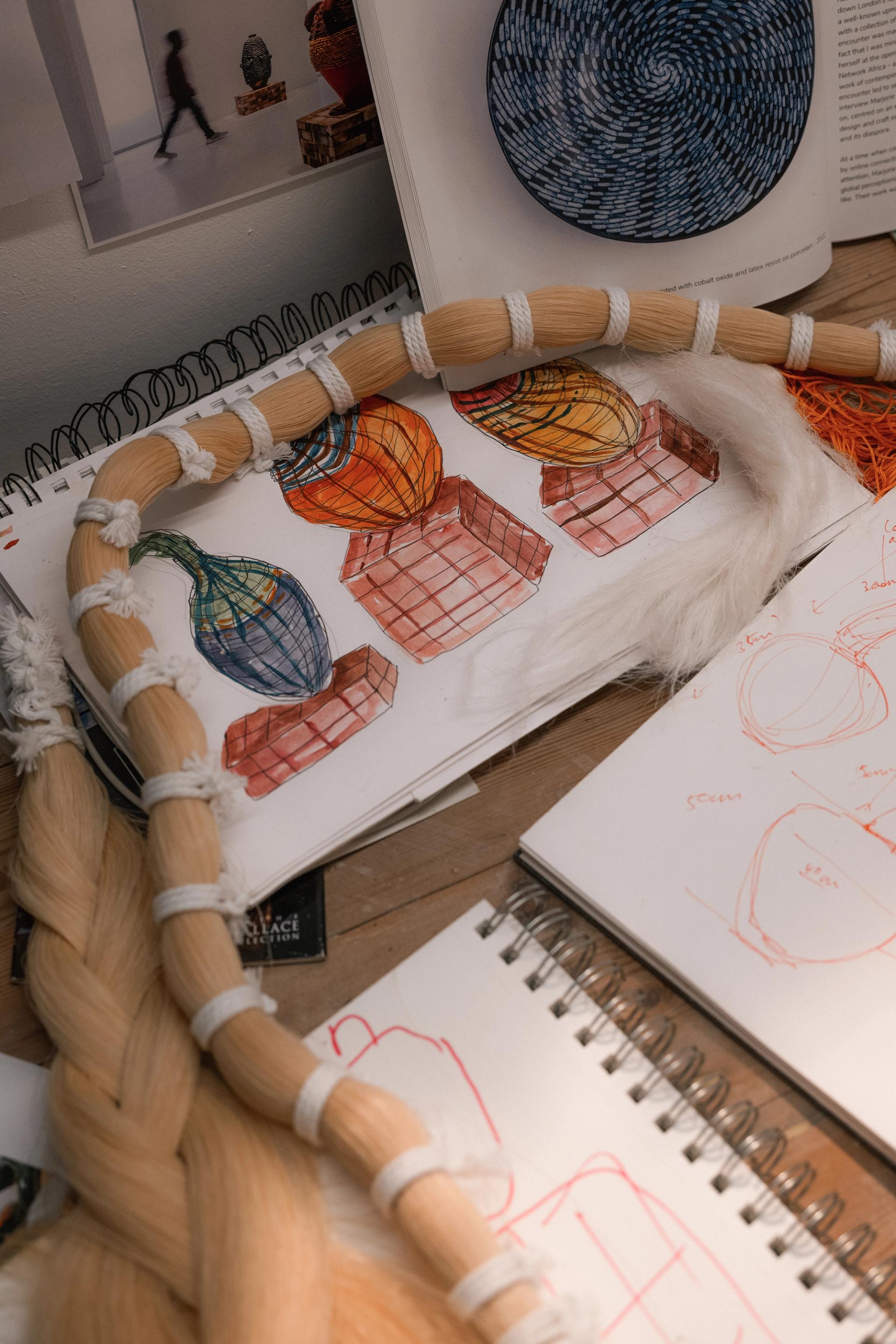
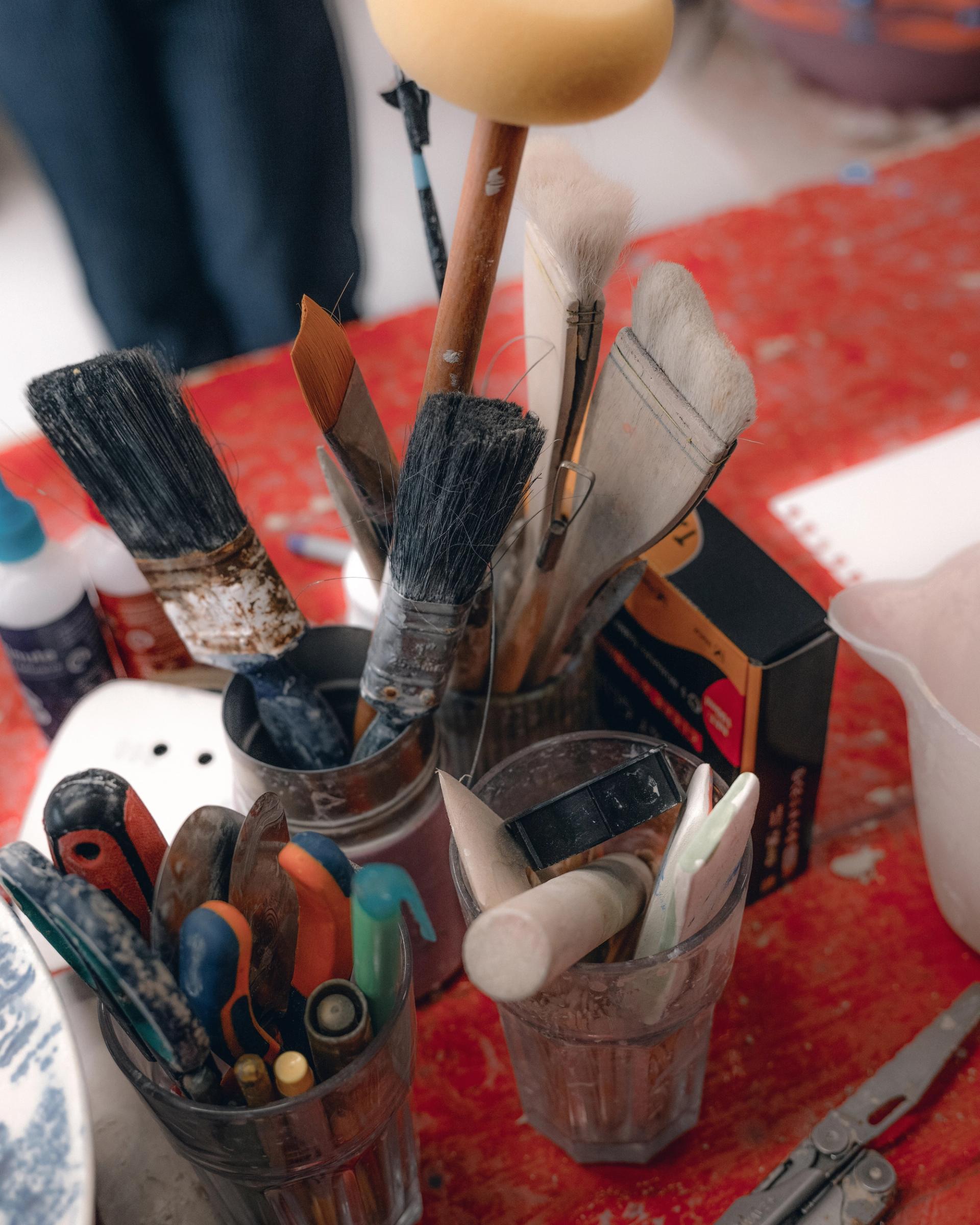
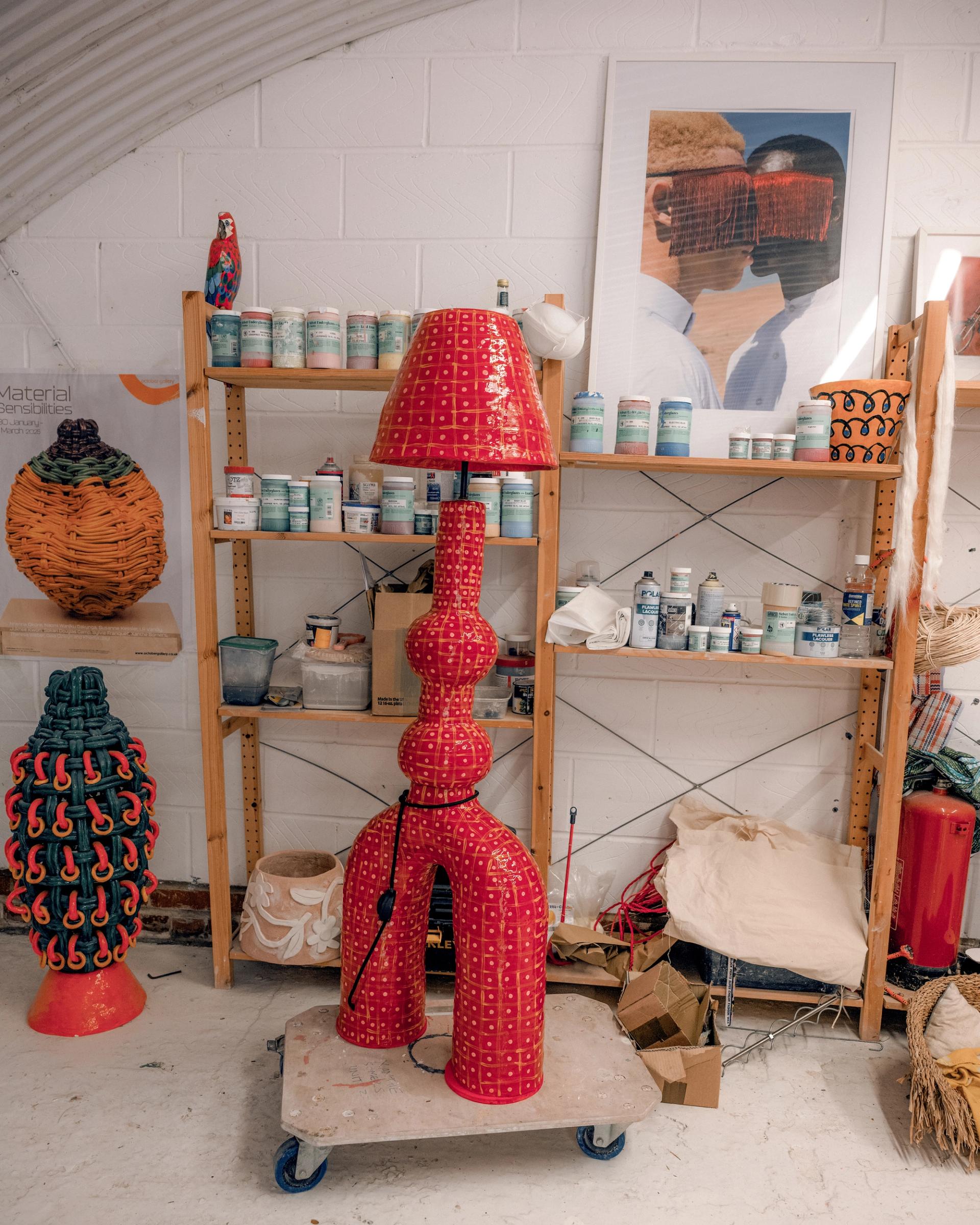
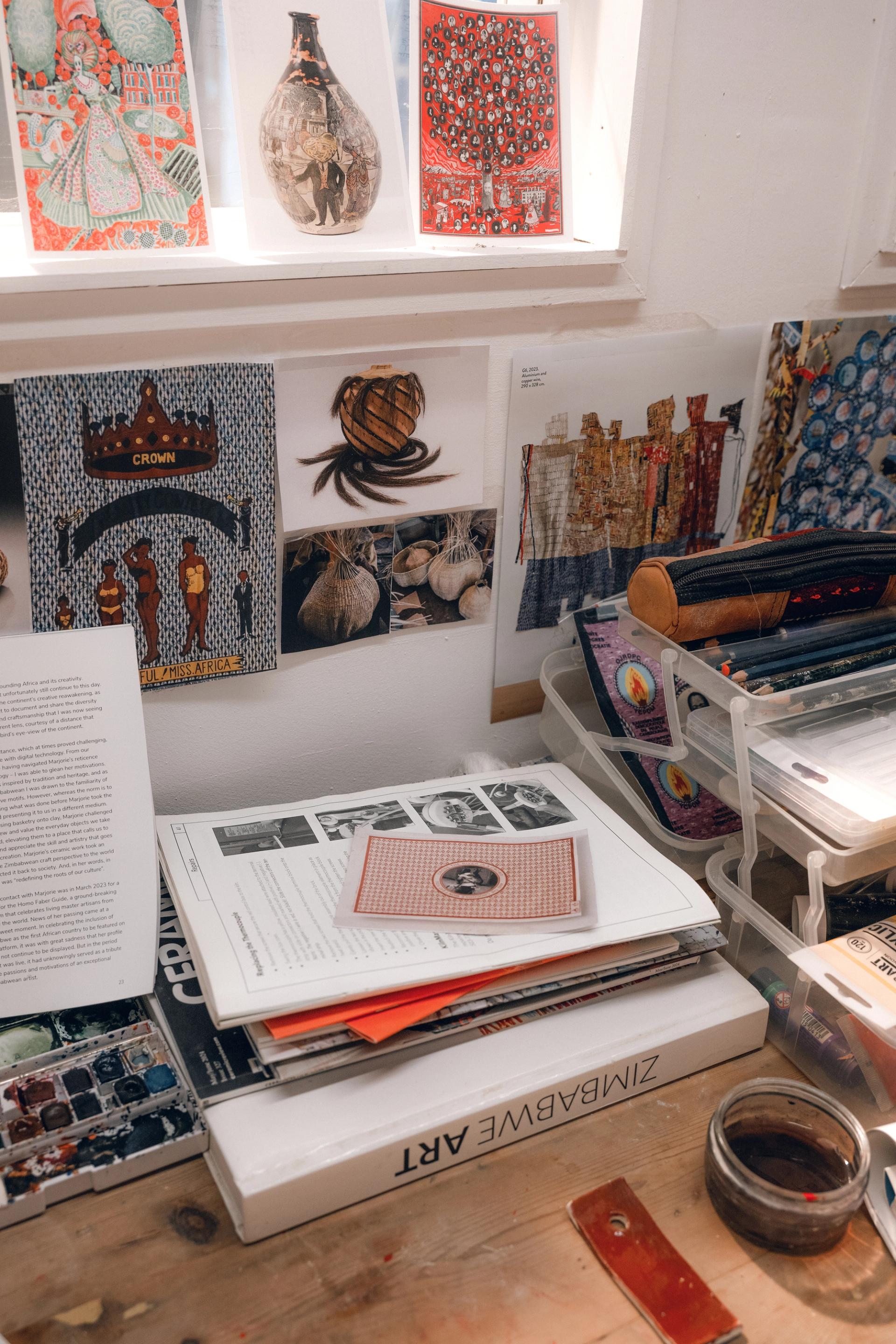
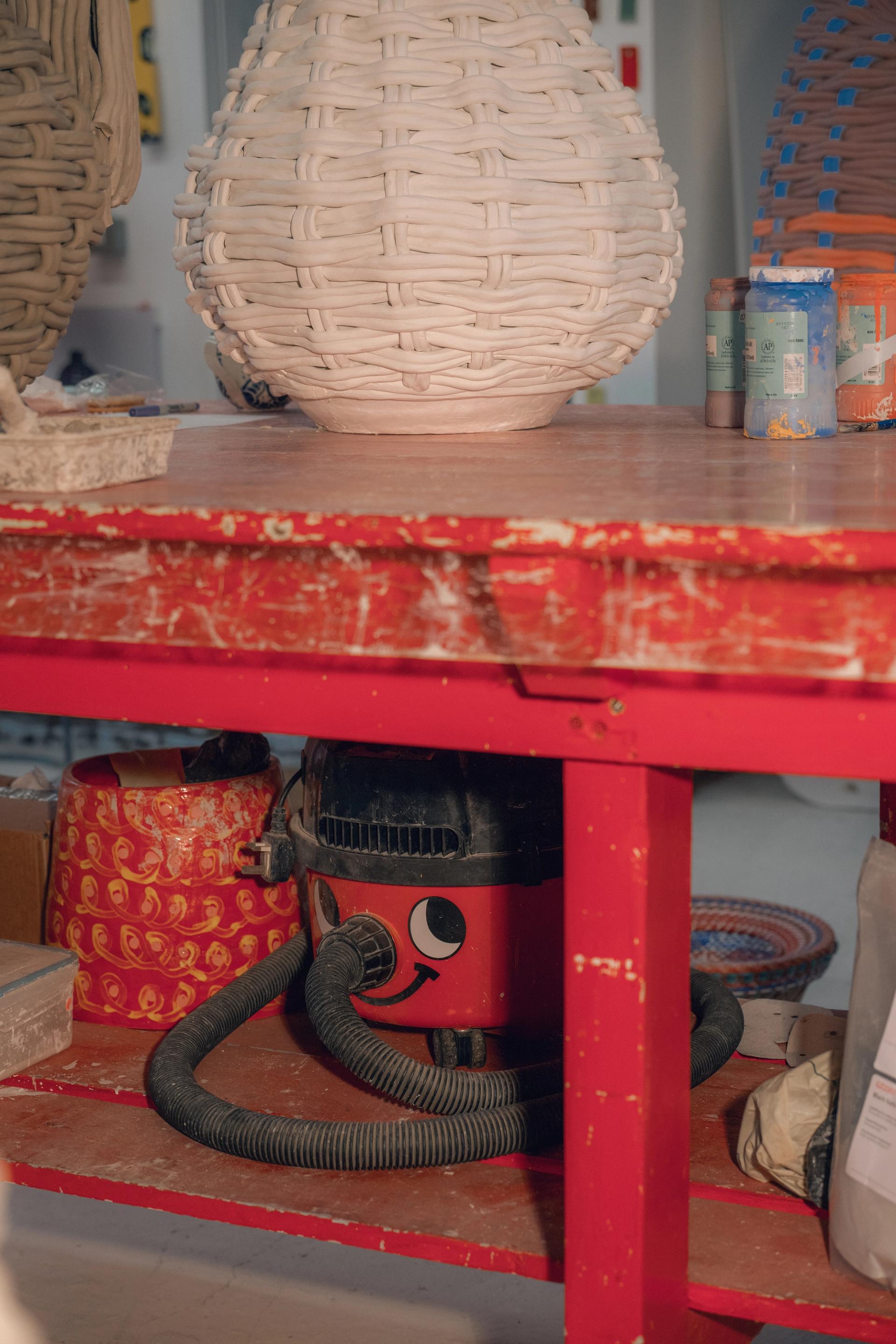
Details of Somers’s studio.
Born in Harare, Zimbabwe, in 1992, she grew up as part of the country’s tiny white minority, which accounts for less than one percent of the population. “I lived in a bubble,” she said, “a very nice bubble.” The country was in turmoil during her upbringing—shadowed by stark racial segregation, economic collapse, hyperinflation, and failing infrastructure. “I lived through these wild times where there was no power, no water,” she recalled, but as a kid, “it just becomes normal.”
Her education was, in her words, “Christian, capitalist, and Eurocentric,” and left her with a distinct sense of dislocation. “I grew up reading about rabbits and meadows, which just didn’t exist there. I learned about Vikings and the Battle of Hastings—nothing about Zimbabwean history, African history, nothing about colonialism,” she said. “My history is in colonial legacy. I only started to unpack it once I left.”
What she remembers most is being surrounded by resourcefulness: passing weavers and potters on the way to school, watching people transform raw materials—natural grasses, discarded tires—into something beautiful and useful out of necessity. “There was an inherent need to be creative out of anything,” she said. “It’s not just learning old mediums. It’s all around you.” It was an early, complicated education in what craft could mean.

Students cheer as the Cecil Rhodes statue is removed from the University of Cape Town on April 9, 2015 in Cape Town, South Africa.
Credit: Photograph by Charlie Shoemaker / Getty ImagesShe went on to enroll in a fine art degree at the University of Cape Town, South Africa, graduating in 2015—the same year the Rhodes Must Fall (opens in new window) movement erupted on campus. It began with a campaign to remove a statue of Cecil Rhodes, the British imperialist who was instrumental in the colonization of southern Africa, and expanded into global protests against institutional racism and the legacies of colonialism, including at the University of Oxford and Harvard University.
For Somers, it was a moment of political awakening. “Just understanding that colonial history was so present, and what my privilege was, how Eurocentric everything was,” she said. She began to interrogate her own position as a white Zimbabwean, and the limited perspectives and racial inequalities around which she’d grown up. “White privilege and white supremacy wasn’t openly acknowledged. It was the status quo.” Finding herself more occupied by the movement than by her art classes, she left for the United Kingdom on a scholarship to pursue a master’s degree in postcolonial theory at Goldsmiths, University of London.
The course was enlightening and grueling, academically as well as emotionally. “You’re learning about the tragic things that happened within Africa and within your home: colonial wars, wars of independence, the ongoing fallout.” As a white Zimbabwean, she added, “you’re constantly questioning your role and your responsibility.”
In need of a creative outlet, she joined an open-access pottery studio, having never worked with clay before. “It was the most freeing environment, because no one was teaching you, no one was telling you what was right or wrong. I had my head full of all the things I was learning about, and it was a contemplative place.” She started inscribing her vessels and sculptures with fragments inspired by her readings—“Fruits of our forefathers,” referencing inherited wealth; “The center cannot hold,” a line from William Butler Yeats, quoted by Chinua Achebe in the epigraph of Things Fall Apart—and began to realize the potency of clay as a political medium. “It felt exciting, like I could try anything and see what happens.”
After graduating, and faced with the question of what to do next, she rented a small studio and “hoped for the best.” That was six years ago.
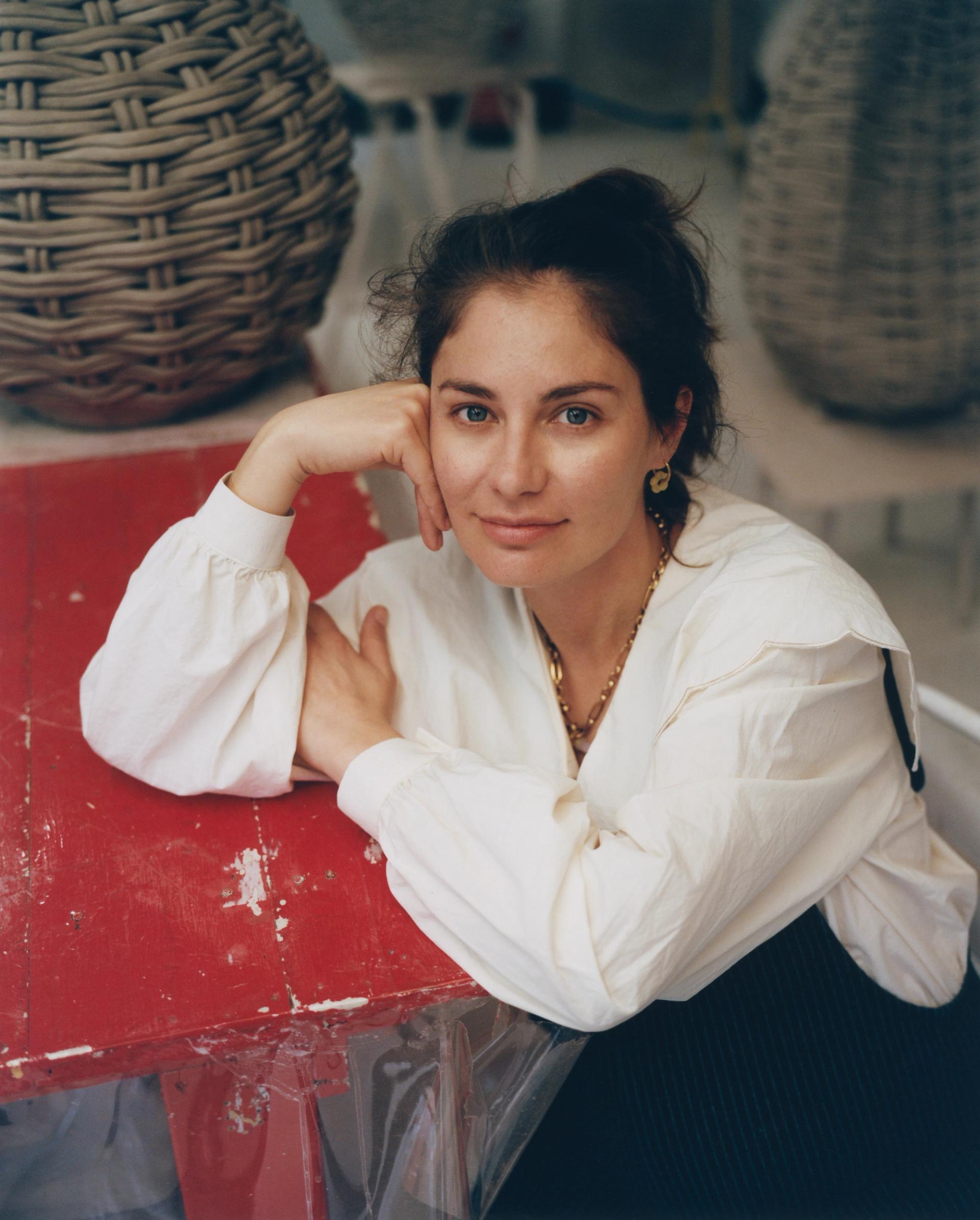
It took some time for Somers’s work to evolve into the vivid, large-scale woven ceramic objects she’s known for today. Always drawn to the form of the vessel—what it can hold, be it water, stories, or aesthetic value—she went through various phases of experimentation. Initially, she deployed bright, exaggerated shapes to gently mock the notions of sophistication and refinement that were pervasive in Zimbabwe’s white community. “White Zimbabweans are very high-minded about taste,” she said. “Little china tea sets…hanging onto old concepts.”
From there, she turned her attention to local craft practices of her youth—basketry, textiles, ceramics—and the unacknowledged artists, often women, behind them. She made vessels with traces of corporate logos, appendages of limbs and hands, and political messages about consumerism and extractive industries. Adorned with references to Zimbabwean materials, like wax fabric and tin buckets, these early works feel somewhat didactic and discursive—the precursors to a subtler, more cohesive approach.
“A lot of ideas were going through my head,” she said. “I wanted to find a visual language that drew them together, but also in an abstract way.” The breakthrough came when she was working on a piece about race and domestic labor in Zimbabwe—specifically the Black workers who still tend the gardens and clean the houses of the white elite. “I grew up with maids who lived in our home. My grandmother still has a gardener. It’s a crazy dynamic when you’ve stepped out of that world, and then you go back and it’s like you’ve gone back in time.”
She started by braiding a hose around a clay vessel, evoking what she described as “the invisible hand” of suburban gardeners. The hose looked striking, but it occurred to her that she could substitute it with clay to create something more visually harmonious. Introducing slumps and indentations into the vessel itself became a way to represent the burdens of labor and inequality, but in a more felt and intuitive manner. Her distinctive style was born. “The pieces look like they’re woven in a similar way to rattan furniture or baskets, but it’s a different technique entirely. I’ve never been taught how to weave.”
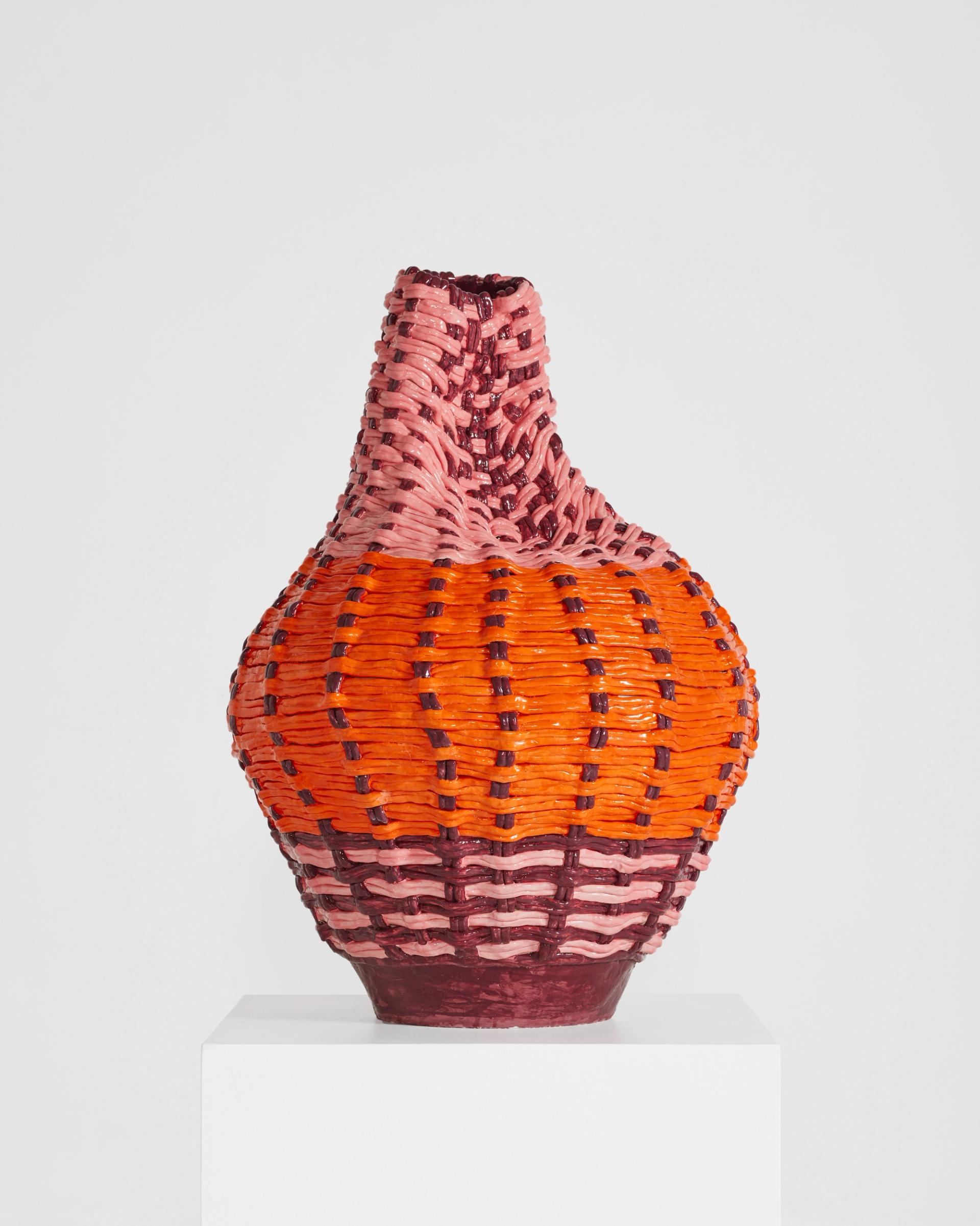
By the Pricking of My Thumbs, 2025.
Credit: Courtesy of Hayden Phipps/Southern GuildThe effect is beguiling. The sculptures appear to be woven of strips of clay, pulled and twisted like saltwater taffy, with a sense of softness and movement that belies their solidity. Weaver’s Woe (2024) is a bright orange, green, and burgundy orb, vibrant and assertive, yet also falling in on itself. The pink-and-orange-striped oblong of By the Pricking of My Thumbs (2025) seems to collapse in exhaustion. In The Caretaker’s Clotheshorse (2025), the Loewe Prize–nominated work, ropes of clay spew from the top of a slumping, rainbow-hued basket, as if the sculpture is on the verge of unraveling.
Making these works is a slow, intricate process. Somers begins by testing out potential shapes on the page, loosely considering how a vessel might droop or fold or bend. When it comes time to sculpt, she tosses the sketches aside, preferring not to adhere to a strict plan. “Clay has a mind of its own,” she said mischievously.
Overlay images: Courtesy of Erin Starr Katzeff / Southern Guild
That process unfolds over two weeks. Then, another endurance test: The pieces need about two months to dry before Somers can paint the intricate surfaces with vivid glazes—each coil and ribbon rendered in a single, flat color. She’s drawn to bright colors, both for their connection to Zimbabwean textiles and because their exuberance appeals to viewers. “Color is a weapon,” she said. Once people are enticed, she hopes they feel compelled to learn about the ideas that underlie the works.
Finally, the sculptures are shepherded across London to an extra-large kiln. “It’s the most frightening part of the whole process. They go in the back of a van, and [my assistants and I] huddle around them to make sure they are safe,” she said. They’re fired twice, presenting still more opportunity for mishap. A piece could explode if it’s still wet, or the glaze could malfunction, or it could crack or break. “You pray to the kiln gods every time.” The whole process is threaded with risk, but Somers relishes the thrill: “That moment when you open the kiln and feel it’s been successful is so satisfying.”
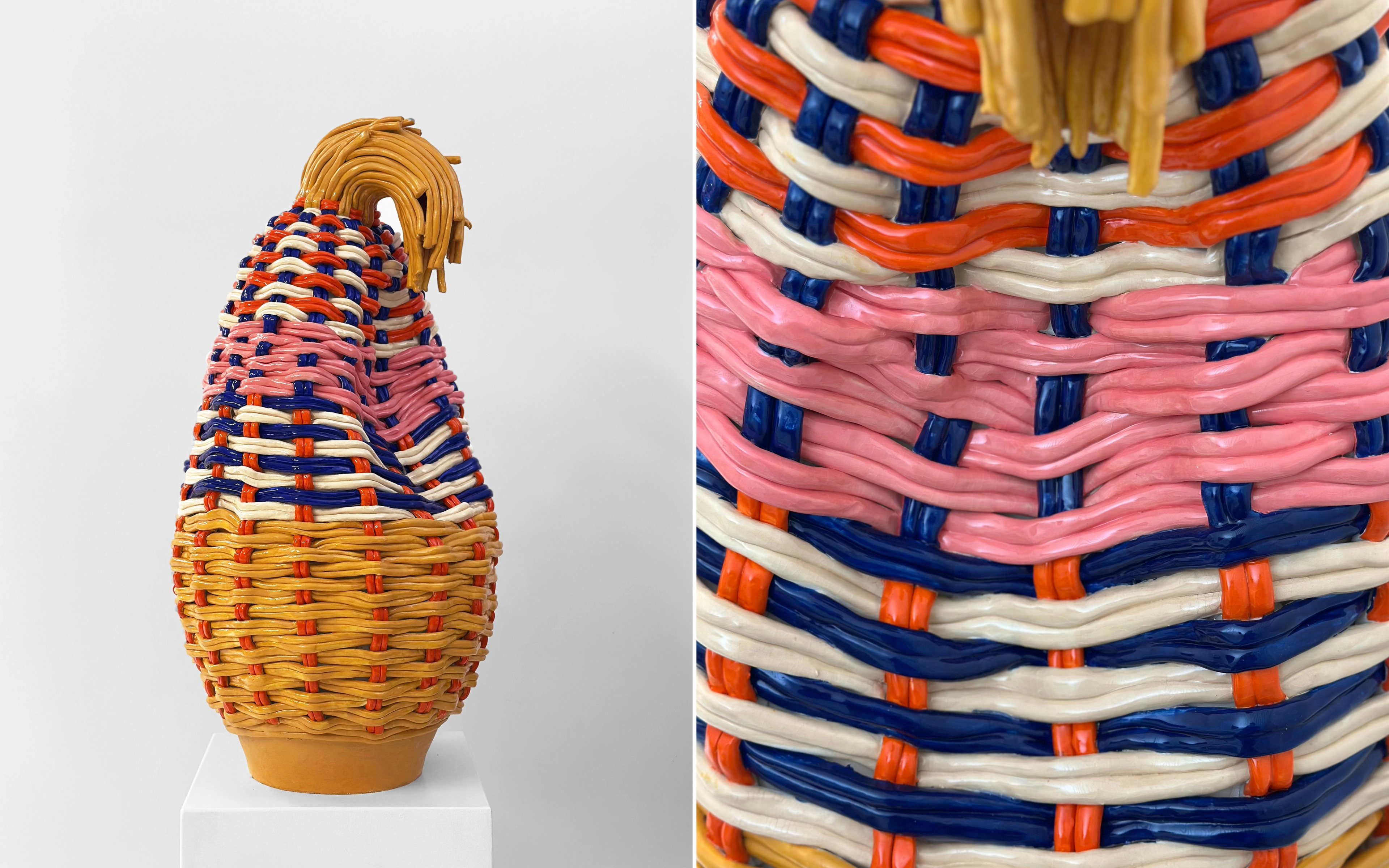
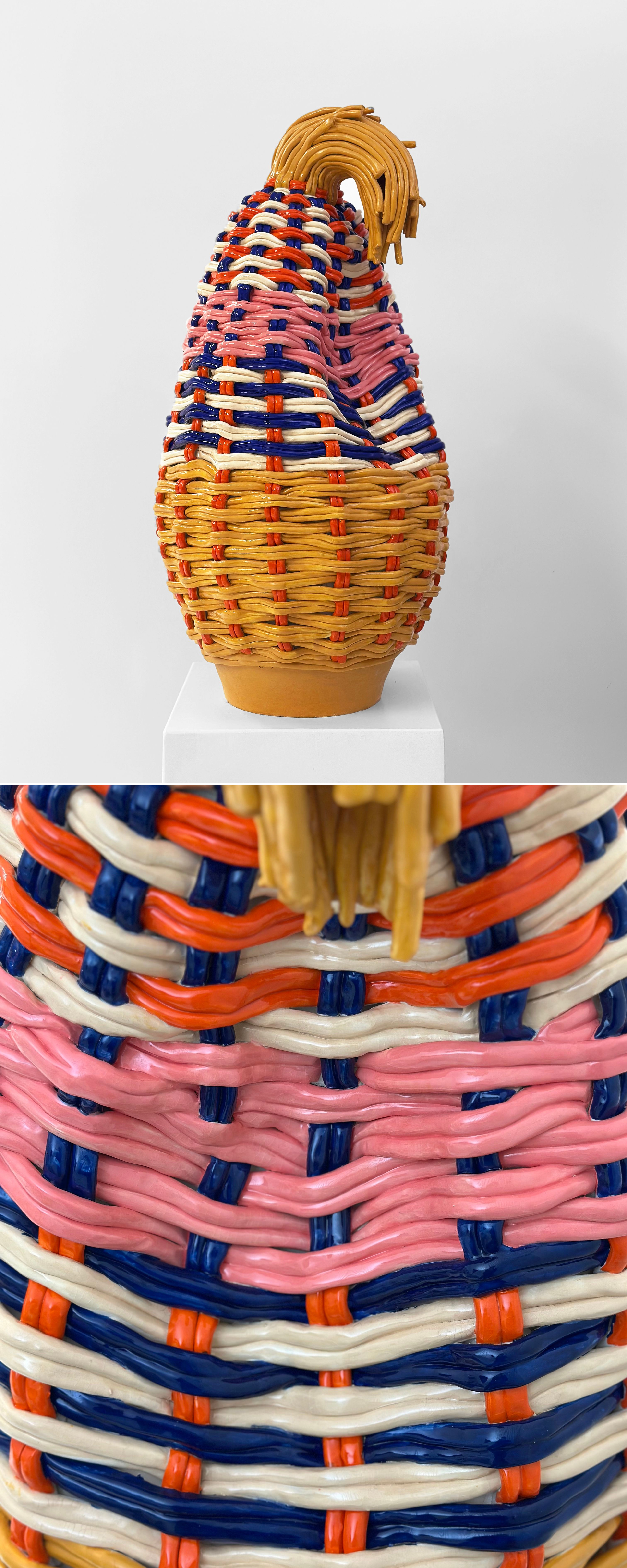
The Caretaker’s Clotheshorse, 2025.
Credit: Courtesy of Xanthe SomersOnce her forthcoming show and baby are out in the world, Somers plans to relocate to Cape Town. After eight years in London, she misses the sunshine and proximity to the landscapes of her childhood. She’ll have to evolve her technique for the climate—the dampness of the UK has been integral to the way she builds her sculptures, as it keeps the works from drying out too quickly while they’re in process.
Returning closer to home after years away will also cast her work in a new light. “I’m a fifth-generation Zimbabwean, but I’m not quite Zimbabwean. You have this feeling of being a permanent visitor,” she said. “I don’t want people to think I’m trying to take up this position as a Zimbabwean artist, but I’m still part of a history. It’s interesting, as long as I’m acknowledging it from my perspective.”
Cape Town, in her view, is a more convivial and conducive place to be an artist—she’s excited to engage with artists from the region, experiment with materials like bronze, and keep pushing the scale of her work. Eventually, she would love to make sculptures that live outside, beyond the gallery walls. “I want them to be monumental,” she said. “Bring the domestic into the public.”