Sarah Zapata’s “In escape from the vices of idleness”
The Peruvian American artist’s sprawling textile installation took months of sketching, weaving, sewing, and assembling. Ancient geoglyphs inspired her to savor the process.
September 30, 2026
Near the southern coast of the land known today as Peru, a network of lines and geometric forms stretches across the desert for nearly two hundred square miles. Archaeologists have determined that the shapes—some simple spirals, trapezoids, and circles; some recognizable images of plants and animals—were made by the ancient Nazca peoples, who removed rocks and layers of earth to create negative images in the ground. Resting flat under the sky is a pelican nearly as tall as the Eiffel Tower, a hummingbird as long as Big Ben is tall, a spider the size of the Arc de Triomphe.
It is impossible for a person roaming Earth on foot to see these early examples of land art, called geoglyphs, in their entirety. Spanish colonizers thought they were roads, and contemporary scholars have long considered them religious offerings. But in a 2020 paper (opens in new window), the academic Darryl Wilkinson reframed the Nazca lines as a form of anarchist ritual. He proposed that we understand them not as finished images but as a record of conscious, time-intensive labor that the government had no productive use for. That is—the act was more important than the final form.
Some two thousand years later, at the New York City gallery Sargent’s Daughters, the Peruvian American artist Sarah Zapata installed a three-dimensional geometric puzzle. It is impossible for a person roaming the white cube to take in the full work, titled In escape from the vices of idleness (opens in new window), at once, or to see the top of its highest point. To make it, Zapata wove and stitched dozens of rug-like panels that together make up a dense, colorful fiber landscape. Thousands of mismatched strands of yarn pool on the floor and crisscross larger-than-life-sized blocks in checkerboard and stripe patterns. Fields of tufted textile mingle with swaths of fabric intricately embroidered to resemble topographical maps. Columns constructed from storage crates are covered, too. There is nothing here that is not soft.
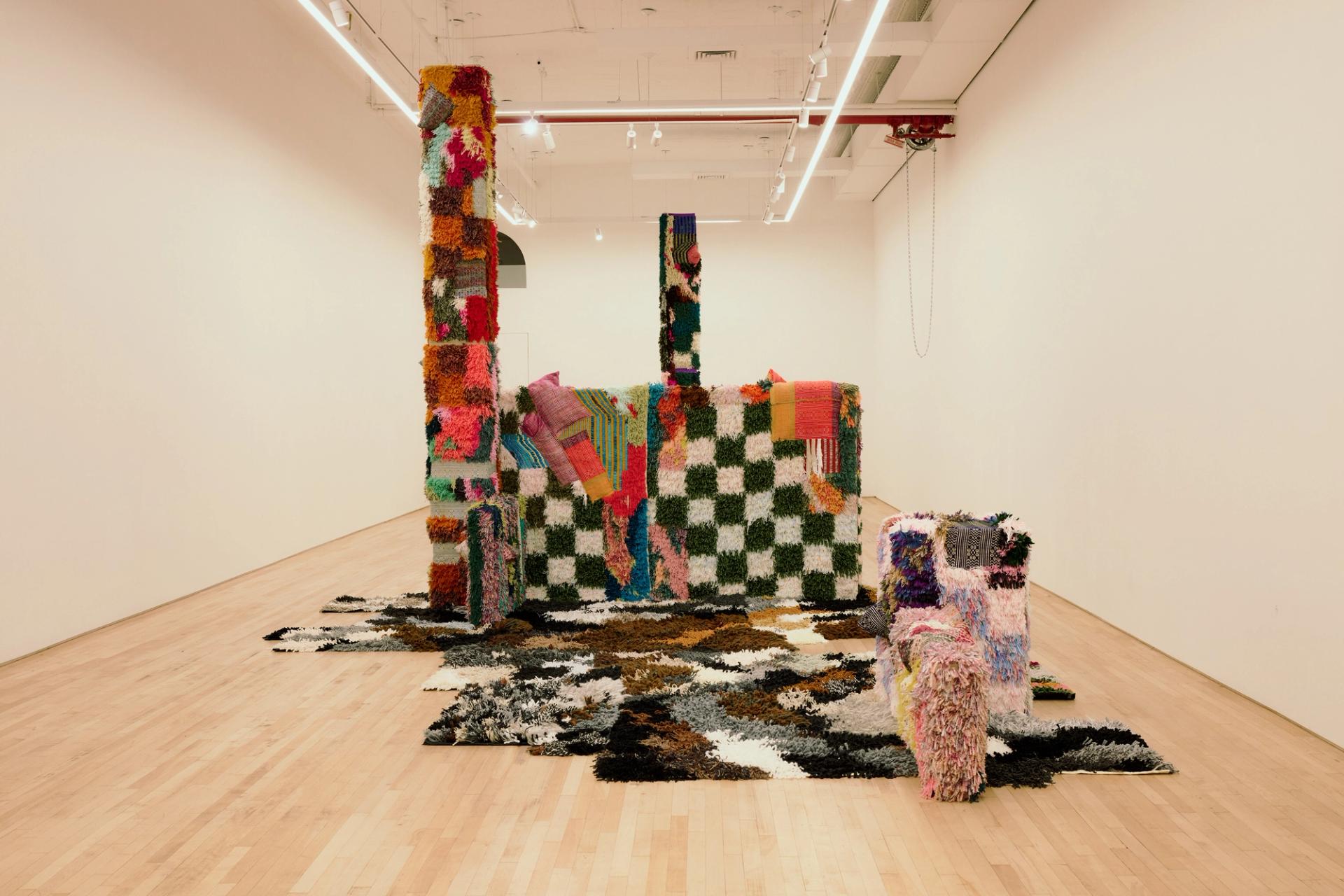
Installation view of In escape from the vices of idleness (2026) at Sargent’s Daughters
As the Nazca toiled without ever seeing the full effect of their work, Zapata—who became fascinated with Wilkinson’s scholarship after encountering it on a podcast—made In escape from the vices of idleness piece by piece, only seeing the finished product after it had left her studio. For her, too, the months she spent at work are the art, an experience the final form can only approximate.
Patience is more than a virtue to Zapata; it’s a necessity, and something she learned young. The first textile work she ever made was a Scooby Doo rug. A latch-hook kit from a craft store was a way to pass the hours in her childhood home of Corpus Christi, Texas—“I hated being a kid; there was so little that you could control,” Zapata said—but she also felt an attachment to the material that ran deeper than the average tween’s after-school hobby. Zapata’s father’s family is from Peru, home to the earliest known fiber work in South America, dated to around 8,000 BCE. Her grandfather owned a fabric store in Piura, a city in the north, near coastal fields where cotton is picked by hand.
“Tradition is something that I think about a lot, and it’s not about making the same object over and over. It’s more about how this is incredible knowledge and it needs to be kept alive,” Zapata said during a visit to her studio, as she worked to finish In escape from the vices of idleness. Her grandmother taught her to sew, but she learned how to weave as a freshman in the fibers BFA program at the University of North Texas. She rejects the idea of ancestral knowledge as a ritual handing down of secret techniques—a notion that appeases the white gaze. Post-colonization is messier than that. “I’m close with my Peruvian family, though I honestly don’t know if they really know what I’m doing,” she said. “Which is fair—I don’t really know what their jobs are.”
When Zapata arrived in New York City in 2011, living as an out queer person for the first time, she found a spiritual outlet in writing lesbian foot erotica. “I got to feet because feet are a common archetype in the Bible,” said Zapata, who grew up in an evangelical Christian household. “There’s feet-washing ceremonies to express humility and service to one another. Feet talk about your trajectory of life, but they also define us from an evolutionary standpoint.” She was looking for ways to connect the foot stuff to her textile expertise, which led her to rugs. But she was shocked to read that woven textiles were not used as rugs—i.e., touched by feet—in Peru prior to colonization. The rug came to symbolize how much she doesn’t know—about her ancestors, about textiles, about ways of interacting with art.
As she honed her skills and did her research, Zapata’s rugs began to sprawl and climb. Today, her tactile, spatial interventions can reach up to 12 feet tall in the gallery spaces where she often exhibits them. In escape from the vices of idleness redirects the eye away from the walls of the room toward the center, and its columns intentionally dwarf the viewer. Zapata wanted to “take up as much space as was literally possible, without having people step on it.” (Pre-pandemic, she sometimes invited people to walk on her rugs, their bare feet “activating” the work; now she’s more conscientious about sanitary measures and preserving her archive.) The scale has feminist underpinnings, forcing us to confront the fruits of “women’s work,” as fiber arts have historically been deemed, and feel small in their presence.
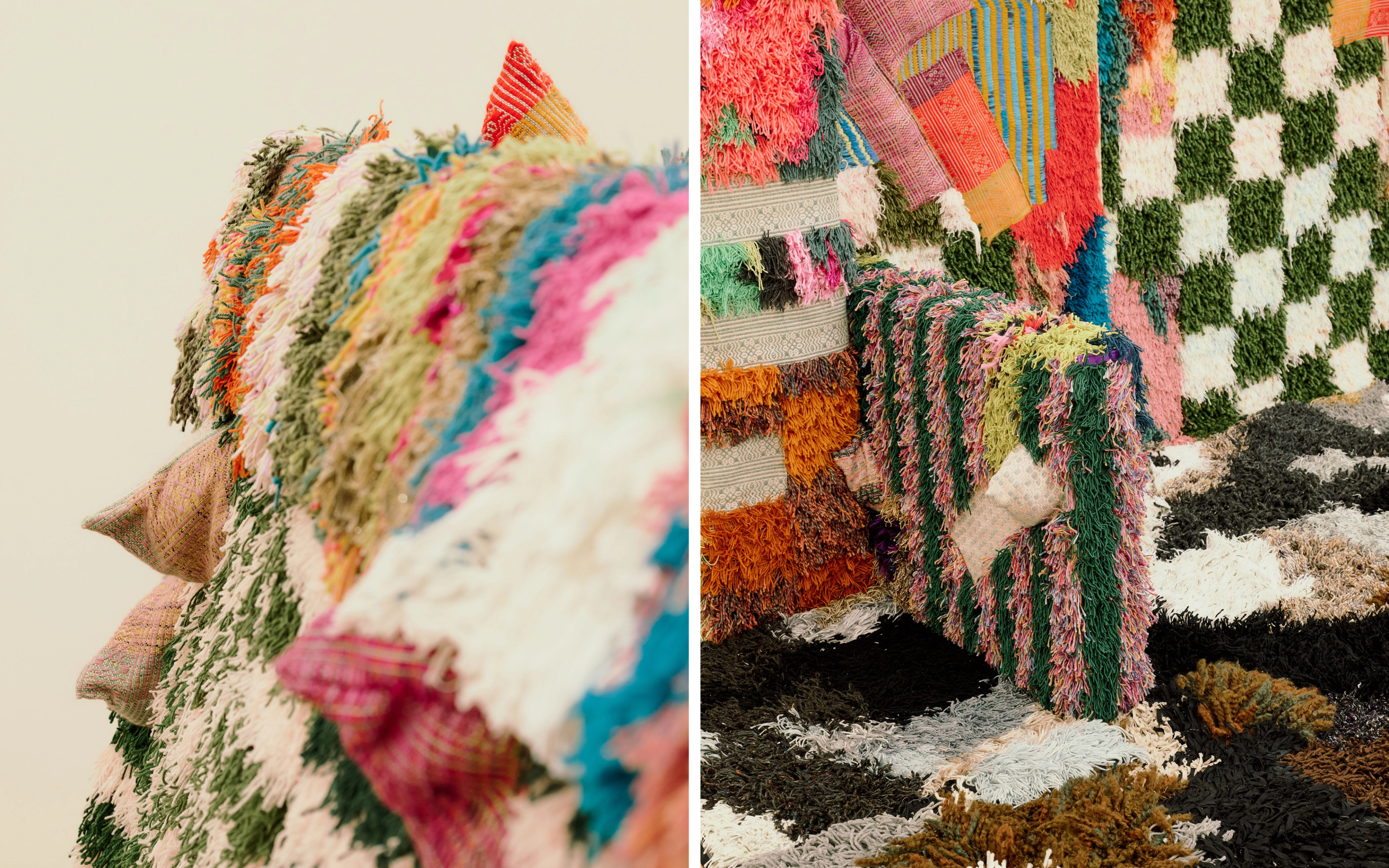
Zapata operates on a conceptual plane—in conversation, she references a grad school seminar’s worth of queer theory—while identifying as a process-oriented maker proud of her dexterity and “fiddliness,” which manifests as visible handwork, even while she’s streamlined some elements of the craft. Using her sewing machine—“an extension of my body,” she joked—Zapata attaches yarn cut to the length of her own fingers onto a rug canvas, a technique that references the latch-hook method she learned as a child, but is far faster. She “realized that scale was much more important than the sanctity of the technique,” she said.
Nestled between the yarn tufts are voluminous pockets of fabric—perky, breast-like protrusions stuffed with personal mementos, like letters, dog toys, and scraps from clothes she’s made for herself. “I like imbuing the life force within them, because, ultimately, I think cloth is meant to hold,” she said. The obviously meticulous, finely detailed embroidery panels are done on one of Zapata’s American-style floor looms using patterns from her personal Bible, A Weaver’s Book of 8-Shaft Patterns, edited by Carol Strickler. Executing the patterns requires exacting preparation: Diagrams help Zapata connect the right strands to the right harnesses, and the right harnesses to the right foot pedals, called treadles. “Weaving is ultimately just like engineering,” she said. “It’s very logical. There’s a lot of places to go wrong, but you’re always checking your work.”
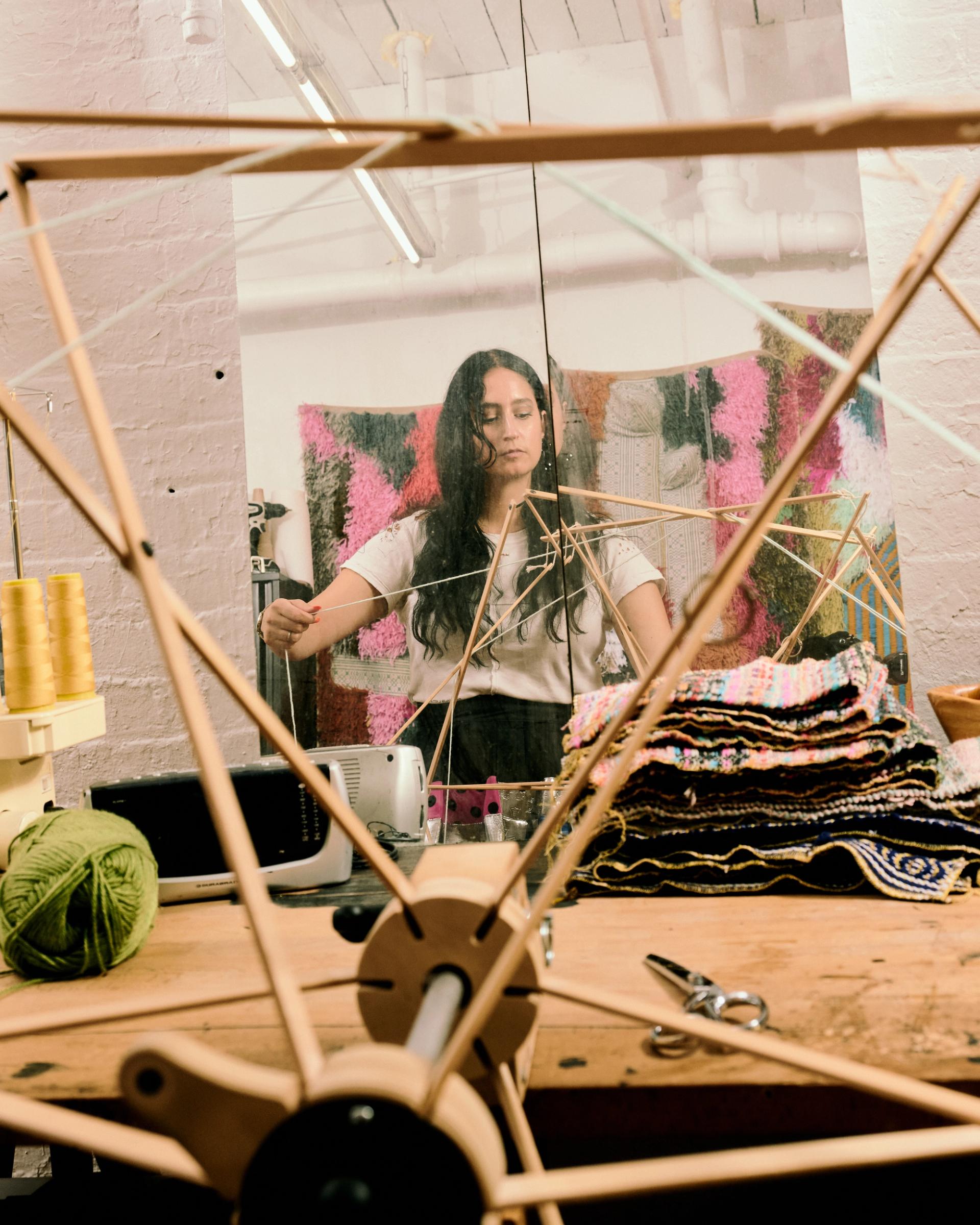
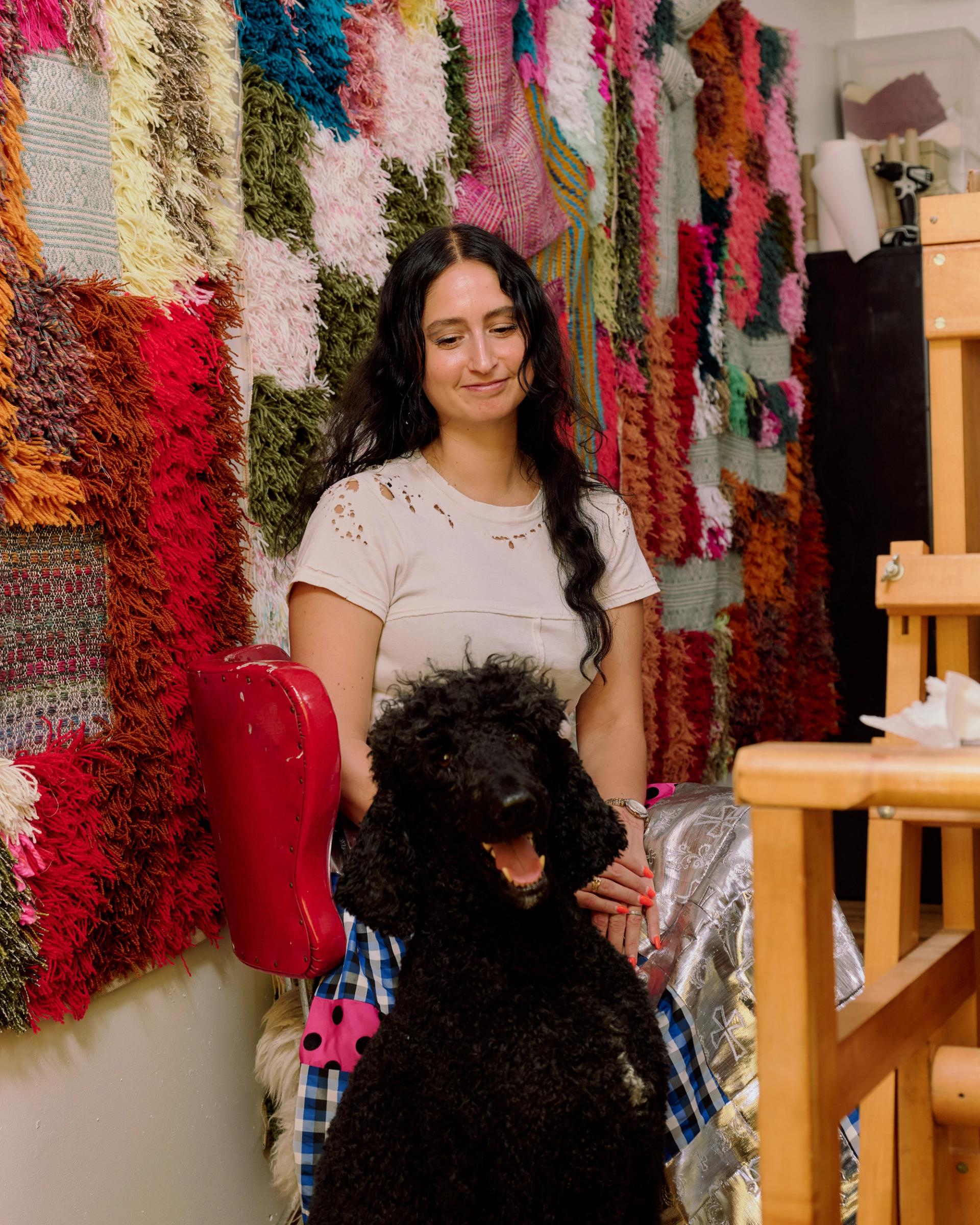
In escape from the vices of idleness originated as a rough pen-and-paper sketch of where the plinths might be arranged according to the size of the gallery. From there, Zapata relied on intuition to determine what kinds of rug fabric she’d make to eventually attach to the cardboard scaffolding. (She admitted that she initially miscalculated how much surface area she needed to cover: “I’m definitely not as good at geometry as I thought I was.”) As she worked, piles of fabric littered her Bushwick studio, and she surrounded herself with her essentials: music, coffee, and “another heartbeat in the room”—a role usually fulfilled by her standard poodle, Pascal. Two eight-harness looms are the studio’s nucleus.
Sarah Zapata in her studio
Very little information about advanced-level techniques for loom weaving is available online, a challenge Zapata finds thrilling: “The loom always wins. I’m thankful to have something to study my entire life because it is so complicated!” She had a stress dream recently where she needed to dress the loom—set up the vertical threads that serve as a backing for the pattern dictated by the horizontal threads—from back to front, when normally she works from front to back. (She blamed Mercury retrograde.) “To be a loom owner is basically to solve your own problems,” she said, pointing to a treadle that needs to be routinely hammered back into place with a mallet.
Scale aside, In escape from the vices of idleness isn’t so far off from a rug depicting Scooby Doo: It’s playful and loud, with violently clashing colors. Zapata loves feminine-coded hues, and kept coming back to the idea of team colors—green and pink would be her picks for an imaginary women’s sports league. The high-contrast pairing also reflects her interest in the relationship between the natural (green) and the artificial (pink). For years, critics remarked on how Peruvian Zapata’s colors were. Then, when she showed in Lima for the first time, in 2020, everyone there asked what inspired her palette. “It’s just a funny fetishization, associating color with a lot of Latino cultures,” she said. “Like, no, every color is incredibly intentional for us, but in very different ways.” The mismatched vibrancy of Zapata’s work is an aesthetic and conceptual choice, but it’s also a practical one: “I use mostly secondhand materials, so I don’t have a lot of the exact same yarn. At times it’s this ridiculous, tacky hobby yarn, but it becomes something else when it works together in a large field of color,” she said.”
All in, In escape from the vices of idleness took Zapata some eight months to create. She keeps coming back to the things that take the most time. “I’ve realized I’m not exactly excited about the future,” she said. “So rather than focusing on things that are uncontrollable, what are things that are very tangible? Everything is moving forward quicker, so how can I get slower?”
The piece’s title refers to, in part, Zapata’s fears of an idleness that will pervade a post-AI culture, where we don’t need to do anything ourselves and so we outsource all our labor—even the pleasant tasks, like writing a note to a friend. Her work reflects a stubborn commitment to doing things herself, by hand, and a secondary belief that those things will endure. “Maybe it’s not about the generative process; it’s about the experience of the process,” Zapata suggested, referring back to the Nazca lines. “I like to think I’m making geoglyphs, too.”