Rick Kelly Will Build Your Guitar from a Church, a Brothel, or a Bar
The legendary luthier of Carmine Street has spent 50 years repurposing old New York into instruments played by Bob Dylan, Lou Reed, and more.
June 29, 2026
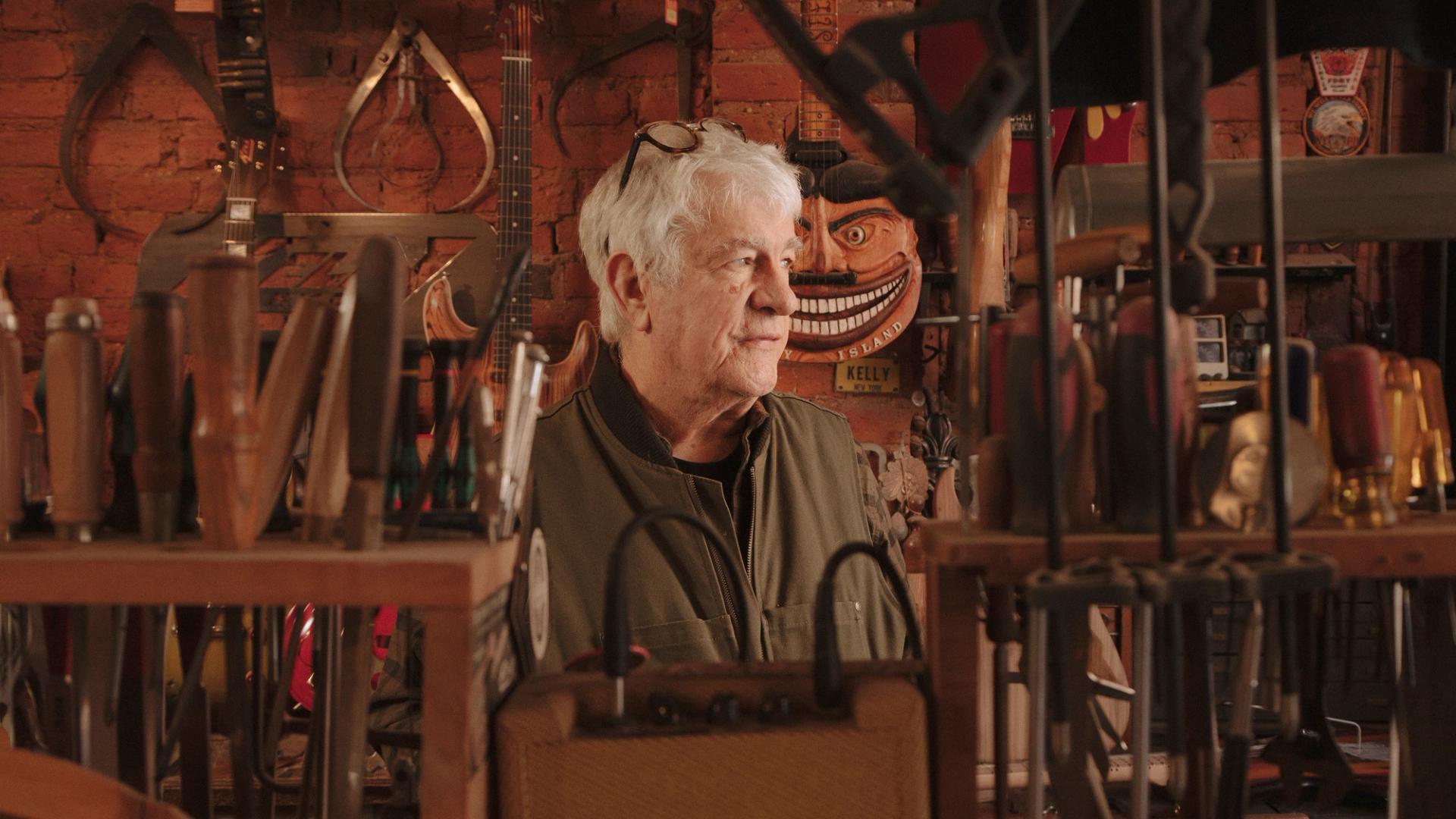
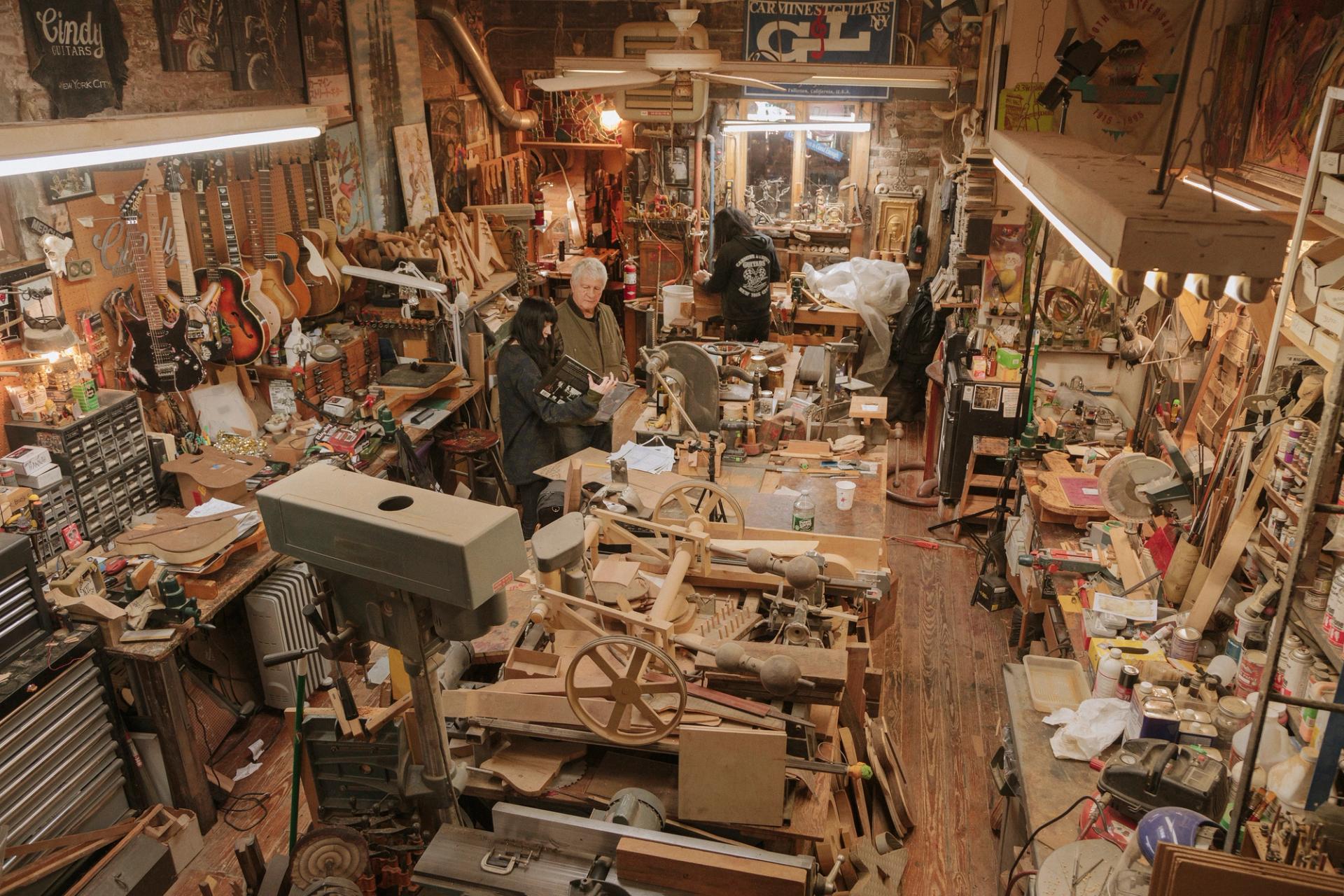
Most mornings, you can find Rick Kelly at the cramped and cozy workbench by his front window, where he likes to get his hands on some wood before any customers come in. The northwestern exposure doesn’t afford him much sun at that hour, but he keeps the lights low anyway. Carmine Street Guitars is quiet, save perhaps for some jazz playing on a tiny old boombox in the back. There are no other people inside, but it wouldn’t be quite right to say he’s working alone. There are guitars everywhere—on the walls, the countertops, in glass display cases, leaning precariously against shelves and toolboxes behind him in various states of completion. And there is wood, old wood: pine, oak, maple, ash, alder, chestnut, walnut; wood salvaged from a historic church, an infamous former brothel, a nearby pizza shop, McSorley’s Old Ale House, the Chelsea Hotel. People will come in soon enough. But from the way Rick Kelly talks about old wood, you get the sense that it’s the only company he really requires.
One icy morning this past winter, he was describing the history and the merits of wormy chestnut, from which he’d fashioned his latest guitar, while a crew across the street unloaded a parade of appealingly weathered-looking 2-by-10s from the windows of an old building into a parked flatbed truck. This is Kelly’s bread and butter, or at least it would seem to be. For decades, he’s been revered by musicians and collectors for the electric guitars he fashions from antique, old-growth wood, much of it reclaimed from buildings under renovation or demolition in and around his Lower Manhattan neighborhood. He paused from his wormy chestnut lecture to consider the lumber passing by outside. “That’s garbage wood,” he said summarily. “That’s what a lot of people misinterpret as the stuff we’re looking for. That’s new-cut, rough-cut wood, the same stuff they use for scaffolding. I call it bunker wood. A lot of times they’ll sink it in the ground when they’re fixing pipes. It looks old because it’s weathered. But it’s not the stuff. I can tell the stuff.”
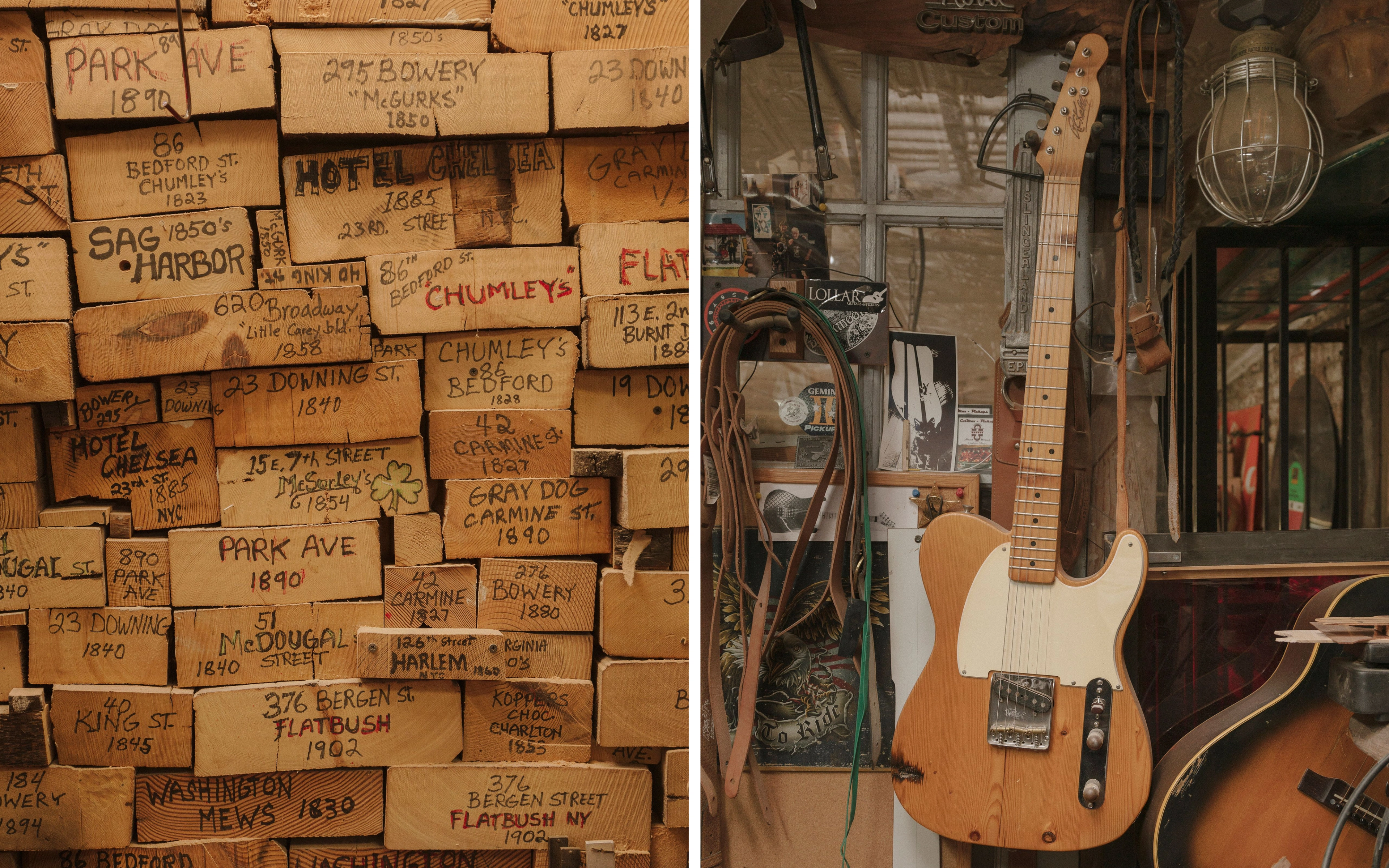
Inside Carmine Street Guitars.
Not long before, Kelly had come into some very good stuff indeed: the most beautiful beam he’s ever salvaged, he says, a 35-foot slab of white pine from the basement of the Church of St. Anthony of Padua, completed in 1888 as the United States’ first dedicated house of worship for Italian American immigrants. It sits at the corner of Sullivan and Houston Streets, about a five-minute walk from his shop. A neighbor who admires Kelly’s work told him that the basement would be renovated soon, and that Father Mike, St. Anthony’s pastor, might be persuaded to save him some wood. Kelly walked by one day and saw a truck loaded up with precious white pine, ready to be carted away. A lot of antique wood ends up sold for fuel and burned, Kelly said, palpable regret in his voice for all the beams he couldn’t save. The workers on the scene at St. Anthony’s were unmoved when Kelly told them that one of the beams was supposed to be his, and turned him down when he offered to pay cash for it on the spot. He figured the St. Anthony’s wood was toast until a month later, when he heard from Father Mike that there was a beam set aside and waiting for him at the church. He cut it into six-foot pieces and brought them back to his shop, where each will eventually be shaped with a bandsaw and then further with the draw knife Kelly inherited from his grandfather; smoothed with all manner of sanders; finished with shellac; fitted with tuners, pickups, strings, and a bridge—transformed from inert material into an instrument that can sing and cry and play “Stairway to Heaven,” all in a matter of about a week from the time he makes the first cut. Then it’ll be handed off to a customer: maybe a regular hobbyist, maybe Bob Dylan.
Kelly’s salvage expeditions often start with a similar tip from a sympathetic neighbor, or a dumpster glimpsed on the curb outside an old building, but they don’t always involve permission from the owners: He’s not above showing up with a hand truck to liberate a few beams bound for disposal under the cover of night. He talks about the wood he’s reclaimed over the years the way a great romancer might talk about his partners in long-ago affairs. He gets wistful, proud, a little verklempt. “What a piece of wood,” he said of the St. Anthony’s beam. “One board, no connections. So that tree has gotta be huge. Those guys who built that church didn’t go to a lumberyard. They bought the trees, and cut their own wood from them. Because they were building God’s house. It was the first time—built for the Italian American community, by Italian American immigrants. So they weren’t skimping on the wood. They got the trees they wanted.”
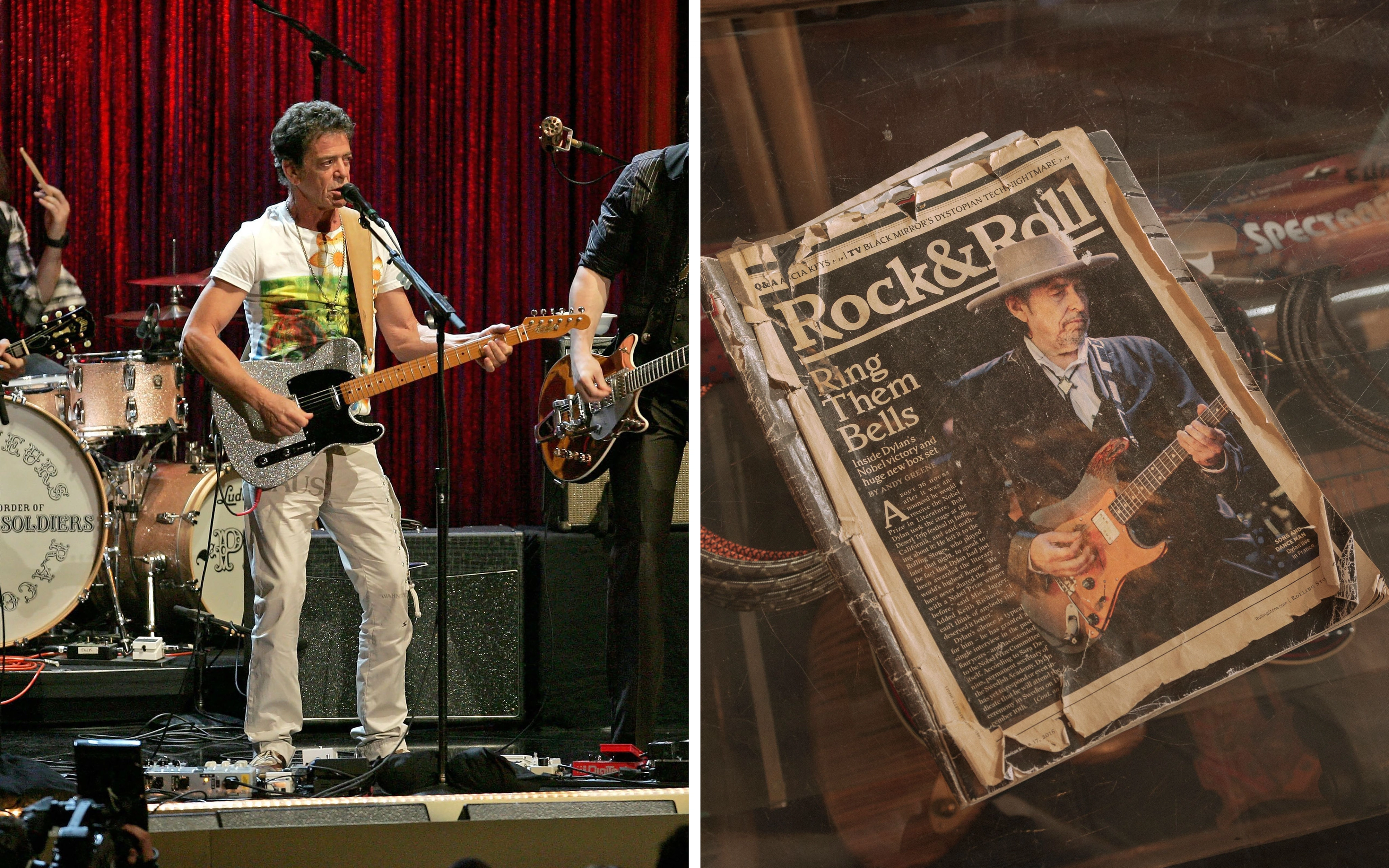
Lou Reed playing a Rick Kelly guitar at the 2006 MTV Video Music Awards; a copy of Rolling Stone featuring Bob Dylan playing an “Eaglecaster”
Credit: Photograph by Scott Gries/Getty Images; Photograph by Landon Speers for ToteiKelly is as devoted to his craft as those 19th-century Italian American artisans were to their church. He has his share of faithful adherents, as well. Marc Ribot and Bill Frisell, two of our era’s most acclaimed and adventurous jazz guitarists, are Kelly enthusiasts. Dylan owns several Kelly guitars; he favors the “Eaglecaster” model, which resembles a classic Fender Stratocaster, but with a regal bird of prey carved into its top horn. David Bowie and Lou Reed both started coming by Kelly’s first New York shop in the ’70s; Bowie never bought any guitars, but Reed did, including the sparkly silver Telecaster he played in his surreal performance (opens in new window) of the Velvet Underground’s proto-punk classic “White Light/White Heat” at the 2006 MTV Video Music Awards. Kirk Douglas of the Roots, Nels Cline of Wilco, and Patti Smith’s guitarist Lenny Kaye are all friends of the shop who might pop in at any time.
It can help to have a devoted following. In early June, Kelly checked Carmine Street Guitars’ bank account statement for the first time in a while. He generally kept about $100,000 in there and saw no reason to regularly monitor his balance. He was surprised, then, when it showed a measly four grand. Hackers had managed to access his PayPal account, through which they slowly drained the shop’s coffers over the course of a year, in a trickle of transactions that were mostly small enough to escape anyone’s notice. The situation seemed catastrophic at first. Then the community rallied. A GoFundMe page was set up and word spread quickly, thanks in large part to an Instagram appeal from actor, musician, and Kelly enthusiast Michael Imperioli. Slicehaus, the pizza shop two doors down, donated a dollar to Carmine Street for every slice sold on a particular Saturday. PayPal was able to recover $70,000 within a week. The shop is in good shape again. Kelly is copacetic. “I’m not much of a business guy anyway, so I don’t let it bother me,” he said. “I spent 40 years only having five grand in the account. It’s a different world for me to have any extra money.”
He has always had to hustle. Kelly opened Carmine Street Guitars in 1990 in Greenwich Village, the latest and longest-lived in a series of small instrument shops he’s operated in New York and elsewhere since the early ’70s. Before that, he’d been studying sculpture at the prestigious Maryland Institute College of Art, but he ran out of money after three years and dropped out to pursue woodworking full-time. At some point, he’d realized that art school was a privilege he couldn’t afford, as opposed to many of his classmates, who were well-off enough that the prospect of making a living was a non-factor in decisions about higher education. Rick Kelly needed work, and he found it in the Appalachian dulcimer. Growing up on Long Island, he’d never heard of the instrument, which originated in the 19th century and sits with its four strings facing up on the player’s lap. (Joni Mitchell famously played one on Blue.) But in the afterglow of the ’60s folk boom, he found that he could make money selling handmade Appalachian dulcimers at craft fairs around Baltimore and eventually further afield. The idea to use reclaimed wood came to him in this period, simply because it was cheap and available. Rather than going to a lumberyard, he could walk into a church, ask about old pews they were getting rid of, and often enough, take one home for free.
Kelly opened his first New York shop in 1977. It was a block away from Carmine on Downing Street. He was broke, living in the shop and “sleeping in the wood chips,” he said, subsisting on a slice of pizza a day and taking showers at the local YMCA. He’s full of colorful stories about his early years in the city. In ’79, the great bassist Jaco Pastorius was living downtown and struggling with addiction and mental illness. From time to time, he would ask a local police officer known as Mike the Cop to hold onto his fretless Fender Jazz Bass, a now-legendary instrument known to fans as the Bass of Doom, to keep himself from pawning it for drug money. One morning, Mike the Cop walked into Kelly’s shop and asked Kelly to hold onto the Bass of Doom while Mike walked the beat. “And while it was there, I completely traced around it really quick on a piece of paper,” Kelly said. “So my first 1979 Jazz Bass template actually came off of Jaco’s bass.” A year later, Kelly closed up shop on Downing Street and made a temporary move to Carmel Valley, California. “My old shop around the corner, we ended up getting a little involved with the wrong people, and I had to leave for a while,” he said. “Let’s just leave it at that.”
By this time, Kelly had abandoned dulcimers and adopted electric guitars and basses as his instruments of choice, drawn as much by their sculptural qualities as their sound. With a solid slab of wood, rather than the dulcimer’s delicate, hollow body, he had more leeway to experiment with form. Some of his earlier guitar designs were heavy on visual novelty: At Carmine Street, there are guitars on display shaped like an automatic rifle, the Coney Island “Funny Face” sign, the MTV logo. The Eaglecaster model that Bob Dylan owns originated during the 1976 US bicentennial, when Kelly “got this idea to do a patriotic guitar.” These days, he’s more interested in showcasing the wood, both visually and musically. He focuses on simpler-looking instruments based on classic guitar designs and finishes them with a thin clear coat of shellac, to highlight the wood grain and the patina that comes with decades or centuries of air exposure, and to allow the wood to resonate without the interference of a heavier finish. At first glance, many of his guitars look the same, but look closer and there are worlds of rich gradation: pale honeys, milky browns, charred near-blacks, all imparted not by Kelly’s hand but the subtleties of the environment in which the wood had spent most of its life. If there are nails in a particular beam, he might recycle them for use in the pickups, the magnetic devices that translate a guitar’s string vibrations into electrical current.
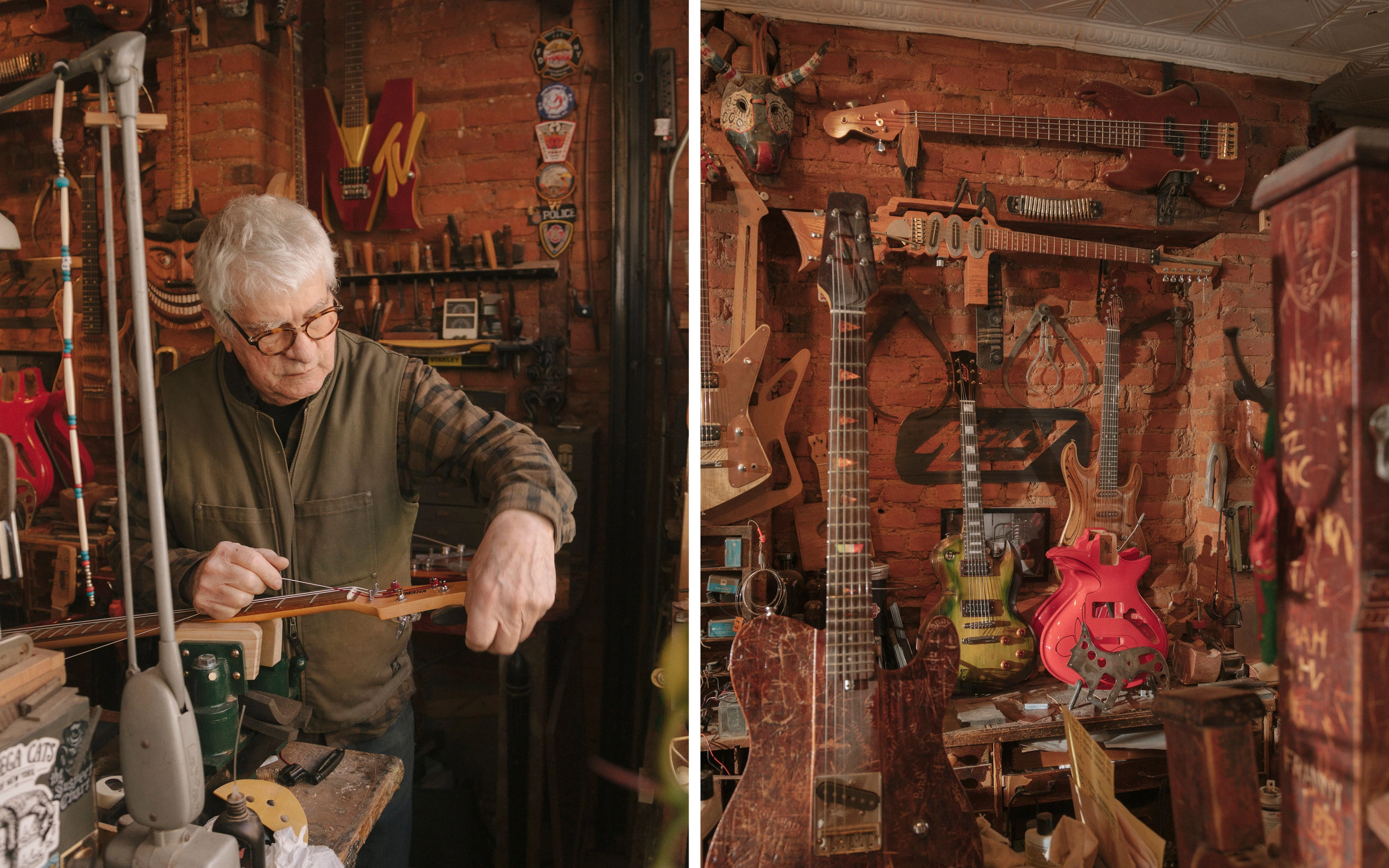
Guitarists are an opinionated bunch. Poke around online and you can find dozens of message board threads full of players arguing passionately about whether an electric guitar’s wood matters to its sound at all, compared with the more overt impact of pickups and amplifiers. Kelly understands this line of thinking, but he rejects it. Aside from the cool factor of owning a guitar built from the beams of John Lennon and Yoko Ono’s old apartment building or the former headquarters of a Gangs of New York–era crime boss, there are real sonic reasons to opt for antique wood, according to Kelly. Over time, resins crystallize and wood dries out, making it more porous and receptive to vibration. “It’s a molecular thing,” he said. “You can feel the wood when you’re moving it around. It’s loud. It’s making noise. Just rubbing it on the floor, the whole board’s going. And you don’t hear that on a piece of lumberyard wood.”
Kelly’s period of morning solitude often ends with the arrival of Cindy Hulej, the other builder at Carmine Street, who showed up on his doorstep a little over 13 years ago and asked to be his apprentice. Or as Kelly put it fondly, “She barged in one day and said, ‘I’m working here! Get out of my way! Show me how to use that bandsaw!’” Now, Cindy builds the shop’s custom orders and Rick builds the guitars they sell off the rack. They make a charming professional duo: a couple of decades apart in age, Rick looking like a grizzled oysterman and Cindy like she just stepped offstage at a punk rock show. They busted each other’s chops in the expansive workshop in back of Carmine Street as he applied the final coat of shellac to a wormy chestnut body before its neck was attached and she inspected a shipment of material that would be used to create decorative fretboard inlays. He did indeed teach her how to use the bandsaw—and everything else he knows about making guitars. The shop will be in good hands when the unthinkable happens and Rick Kelly finally retires. Wood might make for good company, for a man like him. But it’s nothing like other people.