A Penny for Genesis Belanger’s Thoughts
The ceramicist’s first public commission puts a flock of coin-snatching birds, three artificial fruit trees, and two seven-foot Lady Justices in New York’s City Hall Park.
September 1, 2026
Genesis Belanger’s Heads or Tails (opens in new window) went up in New York’s City Hall Park this summer, becoming the first Public Art Fund commission to land on the mayor’s doorstep since Zohran Mamdani took office. It contains three vignettes. A flock of pigmented-concrete birds pick pennies out of the fountain. Several artificial fruit trees wait on dollies to be planted among the living ones. A pair of seven-foot bronze Lady Justices flank the path, each missing half her face.
After a stint working in advertising as a prop stylist, Belanger built her artistic reputation indoors, staging psychologically charged interiors where the objects appear as manifestations of individual neuroses. Heads or Tails is her first public commission and her first work in bronze, and it includes the first complete human figure she has ever made. She has described this new body of civic work as being about the contradictions we navigate in everyday life, which in the park resolves into something more specific and more mercenary: the rising cost of the American dream. The US Mint retired the penny. It is now more expensive to make a wish. Blocks away on Wall Street, someone is pocketing the difference.
We spoke by phone in July, during her summer retreat in Maine.
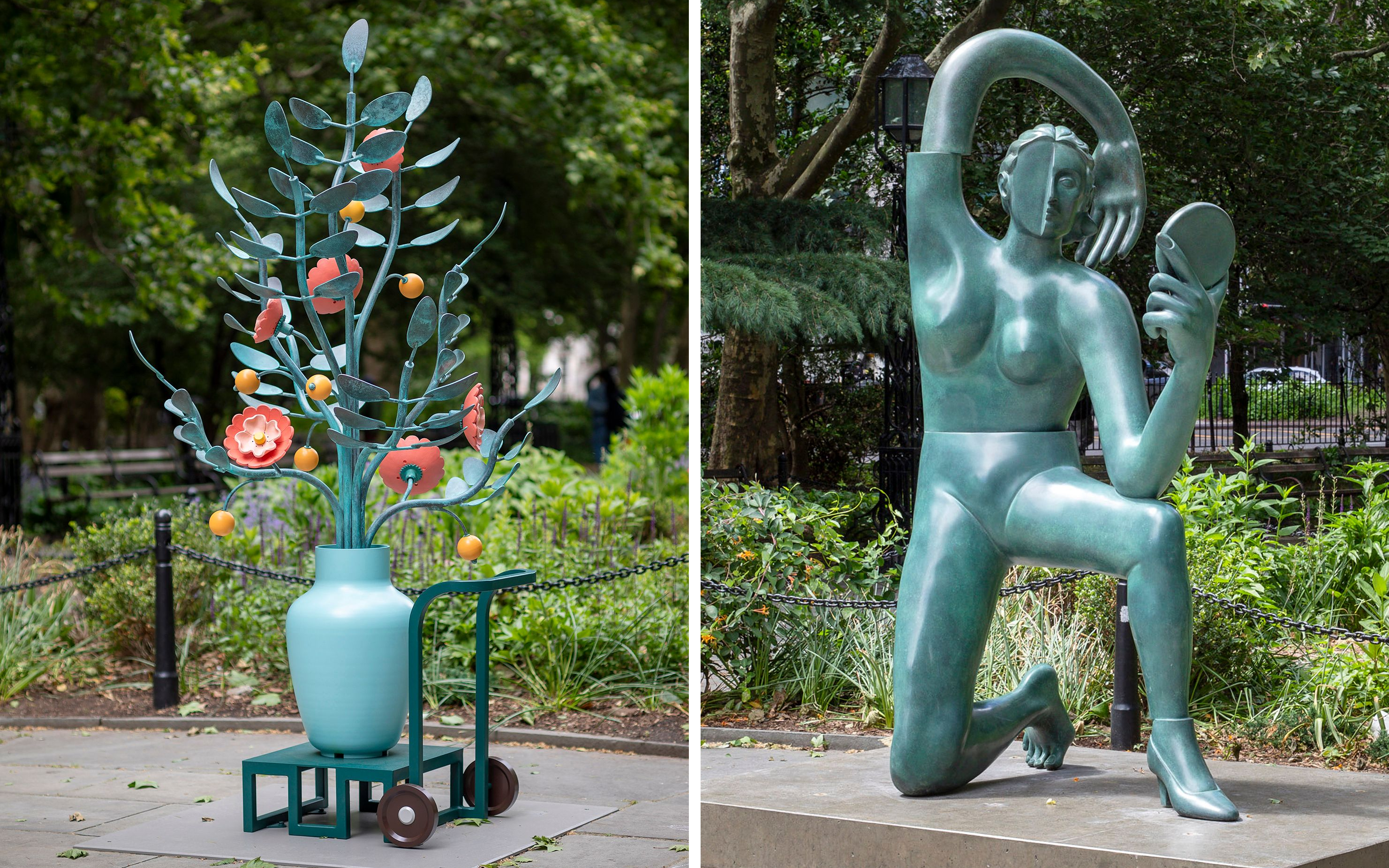
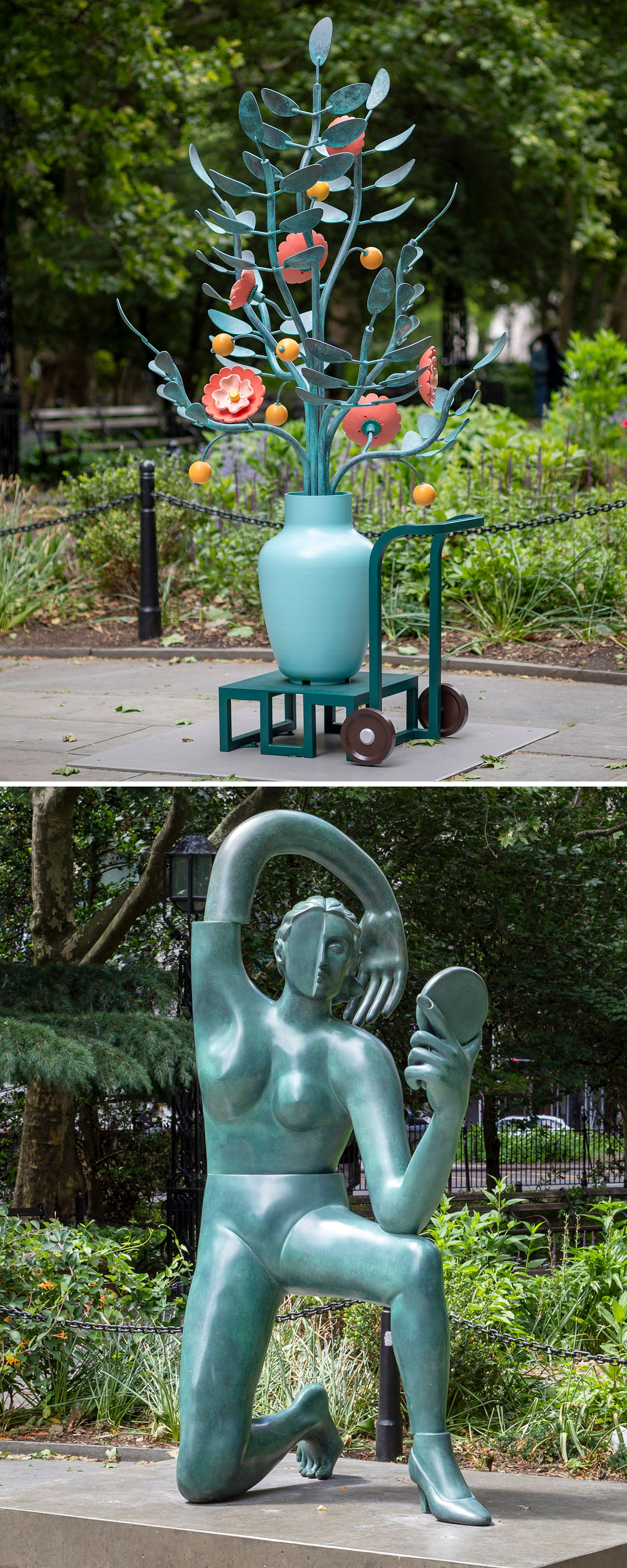
Details of Heads or Tails (2026) installed at City Hall Park.
Credit: Photographs by Nicholas Knight. Courtesy of Public Art Fund, NYThe last time we met, shortly after your 2020 show at the Aldrich Museum (opens in new window), your work was grounded indoors—living rooms, dining rooms, interiors, and psychologies. What did that domestic register do for you that a more civic mode couldn’t?
I never think of them as in opposition to each other. I think of it as a fluid trajectory. I have always been a site-first artist, and since I was making shows for indoor spaces, it made sense that the environments I created would be interior ones. In my earlier work I was really interested in the psychological environments that exist within a domestic space as a way to talk about power imbalances through a female lens. Because women have been the muse of art forever, it feels really important to me that there is work made from the perspective and the experience of a woman. The domestic space allowed me the broadest environment to create different scenes and explore different power dynamics more intimately.
When I was a student, I used to say I had no desire to make art for five white guys in a room. Not that galleries or museums are private, but the spaces still feel inaccessible. They are rarefied. I’d already started thinking about complete figures and representations of monuments, and I kept trying to convince my galleries this was a great idea. Then this came along, so it felt serendipitous that I now had a place to flesh it out.
I don’t imagine your audience has ever been limited to “five white guys in a room,” but being in public has probably exposed the work to new people. What kind of feedback have you gotten?
During installation, which was extensive, I spent a lot of time in the park not identified as the artist. Anytime you make something that goes in public space, it’s going to be critiqued in different terms than it is inside this rarefied world. I was like, “Am I making my own version of the Tilted Arc (opens in new window), and everyone’s going to hate it?”
There will be public hearings to take it down.
Exactly, there would’ve been a protest! But it was really cool to see how the park attracts a broad audience and how enthusiastic everyone was. People were taking their wedding photos, holding hands. At one point we were adjusting something on the trees, and some construction workers on their lunch break came over, and they’re like, [mimics a heavy New York accent] “You know, this is really making me think…beauty is art!” And I was like, “I don’t think these guys ever think about art.” It was everything I would’ve wanted.
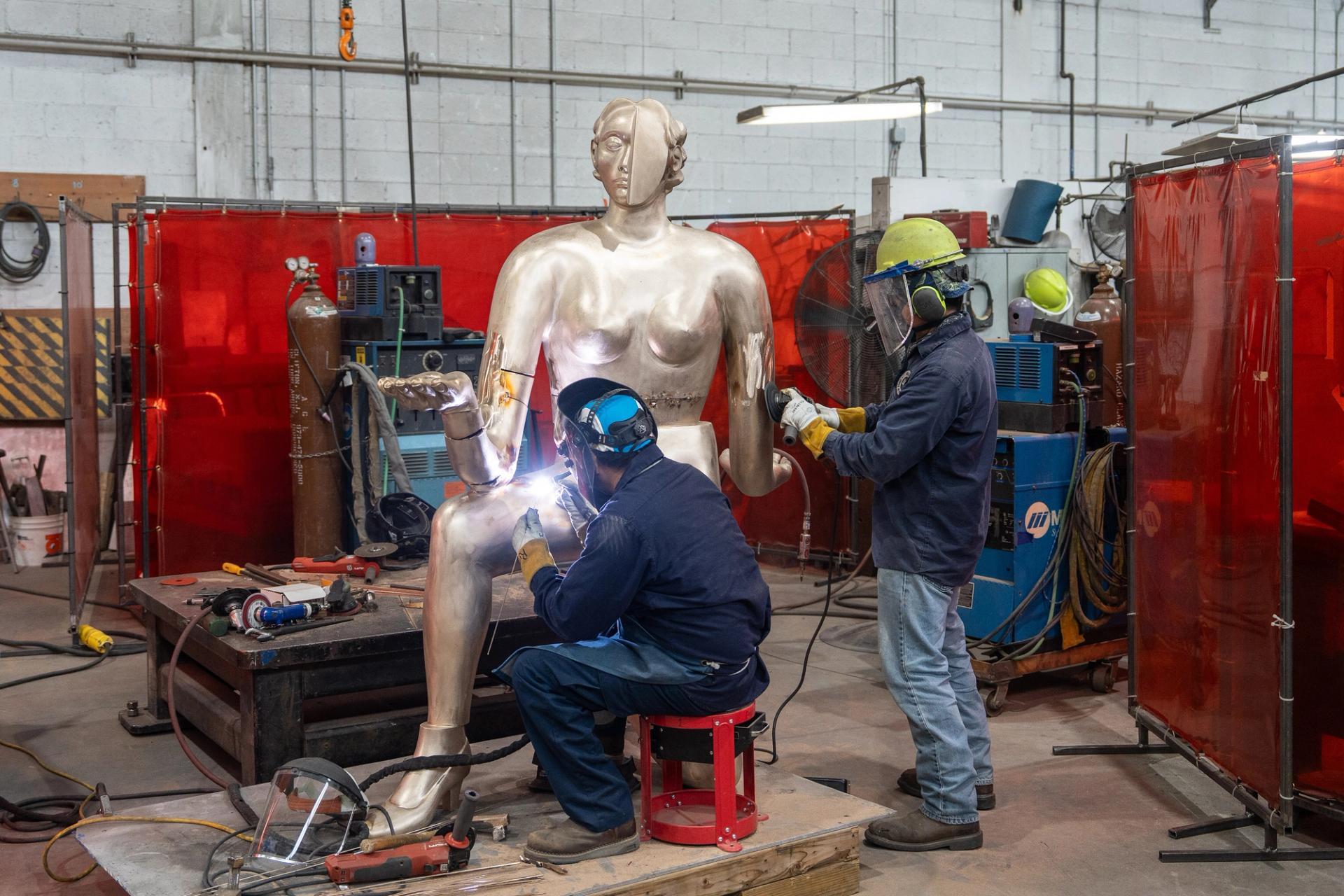
Fabrication of Heads or Tails at Urban Art Projects.
Credit: Photograph by Chris Roque. Courtesy of Urban Art ProjectsBronze is new to you, and so is this scale. What was the process like?
The timeline was so compressed. I worked 21 days in a row to finish just the first big bird, and the project took an entire year. I started with drawings—lots of drawings. For the justices and birds I made maquettes, because those are forms I’d never made and I wanted to figure out the scale shifts and the simplification I always have in my work.
Then I welded metal skeletons, covered them in mesh and oil-based clay, and built the ladies at 60 percent scale and the birds at 100. I work with clay all the time—not this clay, which is gross—but I’ve never done anything so physically challenging. I’d be lying on the concrete floor of my studio sculpting the underside of the feet.
Then the ladies went to the foundry, where they were scanned and enlarged. Everyone thinks tech is this miracle that can replace humans, and I find it comical. You cannot scan something flawlessly. Even if you do a really good job there’s always missing information, and that has to be resculpted by some 23-year-old computer guy who’s not you. At no point is that process absent a person. They print the file at seven feet tall, and even that requires a human to assemble the parts and break them down to be cast in bronze—traditional lost wax. Then the ladies were patinated to get them close to the civic monuments we’re used to, that green-blue that bronze naturally wants to do. You heat it with a blow torch and spray it with acid. It’s like cooking, but much more precise.
So much of what public sculpture is supposed to do is memorialize—an individual, an achievement, an ideal—and that’s being challenged now in very direct ways. Confrontation, defacement, and provocation are increasingly the norm. Your works are playful, but there’s a slyness I don’t want people to miss. They seem very much part of the ongoing dialogue about the role of sculptures in civic space.
The one thing I walked away from my years in advertising with is how incredibly visually intelligent the average person is, and I don’t know why that’s overlooked in the art world. Things don’t have to be so didactic. You can take real subtlety—visual subtlety—and make something complex, and the average person will walk away with an understanding. Maybe they won’t articulate it back to you, but that doesn’t mean they haven’t left with a deep understanding of what they saw. So I use craft, I use beauty, I use complex political ideas, and I smash them together and trust the viewer.
I’ll start with the fountain. The penny was retired, and when I heard that I started thinking about how you cast a penny to make a wish. By retiring the lowest denomination you’re essentially creating wish inflation, so now it’s more expensive to wish—which felt like an incredible metaphor for the experience we’re having all over the world now.
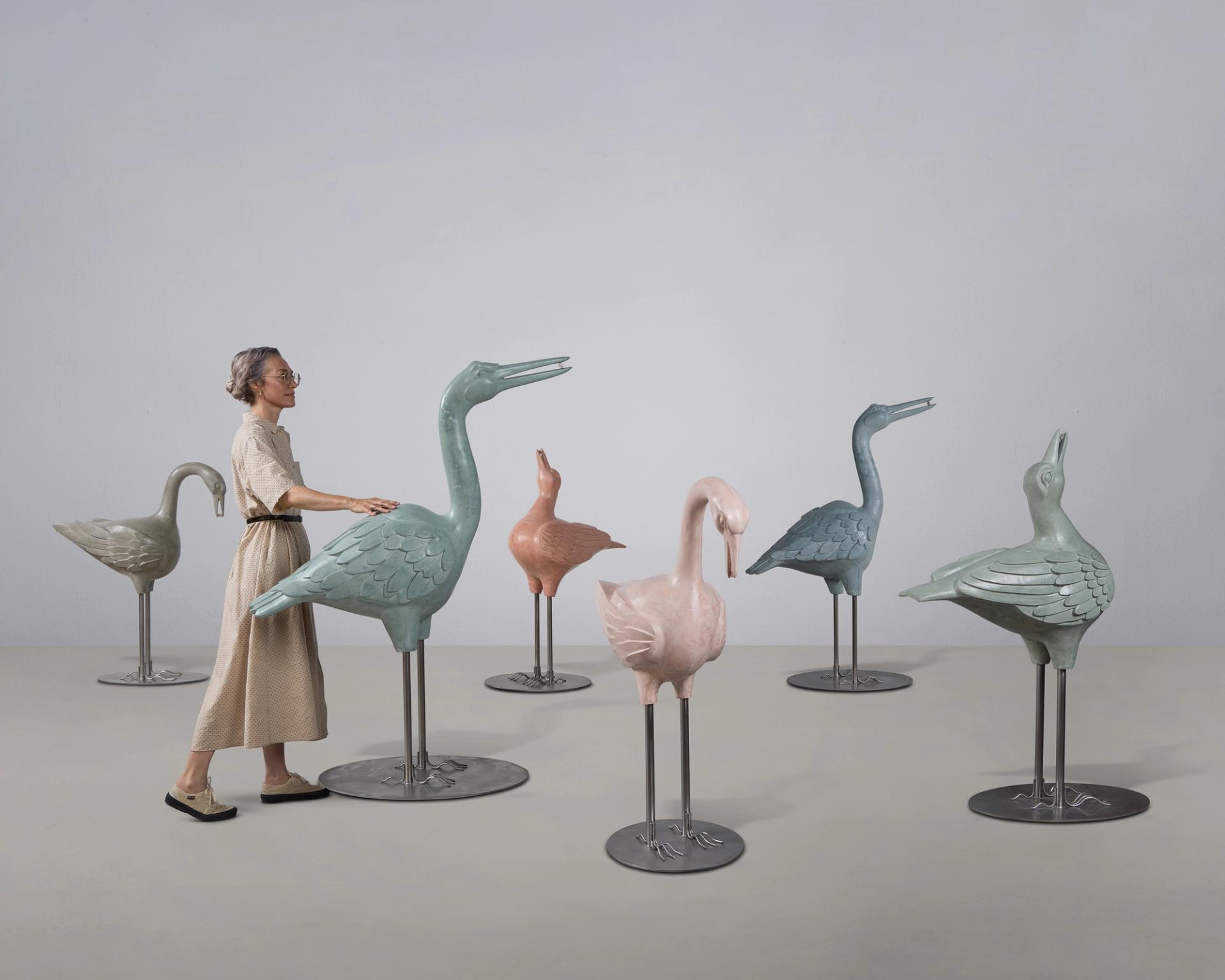
The additional layer is that everything has been profit-optimized to such an extent that no tiny bit of additional income is ever overlooked, regardless of what it means for the person experiencing the thing. We’re all lemons being juiced. So I started wondering, “Who’s collecting the little bit of value in these wishes?” I made a flock of birds that would harvest them. Each is a different color of cast concrete that relates to the marble in the fountain, and their design references friezes in nearby buildings. They’re all plucking coins, and they look like they’re having the most fun ever. So it’s dark but joyful. My husband keeps calling them private equity bros.
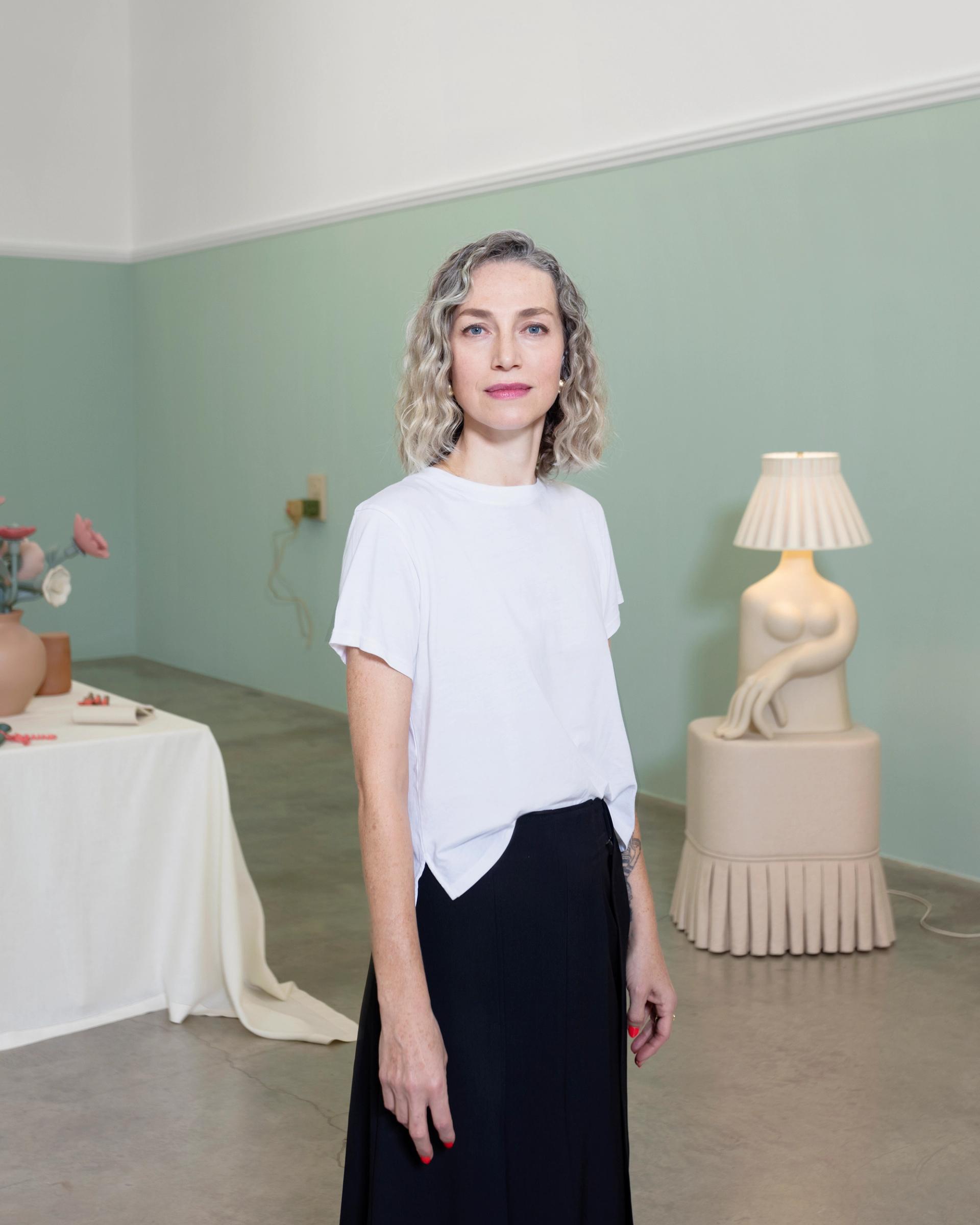
Genesis Belanger.
Credit: Photograph by Claire Dorn. Courtesy of the artist and PerrotinAh, they need little Patagonia vests.
Exactly! If you want to understand a problem in the world, you follow the money. When you work in advertising, you realize it’s just about how we use human psychology to control the money. That’s where my work is all connected—how desire is manipulated to make us consume.
The other vignette has three trees wheeled in on dollies. They’re 3D versions of 2D depictions of nature, and they take the place of the real plants. I was thinking about nature’s role as decoration and how, as our lives become less about in-real-life experiences, the backdrop becomes more important. Does it even matter if the trees are real if they’re just backdrops to your selfie?
So the playgroundification of everyday life. Everything rendered fake and harmless and quaint.
Then I made two Lady Justices, one on either side of the fountain. One holds a mirror in a selfie pose; the other is almost like that ’80s music video “Walk Like an Egyptian”—as if she’s giving and taking a bribe. Temples often have two allegorical women flanking the entrance, and I was thinking about the role of personifications of virtues in public space. They’re always women. What is their job? Are they there to inspire us to be the best versions of ourselves? To represent the values of the culture? And what should they look like when those values seem to be disintegrating?
They’re images of women from the vantage point of being a woman. Their bodies are in sections, an arrangement of parts. They have severed joints, where the parts don’t exactly fit and the scale is a little different. That’s what I think it feels like to be a woman: You’re never taken as a total. You’re always taken in parts. “Oh, she’s so smart.” “Oh, she’s very beautiful.” So Lady Justice is a collection of parts, but she also represents what it feels like to experience the justice that backs all our institutions—which feels corrupt and biased and on its knees.
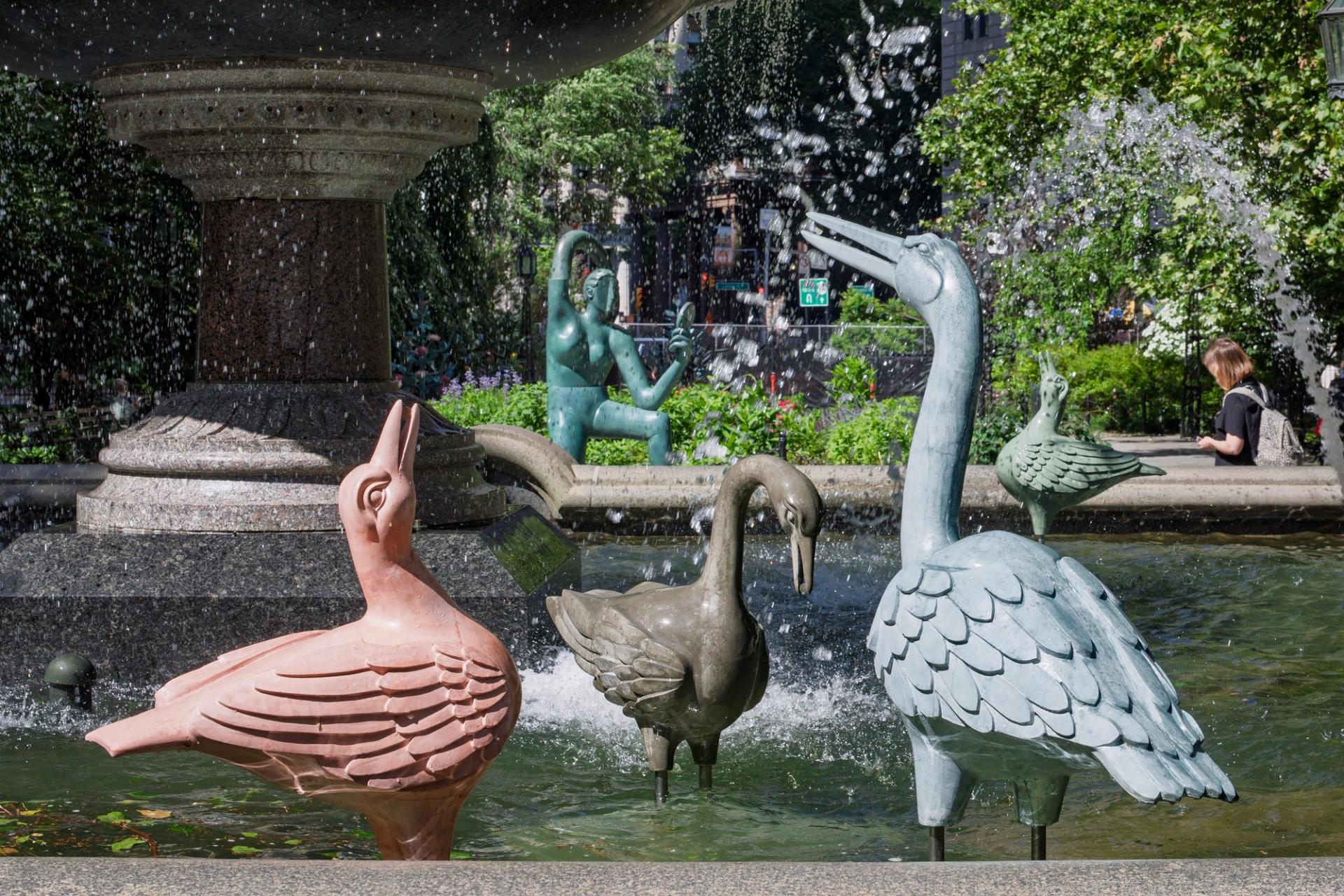
Heads or Tails (2026) installed at City Hall Park.
Credit: Photograph by Nicholas Knight. Courtesy of Public Art Fund, NYDo you see a correlation between the private neuroses your ceramics explore and the social-scale issues these works touch?
The topic has always been exactly the same. The Aldrich work is first-person: This is my experience of these societal pressures. The park is the bird’s-eye view: This is what’s happening in the world, and here is an environment you can enter as you will.
The way I think about everything I make is, I’m an intelligent human engaged with the world, and I want to make work that’s relevant and relatable. That’s my manifesto. So I make whatever I’m feeling about the world at the time, or whatever feels most upsetting. I call it not touching the butterfly’s wings. I don’t try too hard to control the creative inspiration. Whatever I feel inspired to make is what I’m going to make, and I trust it’s going to be relevant because I’m not living under a rock.
Header image: Photograph by Pauline Shapiro. Courtesy of the artist, Public Art Fund, Perrotin, and Pace.