How Thomas Campbell Turned a Surf Movie into Avant-Garde Art
The director breaks down the psychedelic steez of Yi-Wo.
October 7, 2026
Thomas Campbell thinks of his recent avant-garde surf flick, Yi-Wo (opens in new window), as a kind of cinematic Rorschach test. The feature-length film, released last year after more than a decade in the making, is intentionally and unapologetically ambiguous: Sea-foam intermingles with galaxies; each shot dissolves into the next; nothing is filmed at regular speed. Every aspect of the film is up to the viewer’s interpretation, even the title—a word that Campbell made up. He won’t even say “Yi-Wo” out loud, lest his pronunciation conflict with whatever it is you have in your head.
At 57, Campbell is one of the contemporary kings of the surf and skate arts. As a painter-sculptor-photographer, he burst onto the scene in the ’90s as a part of the “Beautiful Losers” cohort of DIY artists on Manhattan’s Lower East Side. He then absconded back to his home state of California, where he made a trilogy of surf films that reshaped the genre. In the first, a 1999 longboarding film called The Seedling, Campbell took a hard left from the aggressive so-called “Momentum” generation—named for Taylor Steele’s 1992 barn burner featuring, among others, a young Kelly Slater—and ushered in a new era of surfing as art form. Where Steele dealt in big airs and contest-oriented surfing, Campbell’s film made it cool to nose-ride again and popularized a style that was about creativity and flow rather than extremes. Ask any surfer on an “alternative board”—be it a fish, an asym, a glider, or some finless contraption—about their favorite Thomas Campbell film and you’re sure to get an earful.
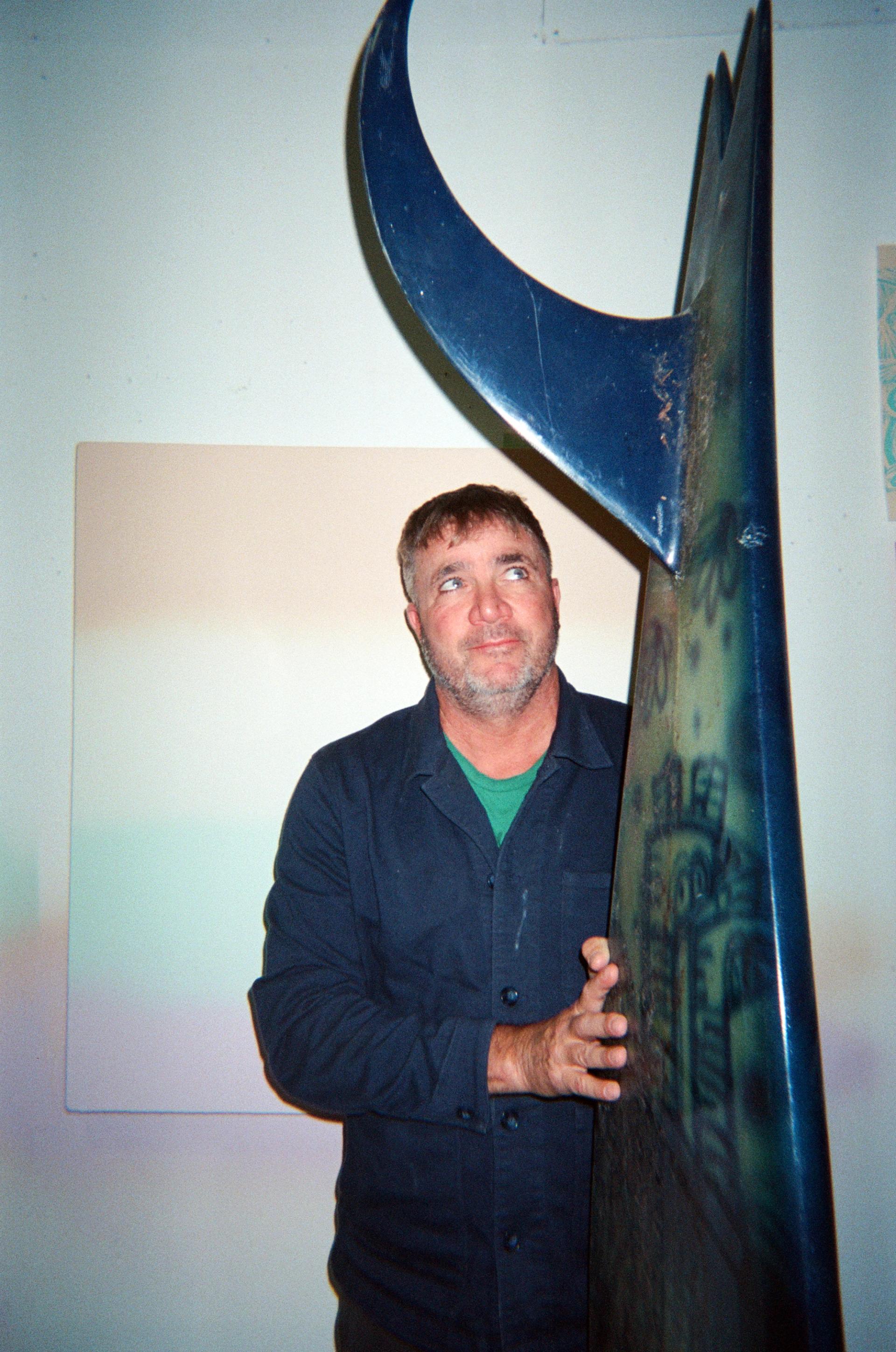
Thomas Campbell at his studio in Santa Cruz.
Credit: Photograph by Laura Thompson for ToteiWith Yi-Wo, Campbell is once again trying something new. He describes his first three films as straightforward and “educational,” in the Endless Summer tradition of teaching audiences about niche elements of surfing. But Yi-Wo is less a movie about surfing than it is a dream set within the world of the sport. The landscapes are otherworldly. The score is, at times, bone-rattling. And the only dialogue in the film is a sort of cryptic incantation—“my weird poem,” as Campbell puts it—about the “Last People,” a tribe of post-apocalyptic survivors taking refuge in the sea.
Not long ago, I visited Campbell at his home just outside Santa Cruz, and we sat down to watch Yi-Wo together just a few yards from the trailer turned recording studio where he edited it. He was happy to go deep on the making of the film—what it’s really like to crisscross the globe for 11 years with a Bolex 16 mm camera and some of the best surfers in the industry today. But, true to form, he was less forthcoming on the question of what Yi-Wo is about. You’ll just have to watch it and decide for yourself, dude.
Below, Campbell unpacks four scenes from Yi-Wo in his own words (lightly edited for clarity). My own commentary is in bold.
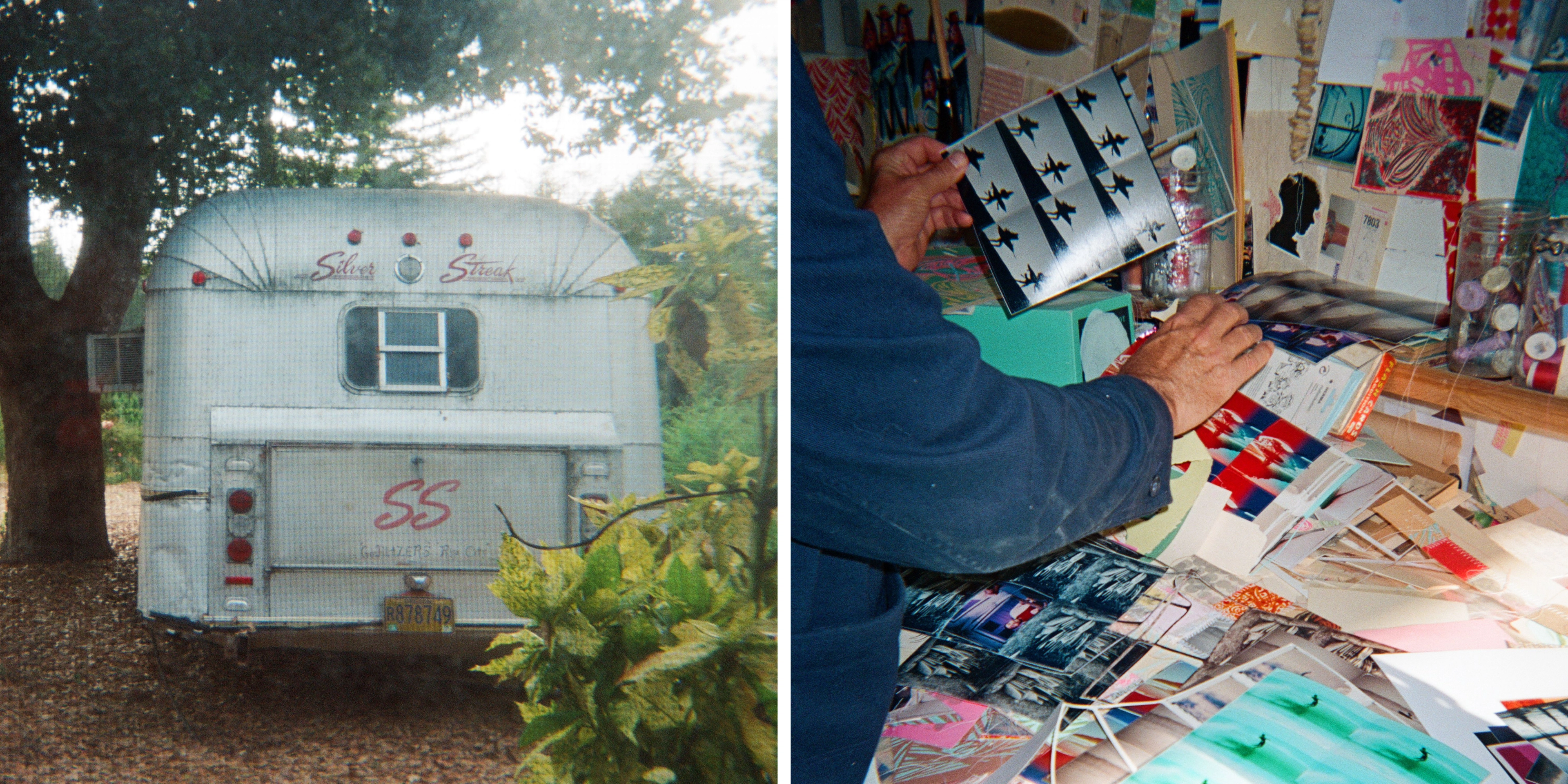
Campbell’s trailer-turned-studio
Credit: Photographs by Laura Thompson for Totei“The Whole Enchilada in One Shot”
Yi-Wo doesn’t give you wave riding from the get-go. The first few minutes feature psychedelic tribal figures making a pilgrimage to the ocean. You follow their silhouettes, unsure where this is all going, until a young, grinning Ryan Burch paddles into the frame. Then you see him, body compressing and extending like an accordion as he swerves along an avalanche of water, and it’s abundantly clear that this is not only a surf movie, but a movie meant to make you feel like you’re surfing.
Burch was one of four surf superstars Campbell accompanied to Morocco in 2014 for a film he was making with fellow surfer-auteur Chris Malloy. For reasons both benign and banal, that project never got off the ground, so in 2016, Campbell bought back the rights to the footage; it eventually found its way into Yi-Wo.
Ryan Burch in Yi-Wo (2025).
Credit: Courtesy of Thomas CampbellCampbell: I just really wanted to make good by the people that I took to Morocco. And it was so much footage that it could almost be something itself. Or it was at least enough to really build on. Because I was like, “This is insane.” All that footage—with all the wind blowing—it has such an amazing texture and emotionality to it. So I was like, “Ah, well, this is not a bad place to start anyway.”
The actual surfing doesn’t come until three minutes in. It needed to go far enough to where it started to feel uncomfortable or unusual, where it made people be like, “Wait, what?” They need to question, “What am I doing? What is this?” And then…[snaps].
It cuts to this track by this band called Fuck Buttons. They’re from England. I’ve never heard anything like that before in my life. I played it for my producer, who’s like 65 or something, and he was just like, “It makes me think I want to throw up, but like in the best way,” and I was just like, “Whoa, that’s a crazy thing to say.” But the beginning is really meant to make you question things. The visuals are so compelling, but then the music really makes you wonder what is happening.
This shot of Ryan is probably my favorite in the entire film. It’s just so visceral. Scott Soens shot that shot, and it shows you something that you otherwise don’t see. You can see his body mechanics really working, and you can see his board design working. You’re looking straight in the barrel, and he’s way back there. And I liked how when he kicks out, you can really see his emotions. I thought, “This is it. This is the whole enchilada in one shot.”
Perils and Predators in the Water
The world depicted in Yi-Wo is full of natural grandeur. It’s also conspicuously devoid of all but a few humans. It was a crucial narrative choice, but it limited how and where Campbell could do his filming. Over the years, in no small part due to the popularity of surf films and their social media counterparts, the best waves around the world have become overrun with crowds. Still, Campbell managed to get off the beaten path in Fiji, Morocco, Indonesia, Costa Rica, Australia, and even the United States.
But getting away from the crowds is only part of the challenge. “On location,” as it were, Campbell was subject to nature’s whims and far from the many conveniences, and sometimes even the basic infrastructure, of modern life.
Jared Mell in Yi-Wo (2025).
Credit: Courtesy of Thomas CampbellCampbell: I don’t really say where these waves are. I’ve always been pretty vague about that. There are not many people there because they’re places you have to work to get to. One place in particular, there used to be two boats you could hire to go there. One of them got destroyed in a storm, so now there’s only one boat with a license to be there overnight. So you go there, spend the nights on the boat, and get up at dawn, surf from six to nine. Then other boats start to come. They leave midafternoon, so you have three to six by yourself again. When you’ve been surfing someplace long enough, you figure out where the loopholes are.
The logistics can be tough. On the boat, they give you a bed. You bring your stuff, you hope it doesn’t break, and you have a backup plan if it does. You’re basically working all day. You’re motoring to the next spot or going in the water or getting to land. Getting to land is really gnarly sometimes. You have to put all your stuff in wet/dry bags, then paddle in on a surfboard or boogie board or swim in. Then you get in, get all your stuff out, make sure it’s all dry, set it all up, film, pack it all back up, get back in the water, and get back out to get picked up. Because it’s all film, mostly, we’re loading our cameras and going in the water, shooting a roll, then going all the way back to the boat, unloading that can of film, reloading a new load, then swimming back out into position.
The spots in Costa Rica are [exhales sharply]. They have the worst sharks and crocodiles. This one afternoon, it was perfect. Alex Knost had already gotten lots of waves but I needed more from Nick Melanson. Jared Mell was out, and it was fucking as good as it gets—it just looked insane. But Alex and Nick were on the boat. And I’m on the beach, waving. “You motherfuckers, get down there!” Like screaming, “This is it, it’s happening!” So they finally get out there, and as they’re paddling toward Jared, suddenly they turn and go back to the boat as fast as they can paddle, like a race. That can be only one of two things. Alex later told me he saw a head this wide [gestures] that started coming toward him—a crocodile, or whatever it is they have down there.
How’d I get off the beach after that? Well, I swam back with a surfboard.
The Art of the Tube Shot
There are few things in surfing that can top the feeling of a tube ride. It’s a bit like a total eclipse, or death (in a good way). Your surroundings darken as the lip of the wave curls over your head, a refractive mist surrounds you, and your body torpedoes toward a ring of light. Time warps, and the ocean’s immense power overtakes you. Surfers call this “the vision.” Plenty of filmers have taken cameras along for the ride in a barrel, but Campbell, with his more-is-more editing style and creative scoring, recreates the surreal experience better than any of his predecessors.
Barrel footage shot by Ry Craike in Yi-Wo (2025).
Credit: Courtesy of Thomas CampbellCampbell: Filming in water is a matter of figuring out what the wave is doing and deciding where I want to be in relation to it. Am I going to shoot a longer lens where there’s more area? If I do, I have to stay really still. The wider the lens you use, the less shake gets in. And since you’re dealing with movement, you can kind of swim into it—it creates a tension.
It’s like the 10,000-hour thing. You do it over and over again, and you learn to make decisions when you’re leaving the boat, like, “OK, the waves look like this; I’m gonna shoot it like this; I should put this lens on; I should shoot it at this speed, but this speed takes more film because it’s high speed.”
This footage is actually from a guy who was in one of my earlier movies. His name is Ry Craike. He posted one of those waves on his Instagram, and I was like, “Do you have more of these?” And he said, “Yeah.” And he sent me three waves. I was like, "Can you not post these? Because this is too good and I might make something out of this.”
To get the shots, I think he’s got a GoPro in his mouth, and he’s surfing. He’s one of the best surfers ever. And you know if you know—that’s not a very big wave. It’s a little wave. But that doesn’t matter. The shot captures the awe of it. You’re just like, “Wow, I want to be there.” When you get to really big waves, inner-tube stuff doesn’t look good, actually. You have to be really far back to even get a view because it’s too big. When it’s smaller, you can get the full arc.
So here’s the funny part: A few of my friends were over, and I wanted to show them this footage. So I took the three shots, and I just put them right on top of each other. Then I dropped on this music that Alex Knost sent me. It’s Kassia Meador playing sound bowls, and he was doing this ambient guitar thing. They were at some café in Costa Rica and someone recorded it on an iPhone. My friends were just like, “Oh, my God, this is crazy,” and I was like, “It is crazy, huh? It works so good with this.” Later, I went back and tried to make edits, tried to move it all around the film, and nothing was as good.
“It’s like the 10,000-hour thing. You do it over and over again, and you learn to make decisions when you’re leaving the boat.”
Shredding the Short Attention Span
Matt Warshaw, who is probably the closest thing the surf world has to an academic authority, draws a distinction between surf movies and surf videos. The former were largely feature-length 16 mm surf montages shot, edited, scored, produced, and marketed by lone filmmakers or small teams. The latter—shorter-form edits released directly to consumers via VHS, DVD, or, now, your streaming service of choice—began to supplant the former in the 1980s, thanks in part to the commercialization of surfing. Now, the genre is dominated by heavily branded sponcon served up in easily digestible clips.
Yi-Wo is undeniably a surf movie. Though the film was far from a one-man undertaking, Campbell drew from his background in the arts to shape every element of the final product. He edited the film himself; built props and set pieces; and wrote and recorded a dozen songs with his band, Cone Cinq, for the soundtrack. For the past year now, he’s been showing it at surf festivals, film festivals, and beach-town movie theaters. (It’s also available for purchase on Vimeo.)
In defiance of the Instagramification of surfing, Yi-Wo is full of long, luxurious shots that are so overflowing with detail that you can’t look away. Case in point: Campbell sent a filmer out into the water with an ultra-slo-mo camera and captured the minutiae of famed surfers Craig Anderson and Ozzie Wright defying gravity.
Ozzie Wright and Craig Anderson in Yi-Wo (2025)
Credit: Courtesy of Thomas CampbellCampbell: With the music, I was trying to create a space of mystery not too tied to anything. I was just really searching—and I have through all my movies—for a vibe to coalesce around. I liked the soundtrack for The Last Temptation of Christ. It’s just really mysterious. I’m not very good at playing music; I’m better at producing. My friends are much better at actually playing. But the good thing with us is that we can aim right at something that’s already been done, and we will miss it by a mile. We couldn’t rip someone off if we tried.
One time, I was driving over the hill here to San Jose, maybe 10 years ago, and I was listening to the college radio station. They were interviewing this guy, and he was talking about how he used to work with New Order and he recorded some frogs down here at this pond in Santa Cruz when he was going to college there. He said he made the frog noises into beats and then sent them to New Order, then they showed up in that song “The Perfect Kiss.” I was like, “Holy shit, that sound was from Antonelli Pond!”
Maybe four or five years later, I’m at my friend Cliff Kapono’s house on the Big Island in Hawaiʻi, and it’s late afternoon, and all of a sudden there are these, like, R2-D2 sounds in the backyard, and I’m like, “What the hell is that, Cliff?” I go out there and I’m recording it with my phone. And he’s like, “Oh, it’s this invasive frog from Puerto Rico.” So I recorded a bunch of the sound, took it back, and made beats out of it. It doesn’t sound anything like New Order; it sounds more like a computer. But we still used the frogs as beats. And then we made the song that ended up over the part with the super-slow-motion airs.
During COVID, I thought I was more or less done with the film. Then this guy, Chris Bryan— he’s one of the best filmers; he shoots in the water on a Phantom, a high-frame-rate, $100,000 camera. He reached out and was like, “I heard you’re making a movie, I want to help.” So I thought about it, then I talked to Craig Anderson about it and he was into it. So I said, “Can we get Ozzie to come?”—because Craig and Ozzie are good friends. And then my other friend filmed from the beach. So it all just worked out.
The stuff in the water was just so weird. At the end of the day, no one, or almost no one, would do that. Like, no one would shoot a five-and-a-half-minute part at only 2,000 frames per second. But for me, that’s what I want to watch. I almost want to be in a dream. And I think it works. A lot of people—maybe 40 percent—say they feel like they’re on mushrooms after they watch the film. And that’s incredible! What do you watch in your entire life that makes you feel altered?
From my time working at Skateboarder magazine, I feel like I understand pacing. This film is paced well—it’s almost paced the only way it can be. But I think it has a good balance.
One of the things I really like in the Costa Rica part of the film is when Alex Knost and Joel Tudor are talking on the beach. It’s a long shot, but to me, those are the two greatest ever. They’re surfing together. They’re talking. It’s very natural, and I was just like, “Why not?” This long shot is meant to honor that. Just go with it. Let it be. Let it breathe.
The advantage this film has is time. Eleven years of just being able to sit with it and ruminate on how to express. When I started, it was probably a little darker, and I was a little more like, “ah fuck.” Then I had a kind of personal awakening in the last five years. Everyone’s struggling so much with getting all these hard narratives shoved down their throats all the time, and then they’re grasping onto them and responding, and I thought, “What’s the opposite of that? How do I help you have thoughts that are expansive without telling you what to think?”
Over the years, I would watch versions of the film with friends, and that was really helpful. We would talk about it. A lot of times, people would go, “Did you try this?” Yes. “Did you try that?” Yes. Almost never, ever did anyone ask anything that I hadn’t tried.
“The advantage this film has is time. Eleven years of just being able to sit with it and ruminate on how to express.”
Once we started shopping the film to distributors, the direction of the movie became clearer. My producer talked to them, came back with the notes, and—I remember the conversation—they all wanted it to be shorter. I said, “OK, Ben, what would you cut out?” He couldn’t think of anything. I said, “You could take this part and this part and put them together, right? That one thing you could cut out. But if you did that, you would lose something. Anything you’re going to cut out is amazing.” They just wanted to cut things out to shrink it. Literally, a lady named Karen at Netflix, who’s probably not a surfer anyway, was saying, “You should do this.” It’s like, wait, you want to rewrite my weird poem? That’s such a weird thing to think you can do.
I got it to a point where every part functions completely. I was pushing, in a sort of punk rock way, against people’s small attention spans. It’s like, man, all these shots are beautiful. We’re honoring the dimension of our existence on this planet and what it can be and what it is. What, you don’t have time? You don’t have time to have this celebration? What the fuck are you doing here? This is a film for the people who want to be immersed and be present.