The IMAX Whisperer
How David Keighley laid the groundwork for Christopher Nolan and the new cult of IMAX.
August 3, 2026
In 1976, the parachutist Bill Cole jumped out of an airplane carrying an early-model IMAX camera. Still only eight years old as a company, IMAX was then known primarily as a purveyor of nature documentaries, deploying filmmakers to capture various corners of the world with its unique 70-millimeter cameras. The results were displayed in a handful of gargantuan theaters tailored to those cameras’ specs, with massive, squarish screens and projectors that could show off the company’s high-resolution film stock, which is three times as wide as standard 70 mm film and can pack in far more visual info. Those theaters were often housed in museums and science centers, functioning as exhibits transporting audiences to new locales. In the ’70s, in particular, IMAX was “mind-blowing to people because it gave you the sense of real image,” said the longtime IMAX documentary director Greg MacGillivray. “Your peripheral vision is filled, and the image is super sharp and detailed.” The fledgling Canadian company was already testing the bounds of what the audience could experience through its theaters—not just scenic footage but thrilling vantage points, like the POV of someone parachuting out of a plane. But on Cole’s jump, something went wrong. His parachute deployed; the camera’s didn’t. It shattered on impact.
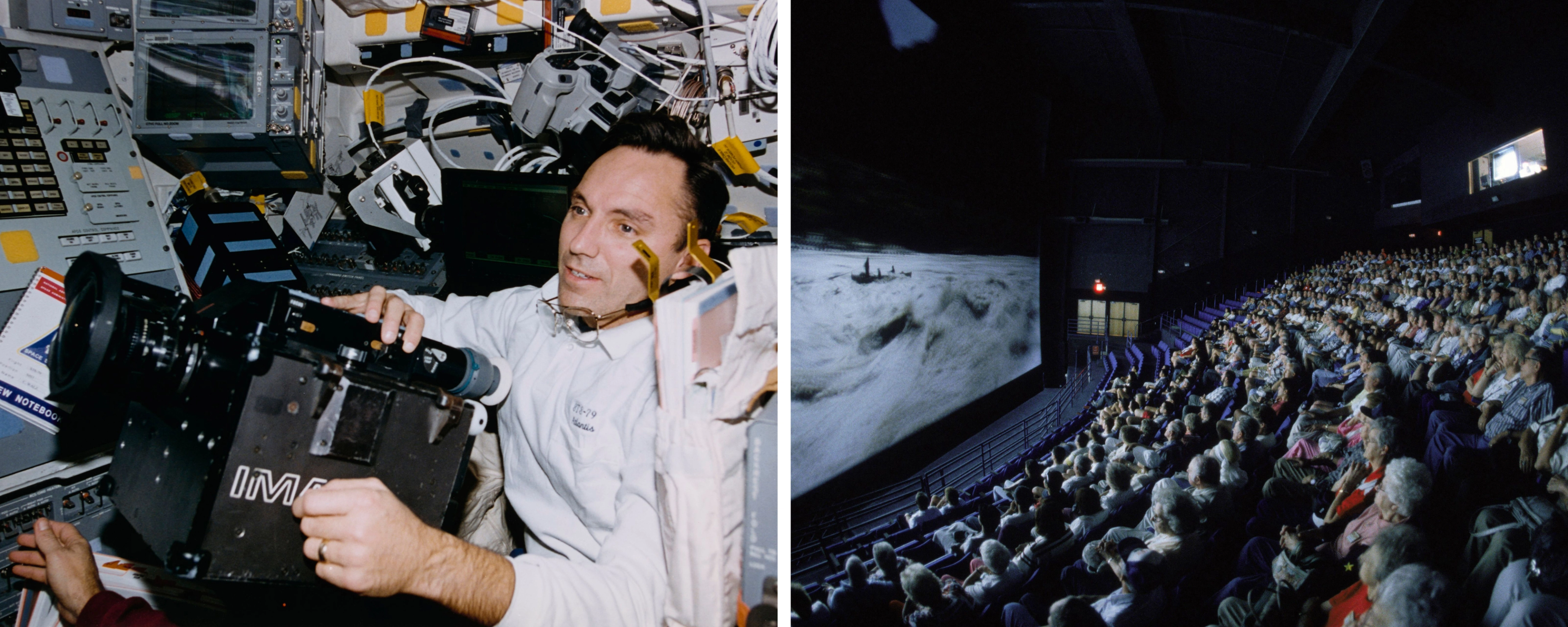
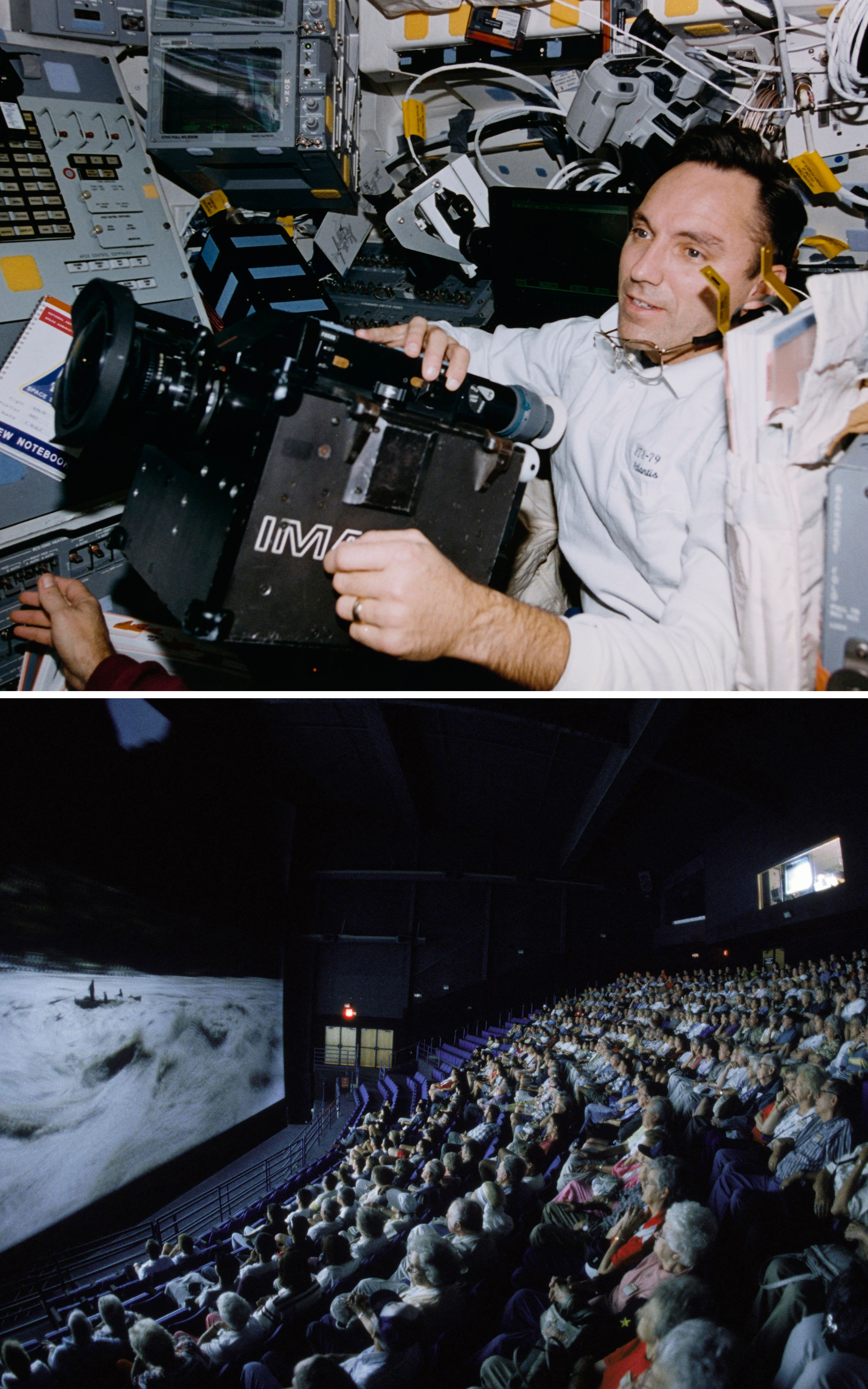
Astronaut Carl E. Walz positions the IMAX camera for a shoot on the Space Shuttle Atlantis, 1996; IMAX theater at the Grand Canyon.
Credit: Space Frontiers / Archive Photos / Getty Images; Cavan Images / AlamyNot far off stood David Keighley, a contractor at IMAX and a day-one true believer in its cinematic potential. Keighley had intended to film Cole’s descent with a 16 mm camera; instead, he watched in horror. Cole landed safely, though, and somewhere in the wreckage of the camera was a silver lining: The insurance money helped a cash-strapped IMAX make payroll. “So we saved the company by destroying one of two IMAX cameras in existence at the time,” Keighley later joked (opens in new window). Alongside his wife and business partner, Patricia, Keighley hitched his fate to IMAX in those rugged early days and spent the next half century engineering ways to get the most out of its technology, during which time he was named the company’s chief quality officer. When Christopher Nolan first came calling around 2005, Keighley quickly became his personal IMAX guru, forming a partnership that brought IMAX to the forefront of blockbuster filmmaking over the next two decades and culminated this summer with The Odyssey, which Nolan dedicated to Keighley following his death at 77 last September. But Keighley was also known to IMAX superfans as their closest ally within the company—someone who shared their passion for film projection and personally responded to their tech-minded questions and concerns via email. He may have spent his days working with their filmmaker god, but to IMAX superfans, Keighley was also, thrillingly, just “David.”
When Nolan chose to film in IMAX 70 mm for certain sequences in 2008’s The Dark Knight, he tipped a domino that eventually gave us the spectacle of IMAX showings for The Odyssey selling out a full calendar year in advance. More than any other filmmaker, he has helped build a cult fandom around IMAX—an ever-growing following of cinephiles who are fans of his movies, sure, but who will also see pretty much anything shot for the format. They gather in Discords and subreddits to share ticket-drop times and debate everything from aspect ratios to the best seat in the house at the Lincoln Square IMAX. When 2023’s Oppenheimer rolled out in IMAX 70 mm, they bought out showings for weeks on end, seeing the talky, three-and-a-half-hour drama multiple times in the format while normies wondered if they’d ever land a ticket. Two projectionists from LA’s TCL Chinese Theatre told me these superfans often stopped by the projection booth after the showings to give their compliments and ask for a tour. As I wrote last year (opens in new window), IMAX fandom is a techy form of cinephilia—one that demands interest in both the films themselves and the projector’s cooling system.

Clockwise from top left: David Keighley posing with an IMAX film platter from Oppenheimer; Christopher Nolan congratulates Keighley during the ribbon-cutting ceremony for the David Keighley Theatre at IMAX headquarters in Playa Vista, California; Keighley reviewing IMAX 15-perf 65 mm film; Patricia and David Keighley delivering Oppenheimer film reels.
Credit: Courtesy of IMAX and Patricia KeighleyIf Nolan brought the IMAX cult’s passion into the mainstream, Keighley laid the groundwork, identifying back in the ’70s that what IMAX needed was end-to-end quality control. Keighley recognized that IMAX’s hallmark 70 mm technology was both finicky and capable of greatness. If the cameras came with their challenges (they’re huge, loud, and can shoot only about three minutes of film at a time), so too did the film strips and the theaters they’re projected in. Starting with postproduction issues, Keighley’s quality-control network grew alongside the company. Eventually, it came to encompass everything from the minutiae of film-strip processing to the brightness of projector bulbs in individual theaters, with the team troubleshooting problems in real time at screenings around the globe.
In other words, Keighley was exactly the guy IMAX superfans would want to talk to. In 2011, Patricia got inspired after seeing one of those cargo trucks with a “How am I driving?” sticker on the back alongside a phone number. Ever since then, every IMAX movie has included a message in the credits to email CQO@imax.com with any questions, comments, or concerns. Up until his passing, Keighley himself was checking the account—if a projector in a Dallas IMAX was dim, he wanted to know about it. And if the nearest IMAX technicians couldn’t figure it out, he was liable to fly out himself. As the cult around IMAX exploded over the last 15 years, superfans began writing to Keighley with increasingly intricate questions about IMAX systems. Afterward, they’d race back to their subreddits to share his responses. “It must have taken entire weekends to respond to everyone,” one of the moderators for r/IMAX (opens in new window) recently told me. “But he did it.”
If much about IMAX now seems so American (e.g. its quest for global domination driven by its brash New Yorker of a CEO (opens in new window), Rich Gelfond), its origins are decidedly Canadian. After launching at the Montreal Expo in 1967, the company built its first permanent theater in 1971 at a Toronto amusement park, which opened with a documentary about Northern Ontario called North of Superior. (Again: Canadian.) That first theater, the Cinesphere, had many of the features that went on to define “true” IMAX: a huge screen with a boxy 1.43:1 aspect ratio, steep stadium seating designed to bring the audience closer to the screen, and a projector running triple-width 70 mm film stock. As a newlywed film student, Keighley caught a North of Superior screening there with Patricia in 1971 and fell in love with the format.

The Cinesphere IMAX theater in Ontario.
Credit: AlamyIMAX’s founders were fellow problem solvers, and they had created a technology with its share of built-in obstacles—many of them brought about by the combination of hugeness and high resolution the company was gunning for. “Everything is magnified in IMAX,” said MacGillivray, a longtime collaborator of Keighley’s, who added that a small bubble in the film strip or a bit of camera unsteadiness that might go unnoticed in 35 mm can become “disturbing” when blown up to IMAX. Keighley decided to tackle postproduction issues, becoming what MacGillivray called “an expert on color,” using his keen eye to review film prints to dial in color according to filmmakers’ preferences. (This involved repeatedly watching footage and taking notes like “Make this shot two points brighter,” then using an analog punch-card mechanism to control the amount of light the printer let in for the next print.) In 1972, David and Patricia founded 70 MM Inc. and worked as contractors overseeing postproduction on IMAX films, with Patricia handling everything from accounting to HR to legal. Those first years were shoestring—while working on a government-backed film in the ’70s, David once emptied the Keighleys’ shared bank account to fly from Toronto to a lab in Los Angeles, betting that the government would reimburse them later. (It did.)
In 1988, IMAX brought the Keighleys in-house by acquiring 70 MM Inc. Six years later, IMAX’s founders sold the company to two American businessmen with Hollywood dreams, Gelfond and Brad Wechsler. But the pair found themselves unable to persuade Hollywood filmmakers to shoot movies in a format that could be displayed in only about 110 theaters. They came up with other ways to expand in the 2000s, digitally remastering new-release movies shot on 35 mm so they could be projected on IMAX. With a steady stream of Hollywood films finally flowing, Gelfond and company built cheaper IMAX theaters by retrofitting existing multiplex theaters with bigger screens and IMAX’s new digital projectors. (Those theaters now constitute the majority of IMAX’s 1,800-ish theaters, though purists consider them inferior to “true” IMAX (opens in new window) since they’re smaller and have a widescreen 1.90:1 aspect ratio.)
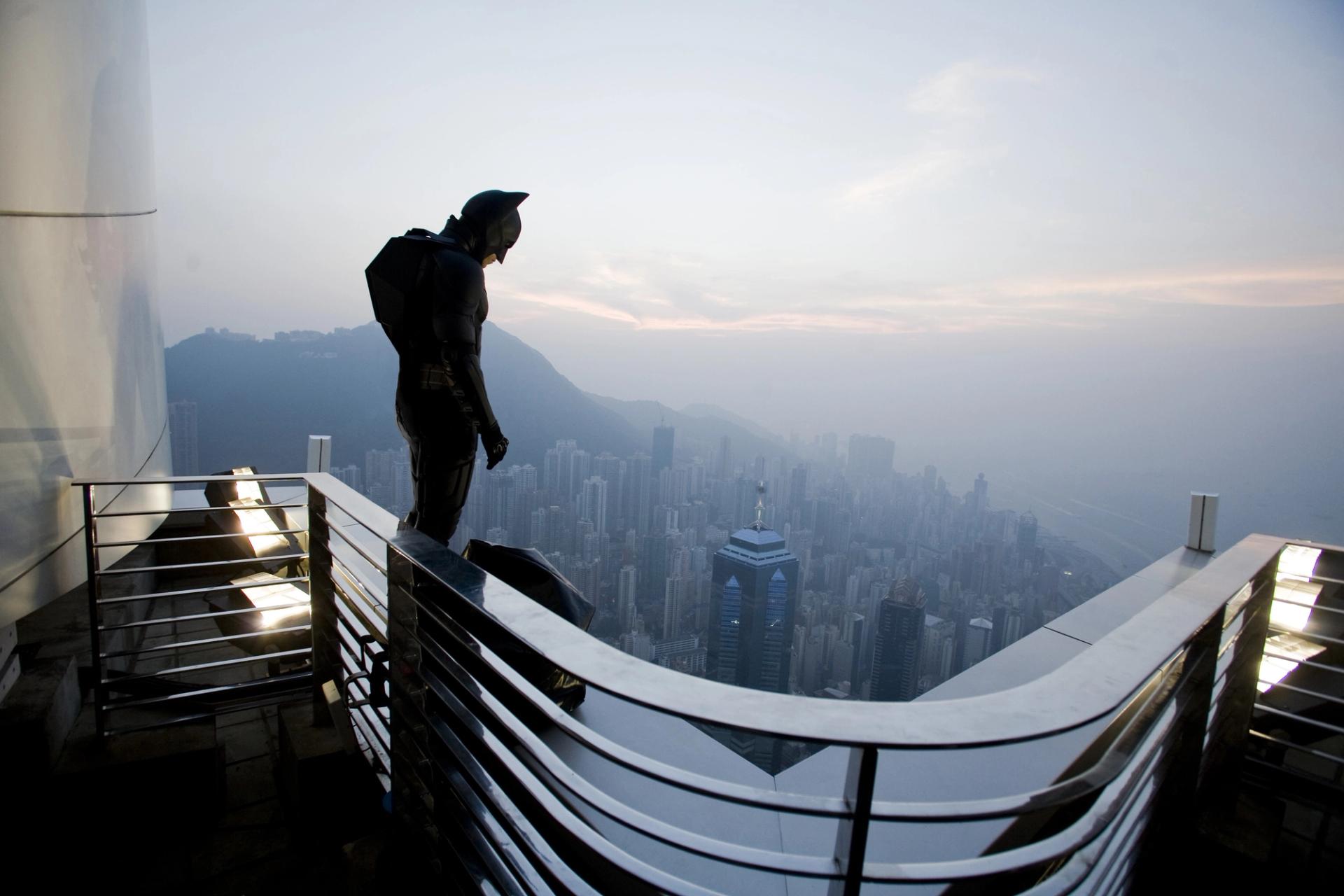
A still from The Dark Knight (2008).
Credit: Courtesy of Warner Bros.While the Keighleys were involved in the digital transition, it also took IMAX further away from the analog 70 mm technology they’d fallen in love with. Enter Christopher Nolan, who’d had his mind blown by IMAX as a kid when he caught a screening of 1976’s To Fly! (opens in new window)—an aviation documentary codirected by MacGillivray that became one of IMAX’s biggest early hits. Nolan was struck by the immersiveness, and after the filmmaker digitally remastered 2005’s Batman Begins for IMAX, Keighley talked him into test-shooting one scene on IMAX 70 mm film cameras for 2006’s The Prestige. The sparkling, high-res results convinced Nolan he could integrate IMAX 70 mm sequences into a 35 mm workflow without issue, leading to him filming six sequences (opens in new window) in IMAX 70 mm for 2008’s The Dark Knight. Anyone who saw that film in an IMAX theater witnessed the introduction of a new element to blockbuster filmmaking: During the IMAX-shot sequences, the top and bottom of the frame expanded to fill the entire 1.43:1 screen, further immersing the audience in the action at key moments like the opening bank heist.
Nolan was hooked, and, with the exception of 2010’s Inception, he has leaned further into IMAX 70 mm with each subsequent film. He has also posed new challenges to the IMAX team every time, whether it was running film backward through an IMAX camera on 2020’s Tenet or developing black-and-white IMAX film for the first time on 2023’s Oppenheimer. Keighley was in the lab for each of these films during shooting, checking the framing and exposure of the footage to ensure everything was coming out as intended before it was too late to reshoot anything. According to Patricia, David knew the intricacies of every machine in the production process and how it could impact a print. Was a flaw introduced in camera or by one of the various machines in the postproduction lab? Often, only David could tell. When Ryan Coogler decided to film sequences for 2025’s Sinners on IMAX 70 mm, Nolan had a word of advice: Make sure Keighley reviewed his dailies.
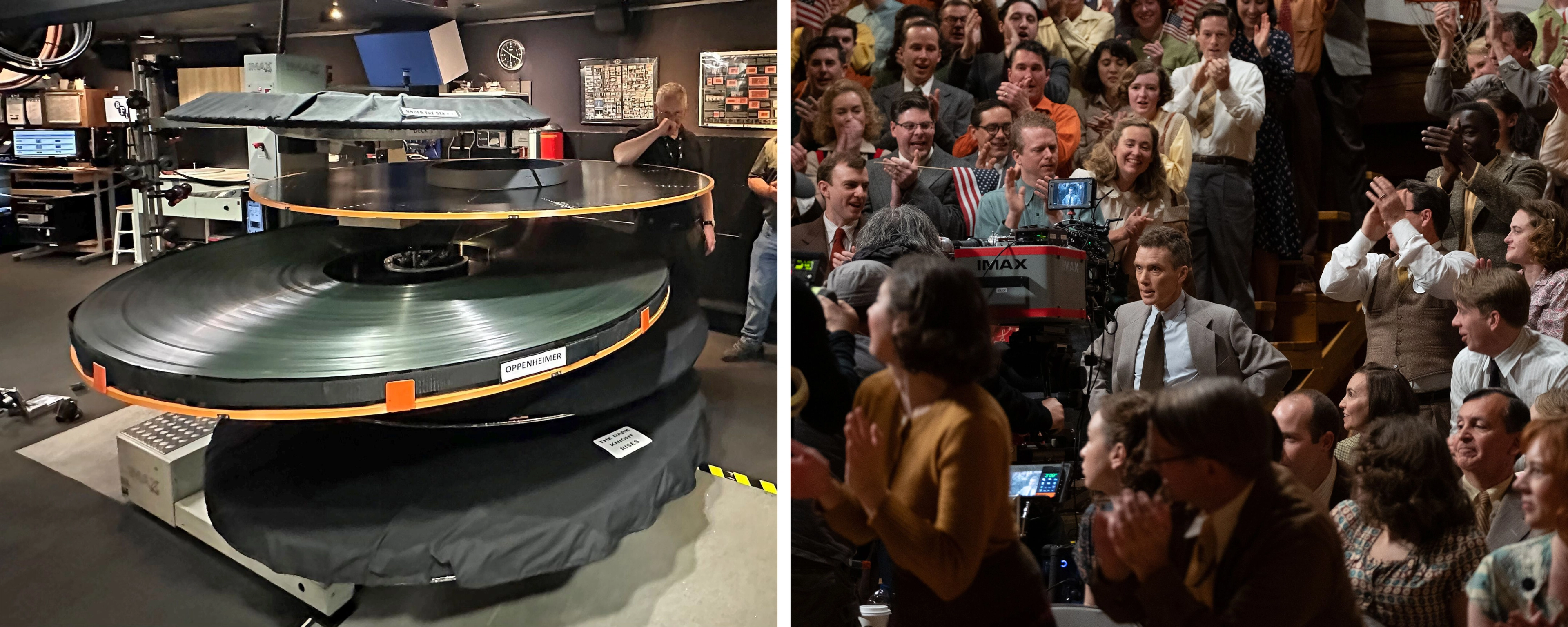
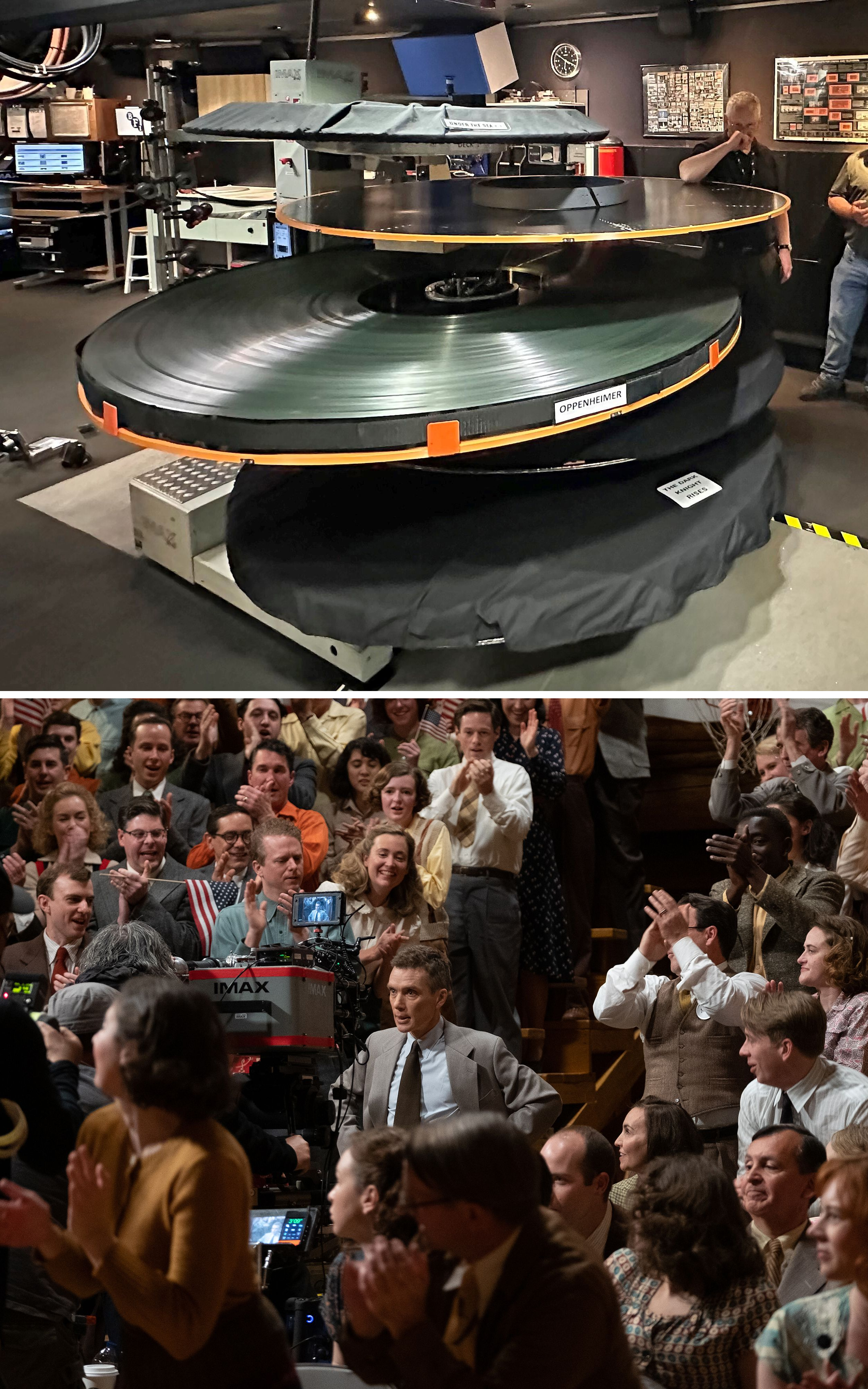
70 mm film platter at BFI IMAX; behind the scenes of Oppenheimer (2023).
Credit: Photograph by David Keighley; Photograph by Melinda Sue Gordon/Universal PicturesWith Oppenheimer, Nolan had a new task for the folks at IMAX: He wanted it projected on true IMAX 70 mm in as many locations as possible. Analog-film projection, a 1.43:1 screen—the same setup on which he had seen To Fly! as a kid and on which Keighley had seen North of Superior. Given IMAX’s previous transition to digital, this meant a massive marshaling of resources to dust off an antiquated medium, including repairing defunct projectors and retraining semiretired IMAX projectionists who might have projected whale documentaries at an aquarium decades ago. Keighley’s quality-control team kept tabs on all these 70 mm theaters, in particular. The longtime IMAX projectionist Pat Caldwell—who referred to Keighley as “Mr. Quality”—explained to me that IMAX projectors come equipped with a dust-clearing button to keep the projector clean while a film’s running, since even the tiniest bit of debris will look like the cyclops on a true IMAX screen. During Oppenheimer’s premiere at the Chinese Theatre, Keighley had Caldwell put that button on an extension cord and run it out into the theater to where Keighley sat. For a screening that important, he wanted to control everything in the room himself, down to the dust motes. “And he did it,” Caldwell said, laughing. “I could hear it every time he hit the button.”
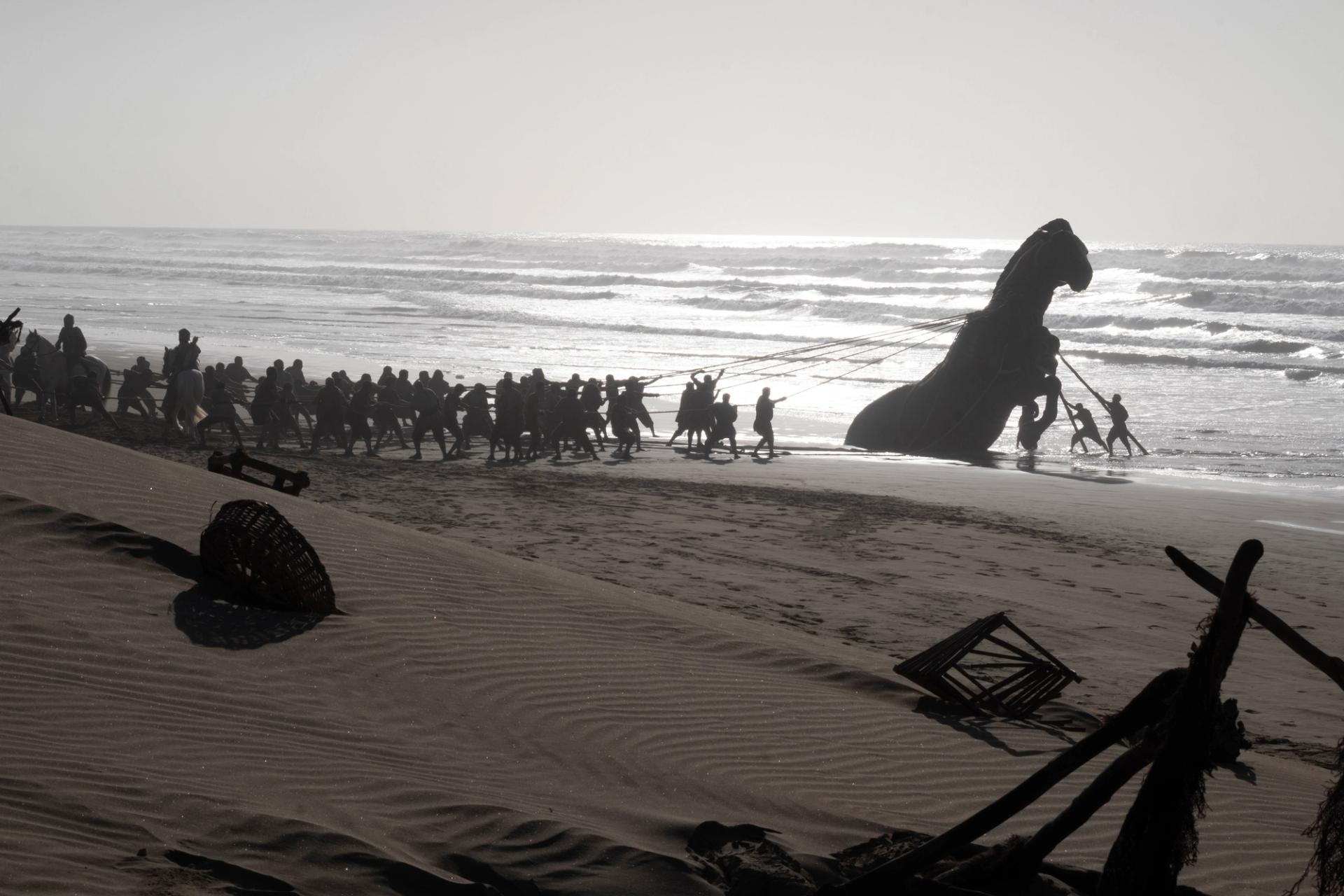
Still from The Odyssey (2026).
Credit: Photograph by Melinda Sue Gordon / Universal PicturesThe Odyssey was rolled out to even more theaters (opens in new window) in proper IMAX 70 mm (41 around the globe), which are all currently sold out for weeks. While Keighley isn’t around to see it, he battled cancer for just long enough to finish principal photography on the film—the first feature shot entirely on IMAX 70 mm. “If you had asked David Keighley, ‘What would you want to be doing the last few months of your life?,’” Patricia told me last year, “working with Chris on an epic film like The Odyssey would be exactly what he would say.”
Nolan, of course, posed new problems to the IMAX team along the way, like creating a “blimp” for the cameras to contain their noisiness during dialog scenes and also developing an entirely new IMAX camera—a nimbler, quieter model later dubbed “the Keighley,” after David and Patricia. In all likelihood, the Keighley will continue solving problems for Nolan on future films, an ideal tribute to its namesake. And if Nolan ever needs to throw an IMAX camera out of a plane, he’ll know which one to use.
Header: Behind the scenes of The Odyssey (2026). Photograph by Melinda Sue Gordon / Universal Pictures.