The Strange Allure of the Single-Sentence Novel
In the past three years, two Nobels and a Pulitzer have been awarded to authors who write for hundreds of pages without using even one period, and we asked them: “Why?”
June 3, 2026
This year’s Pulitzer Prize for Fiction, awarded to the novel Angel Down by Daniel Kraus, was a victory for the long sentence. It was a triumph for snowballing clauses, for the circuitous phrase, for the comma-strewn passage and the parenthetical aside—for literary accumulation itself. And it was a crown on the head of a specific form that has become fashionable in the last few years: the sentence so long it lasts (and sometimes outlasts) an entire book.
The Pulitzer for Angel Down—which opens in the middle of a sentence that does not end—came just a few months after Hungarian writer László Krasznahorkai (author of Herscht 07769: 400-ish pages, one sentence, published in Hungarian in 2021 and in English in 2024) was awarded the Nobel Prize in Literature, making him the second laureate in three years to have written a novel composed of a single sentence, after 2023 winner Jon Fosse (author of Septology: 800-ish pages over seven parts in three volumes, published between 2019 and 2021).
The long sentence has a long history. There are the novels of 20th-century writers Bohumil Hrabal and Jerzy Andrzejewski; there are Marcel Proust’s intricate detours, Thomas Bernhard’s repetitive rants, Javier Marías’s languid digressions, the triumphant final chapter of James Joyce’s Ulysses, and the 1,288-word sentence in William Faulkner’s Absalom, Absalom!
But Kraus, Krasznahorkai, and Fosse—and other contemporary writers like Mathias Énard, Lucy Ellmann, and Mike McCormack—are making fresh attempts to stretch the limits of the sentence. They write celebrated books rife with commas, em dashes, line breaks, and dependent clauses; but the deadly period does not appear for hundreds of pages, if at all. One of their novels contains a sentence that begins and ends outside the bounds of the book entirely; another’s sentence reveals itself to be a loop that returns at the end of the novel to the opening line, trapping the reader in an inescapable sentence-wheel.
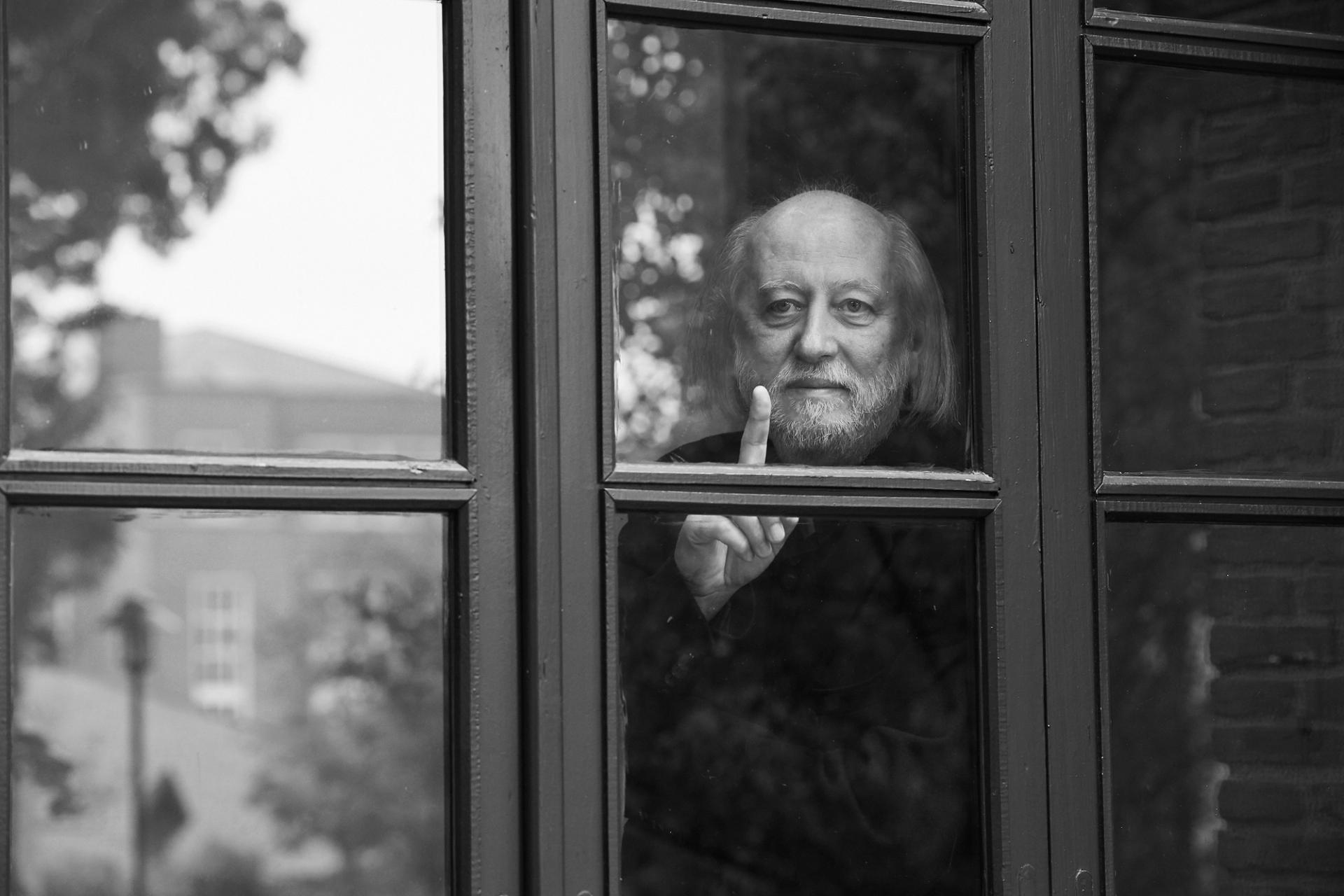
László Krasznahorkai in Madrid in 2018.
Credit: Photograph by Carlos Alvarez/Getty ImagesSince he published his first novel in 1985, Krasznahorkai’s sentences have gotten longer, going on for paragraphs, pages, and finally for a whole book. Why does he do it?
“Is it because, simply, he’s a weird man who just wants to write terribly long sentences, and he doesn’t want you to get a word in edgeways?” said the poet George Szirtes, who translated Krasznahorkai’s first three books into English. “No, it’s not that—it’s what he senses, how he feels about the world. It isn’t literary mannerism or a trick. It’s a genuine sense of what the world is and how it works, and how people get swept up into enormous organisms which are far bigger than themselves.”
At the same time, Szirtes added, Krasznahorkai’s books are “quite funny.” (Other words used by critics to describe single-sentence novels include “epic,” (opens in new window) “urgent,” (opens in new window) “very beautiful,” (opens in new window) “easy, immersive, even trance-like,” (opens in new window) “stylistically daring,” (opens in new window)“a bit like drowning,” (opens in new window) and “not necessarily one for the beach.” (opens in new window)) With no periods, cadence becomes paramount as the sentence goes on, and the writer must work to sustain the rhythm of the prose.
“I didn’t know if people would take one look at it and just be like, ‘I don’t want to deal with this.’ I really didn’t know if I’d just ruined the book. All I knew is that I really liked it.”
Daniel Kraus has written 29 novels, but Angel Down (304 pages, one sentence) was the first in which he abstained from the period. The abstention, he told me, made him realize that the terminal dot “is your most powerful tool in writing.”
“It’s how you create the very smallest building block of structure,” Kraus said. “If you don’t have periods, then it’s like you don’t really have anything.”
Nonetheless, casting the period aside represented a breakthrough in his writing process. He had been struggling with an early draft of Angel Down—a speculative World War I narrative—when he came upon the idea to write one continuous sentence that, on the final page, loops back into the opening words of the book, like in Finnegans Wake. The sentence worked, on a thematic level, as a structural metaphor for the endless cycle of modern warfare, said Kraus.
“It was about the industrialization of war, and how once we started engaging in a war for profit, there was no real end to it—a self-perpetuating wheel, essentially,” said Kraus. “In theory, you’re trapped inside the book.”
As he wrote, Kraus hoped the sentence, with its relentless forward motion and its commas and conjunctions falling ceaselessly like shells on the trenches of the narrative, would evoke something of “the onslaught of war…just one thing after another, after another, after another.”
“I didn’t know if people would take one look at it and just be like, ‘I don’t want to deal with this,’” said Kraus. “I really didn’t know if I’d just ruined the book. All I knew is that I really liked it—it was really exciting for me to write.”
Without the period, his “normal method of creating pace,” Kraus turned to rhythm to regulate the flow of his prose, likening it to the thump of car wheels on a highway when “it gets to where you don’t notice it.”
“When I would set up to write for the morning—and I always go back a little bit and read what I’ve done—it was really about going back and getting back into the rhythm,” said Kraus. “So that’s what I used instead of periods, just a certain beat, and so it was a different kind of writing.”
Charlotte Mandell, the French-to-English translator of Mathias Énard’s single-sentence novel, Zone—which takes place on a train heading from Milan to Rome—said Énard strove to mimic “the ongoing rhythm of the train” in his sentence. (He also wrote exactly 513 pages, to match the 513 kilometers between the two cities.)
Krasznahorkai, a former musician, has also (opens in new window) stressed the importance of rhythm in his long sentences, and Jon Fosse, according to his translator Damion Searls, has spoken of the musical quality of his. “His metaphor for his writing is listening, like he’s hearing it from somewhere else and he’s writing it down,” said Searls, who translated Septology from Norwegian to English. “When he talks about translation, he says what he cares about is that the translator kept the music of it.”
Lucy Ellmann, author of the Booker Prize–shortlisted novel Ducks, Newburyport (1000-ish pages, published in 2019), was motivated by the long sentence’s resemblance to conscious thought. “It seems to me people don’t punctuate their interior monologues, so I dispensed with periods in Ducks: It’s the literary equivalent of menopause,” she wrote in an email.
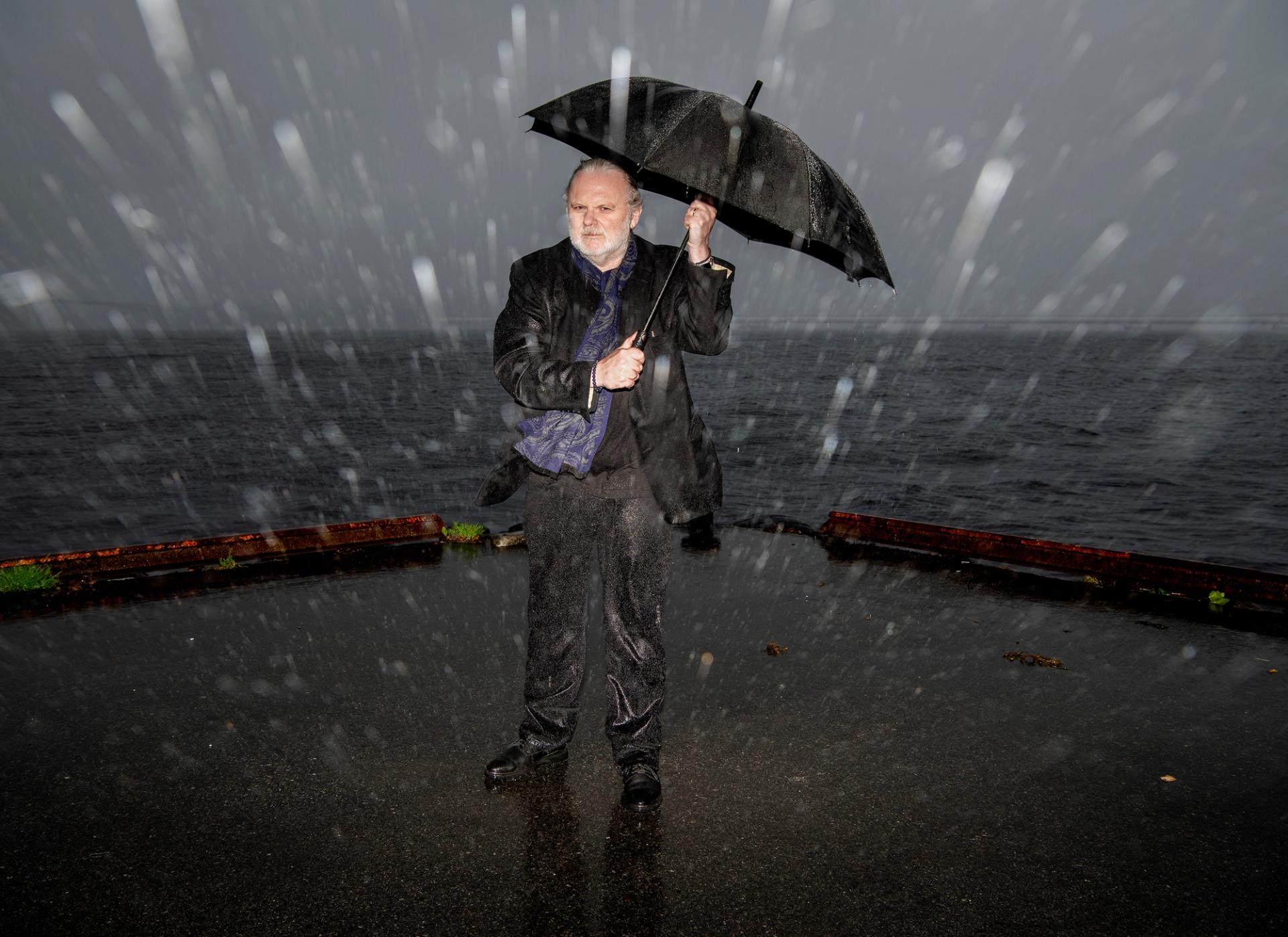
Jon Fosse in Frekhaug, Norway, in 2023.
Credit: Photograph by Helge Skodvin/Getty ImagesFreed from the period, long sentences can digress, meander, sing; the effect is a headlong immersion. Books with never-ending sentences are difficult to put down: Since there is no natural place to pause, halting anywhere feels like an interruption.
The long sentence can carry the reader along like a slow river or a riptide (Searls spoke of “flow” in Septology; Szirtes described Krasznahorkai’s sentences as “tidal”; Mike McCormack dubbed the long sentence of his 2016 novel, Solar Bones, “riverine”). Pleasant scenes can lull and hypnotize; harrowing ones, like the battlefield scenes in Zone or Angel Down, drag the reader forward by the lapel, denying the relief of the full stop. Sometimes the long sentence makes the reader sprint: In Krasznahorkai’s novella Chasing Homer, where the protagonist is fleeing unknown pursuers, “his long sentences emphasize chasing, running away, as you read the text continuously, without full stops,” said Anna Dávid, Krasznahorkai’s Hungarian publisher. The pace exhilarates.
Counterintuitively, punctuation may be the most important tool in crafting the long sentence. In Septology, Fosse does not impose a period once but uses commas, question marks, conjunctions, and paragraph breaks for dialogue—all of which, Searls told me, can provide similar functions to a period. (Fosse has said (opens in new window) he didn’t plan to exclude full stops, but that once he started writing he realized “they would damage the flow.”)
“I guess I would say it’s a bunch of short, simple sentences, but with commas or ‘ands’ in between,” Searls said. Ultimately, he considers the one-sentence question “a technicality”; more interesting on a craft level, he said, are things like Fosse’s grammatically unconventional use of the question mark, which the Norwegian writer sometimes appends to what looks like a statement in order to convey doubt?
“John Banville says the sentence is what sets us above and apart from the animals.”
Mike McCormack, whose novel Solar Bones opens in lower case—possibly even mid-sentence—and ends without a period, said he eschewed the period for character purposes: His narrator is a ghost.
“It seemed to me so obvious that a ghost would have no business with a full stop,” said McCormack. “The full stop is completely outside of his comprehension and being.” He continued: “That was a real governing consideration—that sense of ongoingness. Stylistically, it just clicked into place for me.” (Not for his wife, though. He said she threatened to “come down in the middle of the night” and add a full stop to his manuscript.)
Still, McCormack is wary of the long sentence. “John Banville says the sentence is what sets us above and apart from the animals,” he said. “I would share that esteem. You want to have some seriously good reasons for renouncing the sentence and for writing long outpours.”
When Szirtes, Krasznahorkai’s first translator, heard about the Nobel Prize win, he composed a tongue-in-cheek poem (opens in new window) to celebrate the news. He themed it around Krasznahorkai’s famous sentences: “I went on imagining, well, shall we hunt for a full stop somewhere?” Szirtes said. “Pointless in some books, but you do eventually find one.”
Or maybe you don’t. Angel Down has no period, but it has paragraphs, chapters, and section breaks. Do these qualities detract from the singleness, or the sentenceness, of its single sentence? Does it matter?
“People are getting all bent out of shape about ways that the book may or may not be, technically, one sentence,” Kraus said. “I mean, I don’t care. I’m just trying to write a good book. Forget about all that stuff—just enjoy the book.”
Header image photographs, clockwise from top left: Mathias Énard by Tim P. Whitby/Getty Images; Jon Fosse by Helge Skodvin/Getty Images; László Krasznahorkai by Carlos Alvarez/Getty Images; Daniel Kraus by Lyndon French; Mike McCormack by Astrid Eriksson Tropp; Lucy Ellmann by Matt Crossick/Empics/Alamy