How Aleshea Harris Crafted the Slow-Blooming Violence of “Is God Is”
The celebrated playwright and first-time director on turning her award-winning play into a stylish revenge thriller.
A young girl picks up a bat and beats a boy so badly that blood splatters across her frilly dress as the screams of other children fill the air. That’s the operatic violence that kicks off Is God Is, a stylish revenge thriller directed by Aleshea Harris, who adapted it for the screen from her own Obie Award-winning 2018 play. In both forms, it’s a brutal epic following adult twins Anaia and Racine (played by Mallori Johnson and Kara Young, respectively), as they hunt down their abusive father, who viciously set fire to their mother and left them to die alongside her.
Harris’s filmmaking debut, the movie was critically hailed as the arrival of an exciting new voice in cinema upon its release this past May. That was a relief for Harris, a celebrated playwright known for her genre-breaking meditations on Blackness, who dove into the adaptation process without any prior experience in film. “It was all instinct and gut,” she said over Zoom from her home office in Pasadena, California. “Trying to speak a language—no one understood what I was saying sometimes.”
While writing the screenplay, Harris rewatched films like the Coen brothers’ O Brother Where Art Thou (2000) and Bong Joon Ho’s Mother (2009) for inspiration, intent on avoiding the trap of making a movie that simply felt like a play caught on camera. Her instinct was to do all the stuff she couldn’t do onstage. That meant unleashing the story’s full visual potential—adding sepia-toned flashbacks, using subtitles to portray twin mind reading, applying elaborate prosthetics for burn marks, and closely controlling when violence is implied versus shown. The result is a marvelously assured and splashy first film that gleefully exploits all the stylization and hyper-control that the cinematic medium allows.
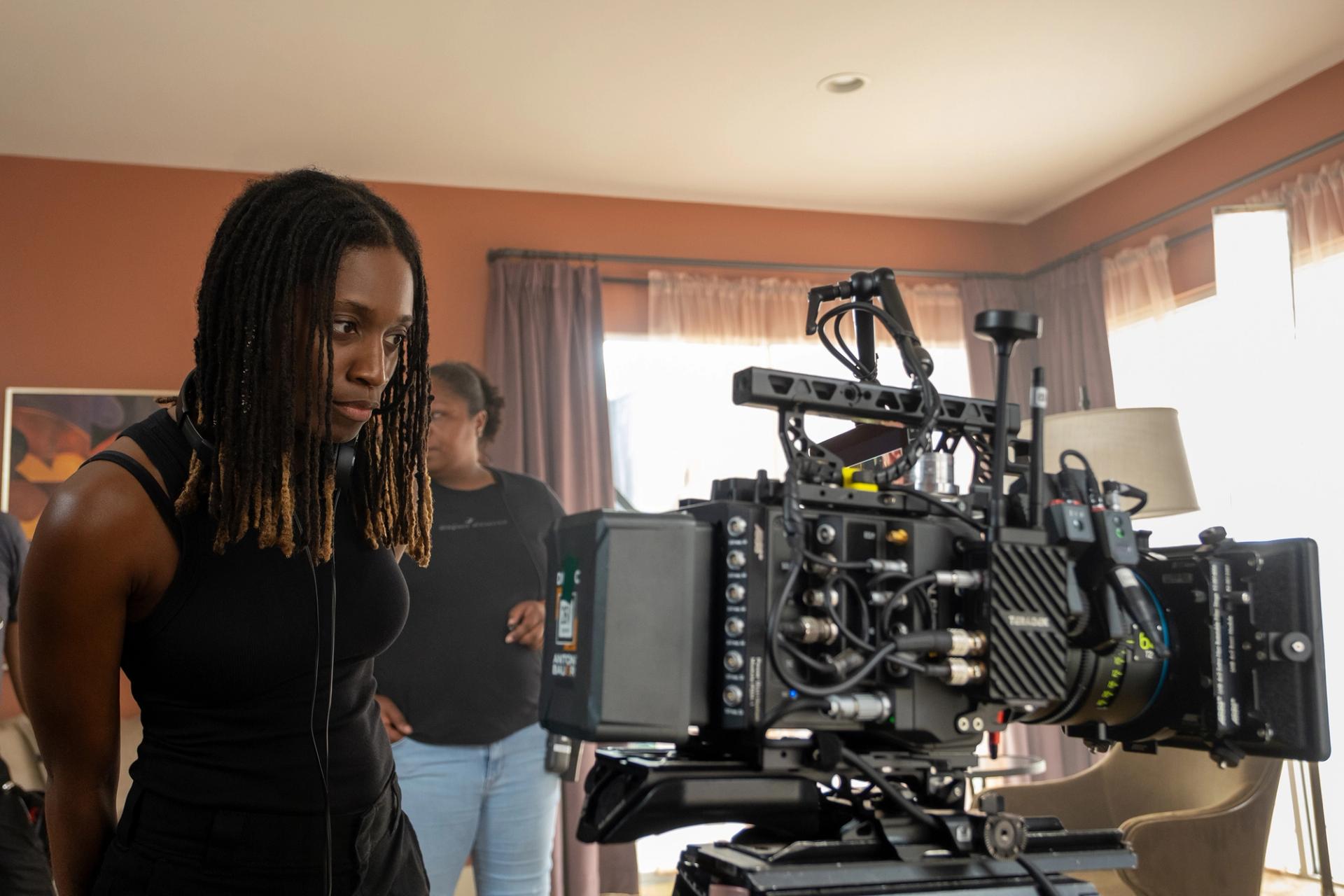
Director Aleshea Harris behind the scenes.
Credit: Courtesy of Aleshea Harris.When asked about her most euphoric day on set, Harris deadpanned: “Was I ever approaching euphoria…?” But she then quickly chose day one. “There was a certain spirit because this thing lived in abstraction,” she recalled. “Calling cut, telling the actors where to move, solving problems…to actually see that I was doing it, that we were making progress, that images were going to the studio and they were happy with them—that felt really good.”
In September, just before the film became available to stream on Amazon Prime, Harris walked me through five scenes from Is God Is that shaped her as a first-time director and tapped into essential elements of filmmaking: finding the visual aesthetic, manipulating the viewer’s perspective, and nailing the climactic fight scenes. If you haven’t yet seen the film, consider this a stern warning that there are spoilers ahead.
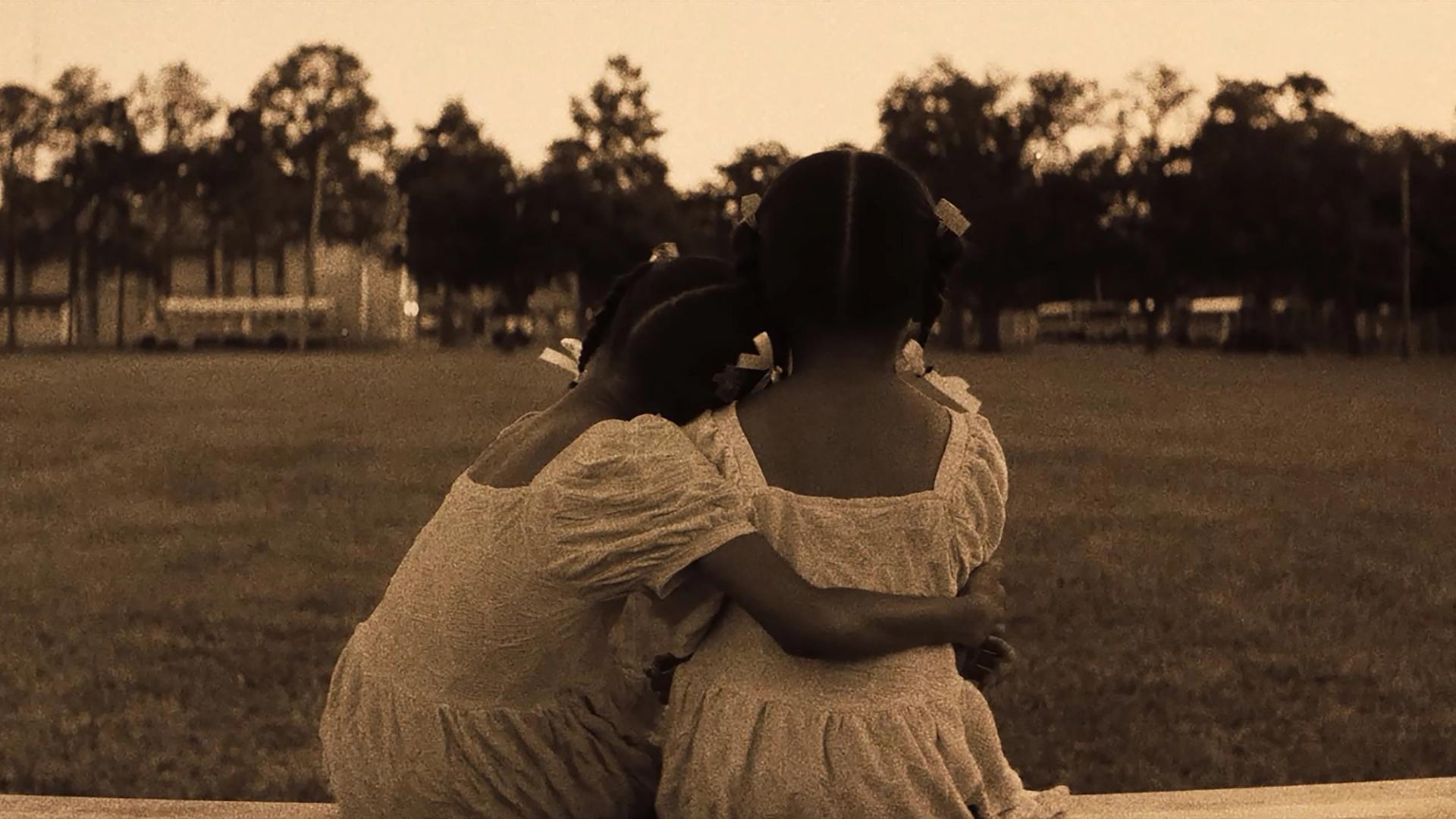
Nuri and Navali Barnes in an early childhood flashback shot.
Meeting the Twins
Is God Is opens on a simple image: a wide shot of the twins facing away from the camera while sitting on a bench, watching a group of children play just out of frame. When a boy calls Anaia “ugly,” Racine gets up, grabs a bat from the ground, and walks out of the shot. As the camera slowly zooms on Anaia, we hear the blunt thuds of her sister beating the boy. Racine walks back into frame and places her bloodied hand on her sister’s shoulder.
While the play opens with one twin icing down the other’s skin as they deliver artful exposition, Harris knew she wanted to start the film with a flashback using child actors (something too logistically complicated to pull off nightly onstage). She also knew all the flashbacks should be rendered in sepia, like a Western. “I wanted to do something to visually distinguish for our audience that we were moving back in time,” she explained. She gave her cinematographer, Alexander Dynan, a robust mood board. On it were images from One Big Self, a 2007 book of poems by C.D. Wright that features stylized, daguerreotype-like portraits of incarcerated people across Louisiana by the photographer Deborah Luster. Harris found the reference fitting because the film itself is one “effed up family portrait,” she said.
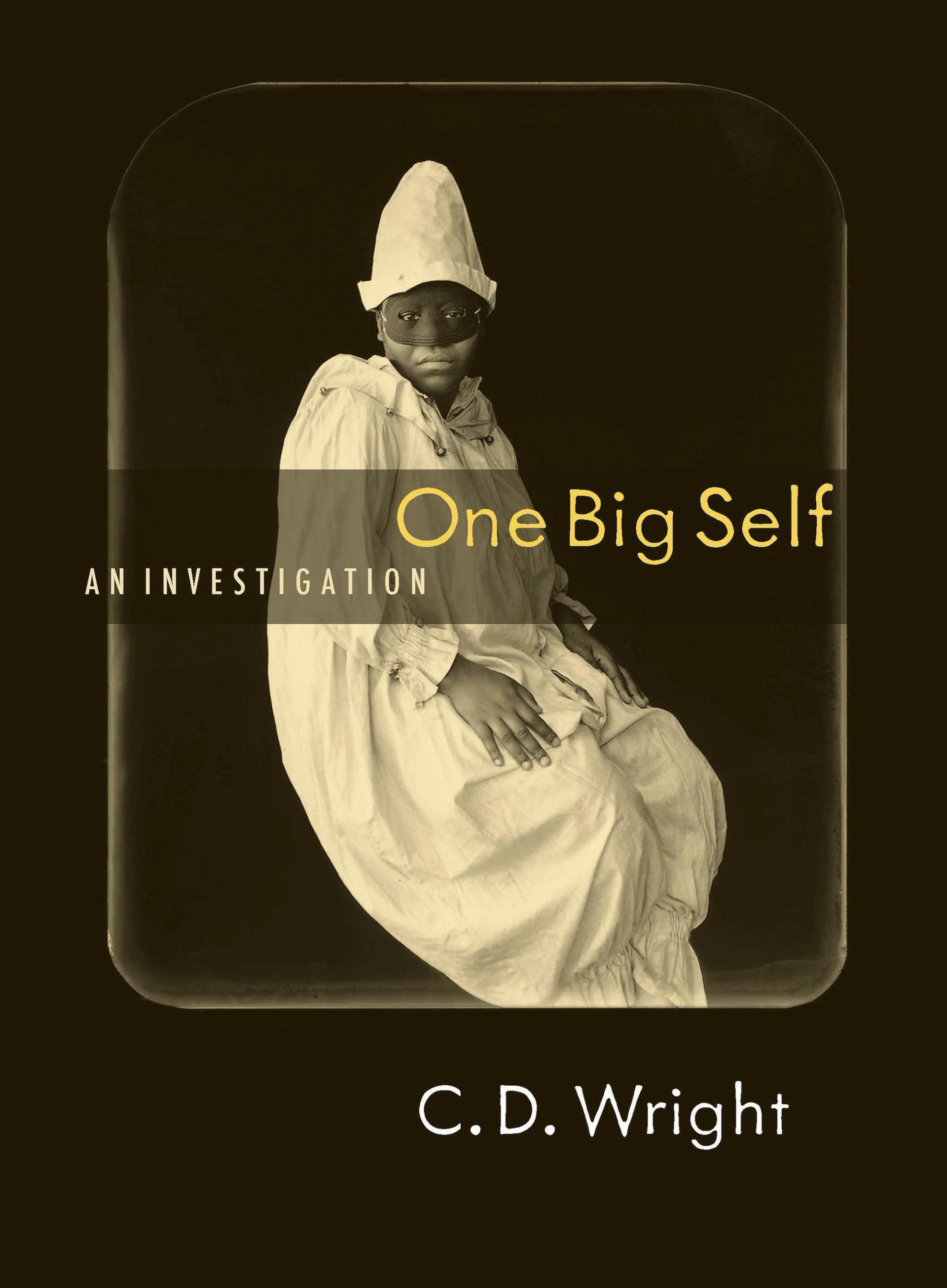
Cover of One Big Self (2007) by C.D. Wright, featuring photography by Deborah Luster.
Even in movie form, the introduction has all the trappings of a difficult scene: child actors, strict blocking, action that has to happen in one perfect take. The young actress playing Racine had to “banana” her walk, curving so the camera could catch all of her movement. Then she had to come back and make sure to sufficiently smear fake blood on Anaia. “There are so many takes of this poor child trying to make sure there was blood on her shoulder,” Harris recalled, noting that they ultimately added the red handprint in post. “I had an idea in my head. Then you get on set and you have to adjust,” she added.
Harris was also surprised to learn that, due to union rules, she wasn’t allowed to give notes directly to the child extras; she relied on her first assistant director, Desiree Stevenson, to communicate with them instead. “The mechanics of some of these things I really should have given more thought to, and wasn’t prepared for,” Harris reflected. “They will not get me next time!”
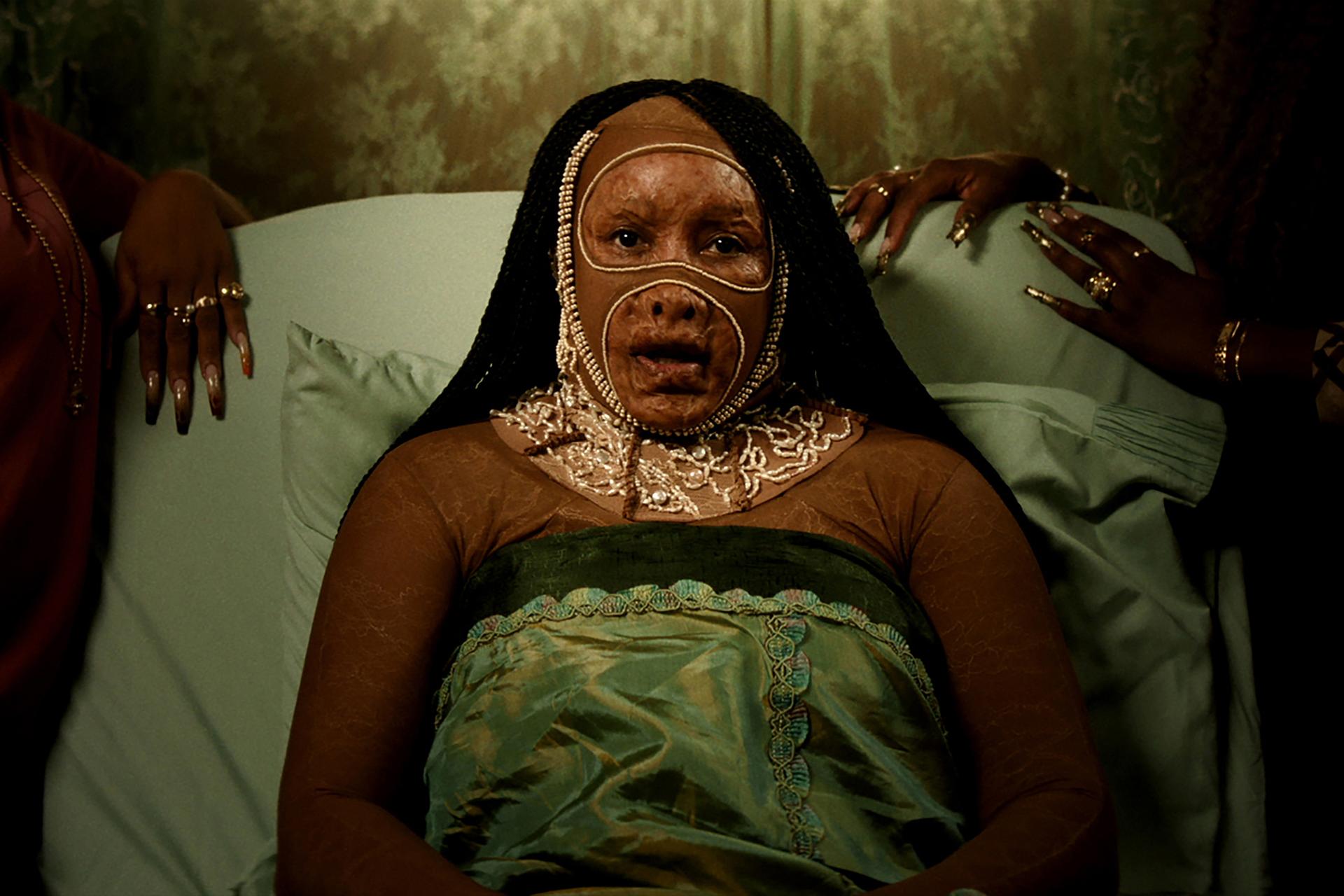
Vivica A. Fox in Is God Is (2026).
God’s Majesty
About 10 minutes into the film, the twins see their mother (Vivica A. Fox), who remarkably survived her attack, for the first time since they were children. They find her hidden away in Tennessee, on her deathbed, wearing an exquisite mask over her severely burned face. (Fox’s call time for makeup was 2:30 am.) But it’s not just a simple reunion. She has summoned her girls for a vengeful request: “Make your daddy dead.”
Throughout the film, the twins refer to their mother as “God,” reasoning that “she made us, didn’t she?” Harris wanted Fox to embody this mythical aura onscreen, recalling that she knew the setting “needed to be grand” and that she told Young to play the scene with “tremendous reverence.” To fulfill her majestic vision, she worked with production designer Freyja Bardell, who drenched the set in Southern gothic–style green wallpaper and bedding. Harris placed God at the center, sumptuous curtains dramatically drawn back to frame her on either side.
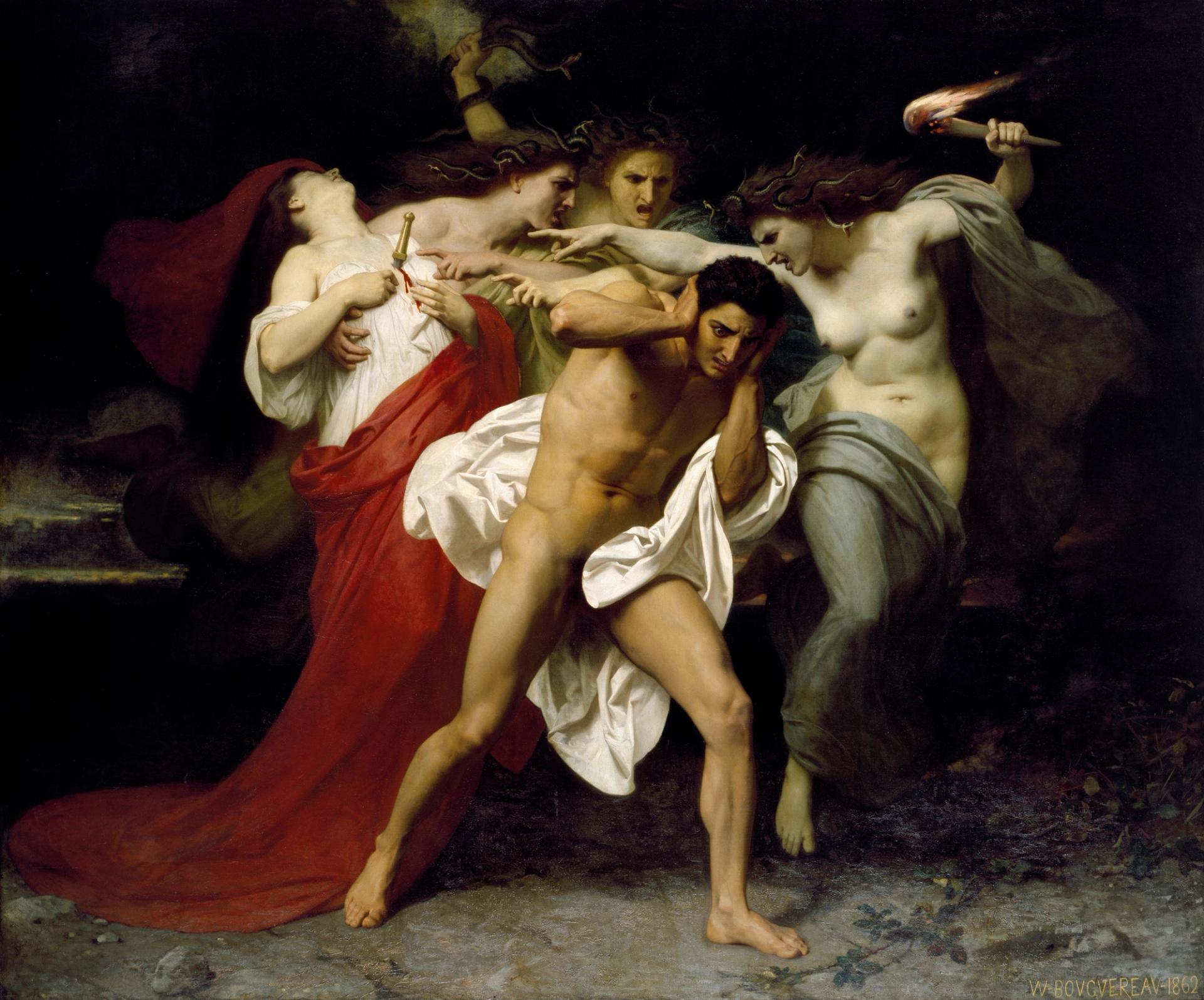
William-Adolphe Bouguereau, Orestes Pursued by the Furies (1852) .
Harris decided that God should be dolled up in spite of her pain, with a trio of women braiding her hair. “Even though her body is damaged, she is reaching for beauty,” she said of the meticulous aesthetic. The three braiders are a nod to both the rituals of Black women and the Eumenides, the trio of goddesses of vengeance in Greek mythology (also known as the Furies, their Roman counterparts). A self-described “composition nut,” Harris wanted God perpetually flanked by three goddesses, adding a tinge of grounded surrealism. “The term that I use is ‘three clicks to the left of center,’” she said. “How can we have one foot in things that are quite familiar and then a foot in something else?”
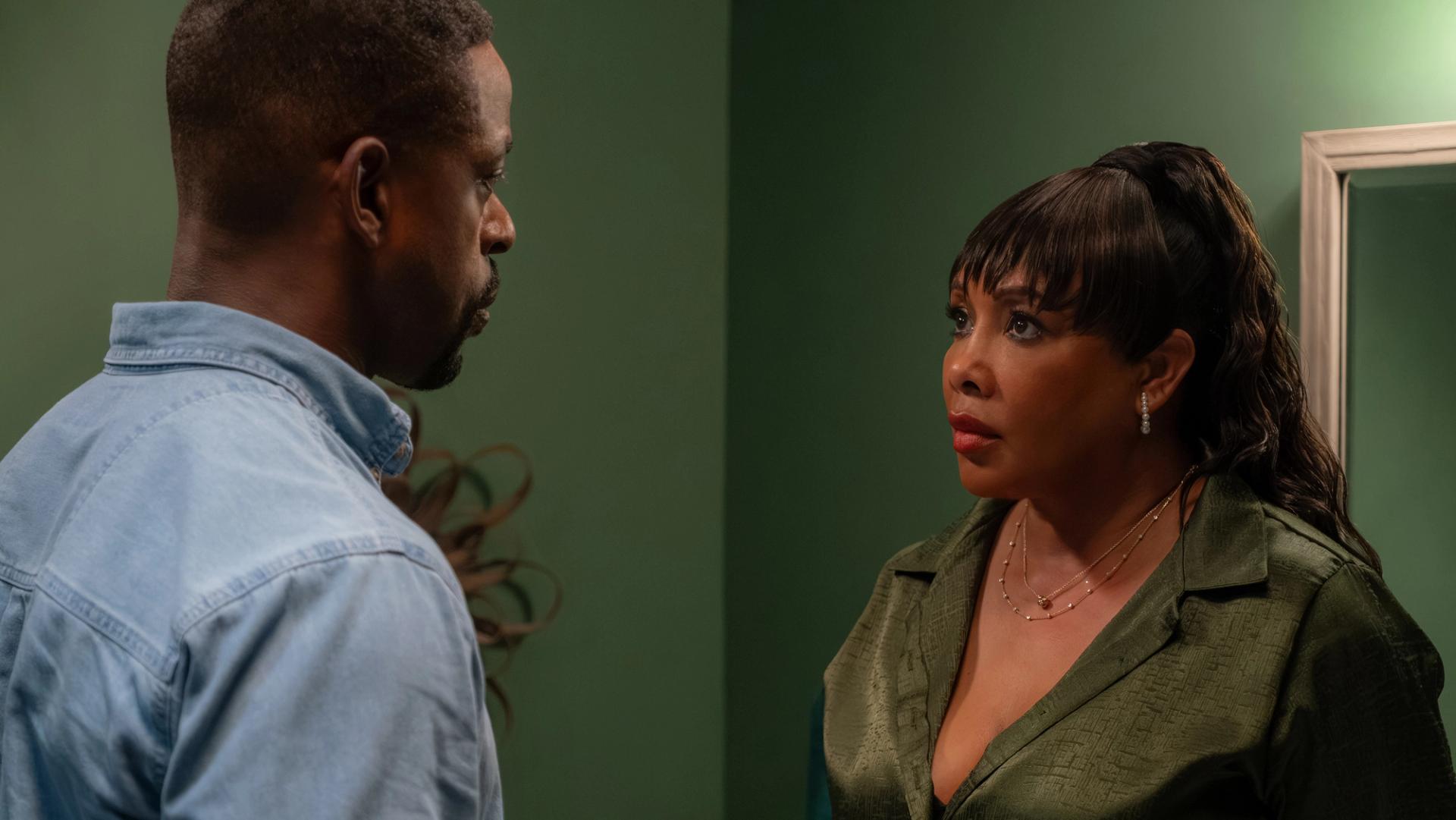
Sterling K. Brown and Vivica A. Fox.
Man Sets God Aflame
Throughout the film, Harris exploits her ability to play with the viewer’s perspective, keeping certain elements censored while dramatically calling attention to others. That control is especially clear during the flashback that reveals how the twins’ father (played by Sterling K. Brown and referred to in the screenplay simply as “Man”) set their mother on fire. In the scene, he chokes her until she loses consciousness, dumps her in a bathtub, and lights her on fire, leaving his daughters behind to burn up, too.
But the assault doesn’t simply happen to God. Instead, in a style more typical of theater, Harris had Fox break the fourth wall and narrate the action directly to camera. “I just thought that it would be fascinating to have this woman inside and outside of the experience at the same time,” Harris said. “To have this woman be able to look down the barrel and tell us when [her husband is] kissing her neck…the complexity of the sensual-slash-violent nature of their relationship.”
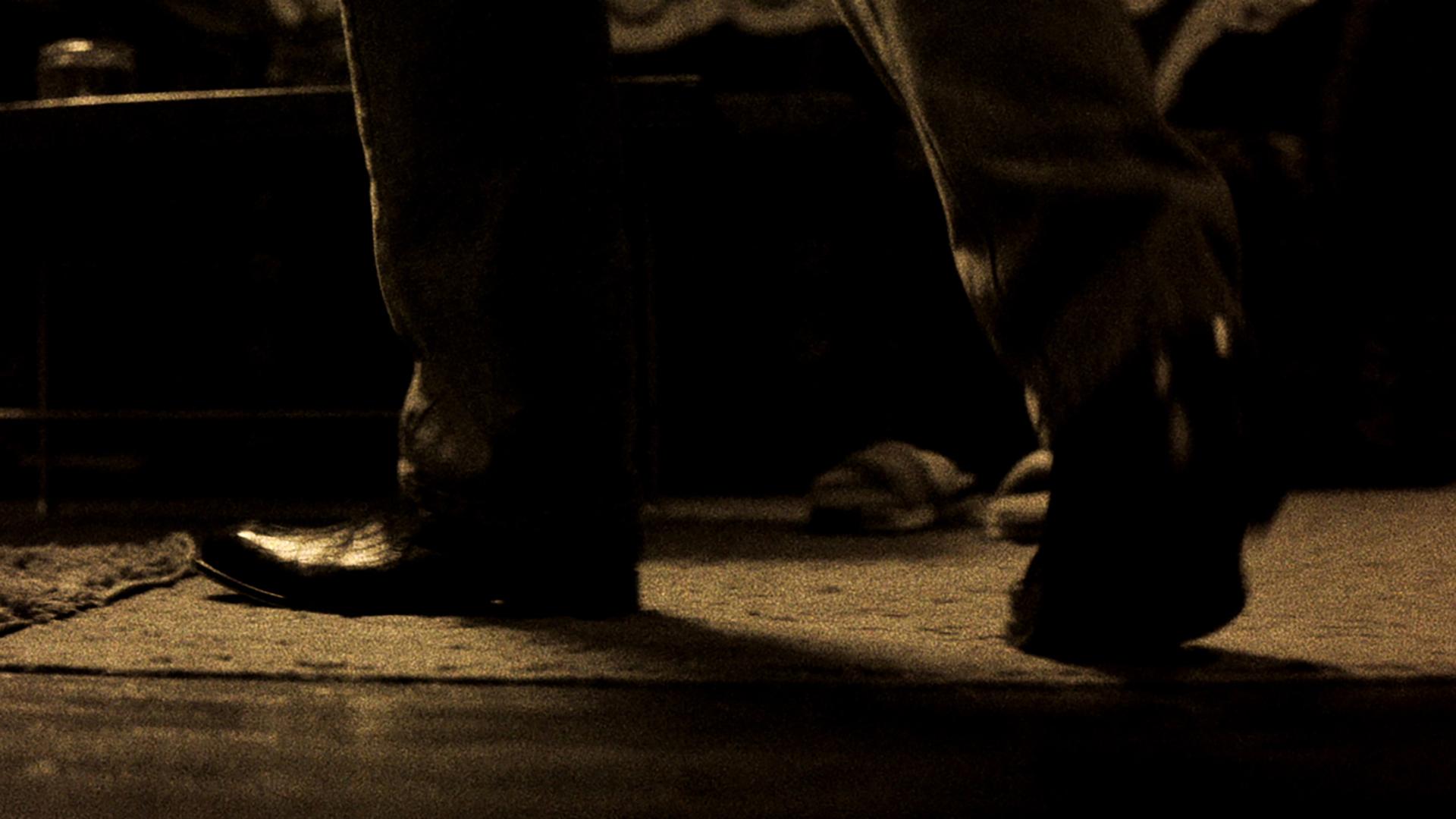
A tracking shot of Man’s feet following his attack on God.
Keeping the focus on Fox also takes the shine away from Brown, who appears throughout the film, but whose face isn’t revealed until the protagonists finally meet him. Until then, Harris chose to only show him in bits and pieces—from the back, or as just a hand or limb—grounding the viewer in the twins’ perspective. In lieu of sharing his expression after the attack, Harris had Dynan follow Brown’s feet in a long tracking shot to “feel the callousness” of his action.
That restraint also extended to the attack itself. Instead of showing the burning in its full gruesomeness, Harris worked with editor Jay Rabinowitz—“a true artist,” in her words—to incorporate blackouts throughout the scene that weren’t in the original script. “I struggle with certain scenes of violence against marginalized people. I’m not watching that,” Harris declared. “So I wanted to be very careful about depicting it. You don’t have to show everything. It’s like looking into the sun. People have imaginations. Trust them and be clever.”
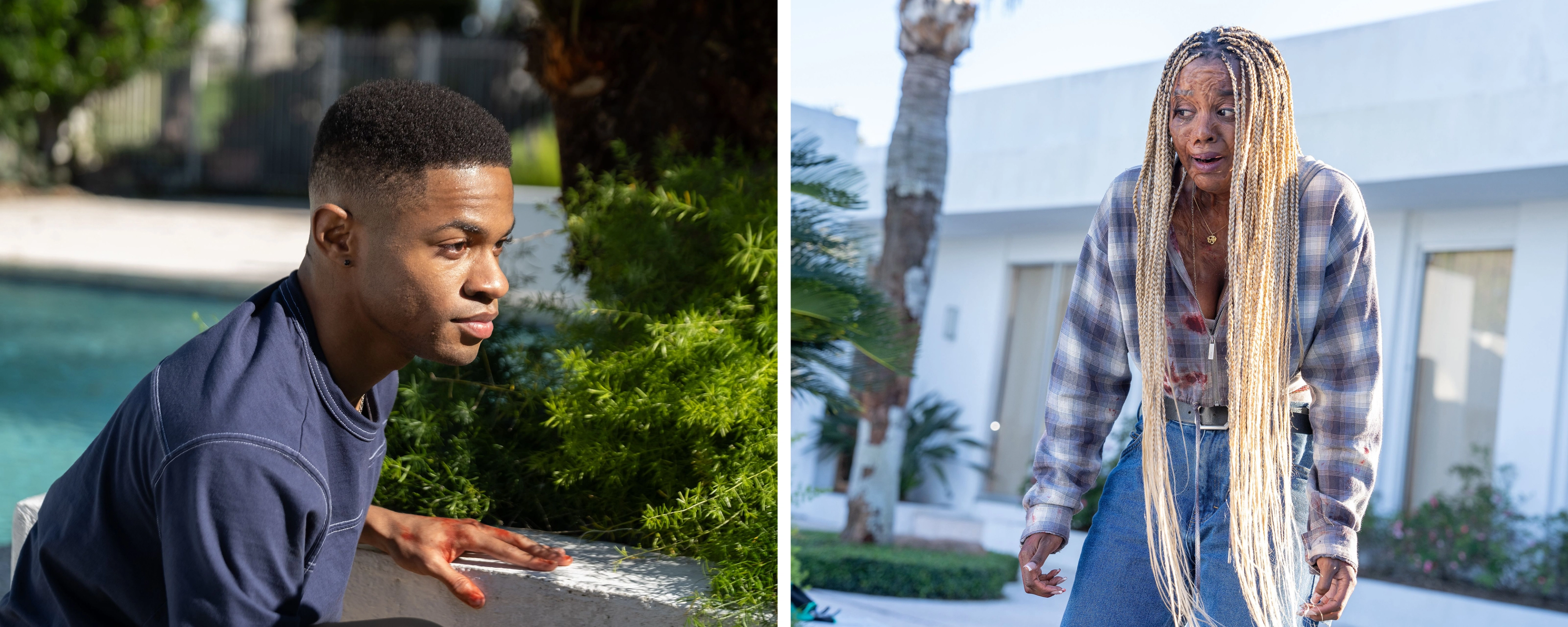
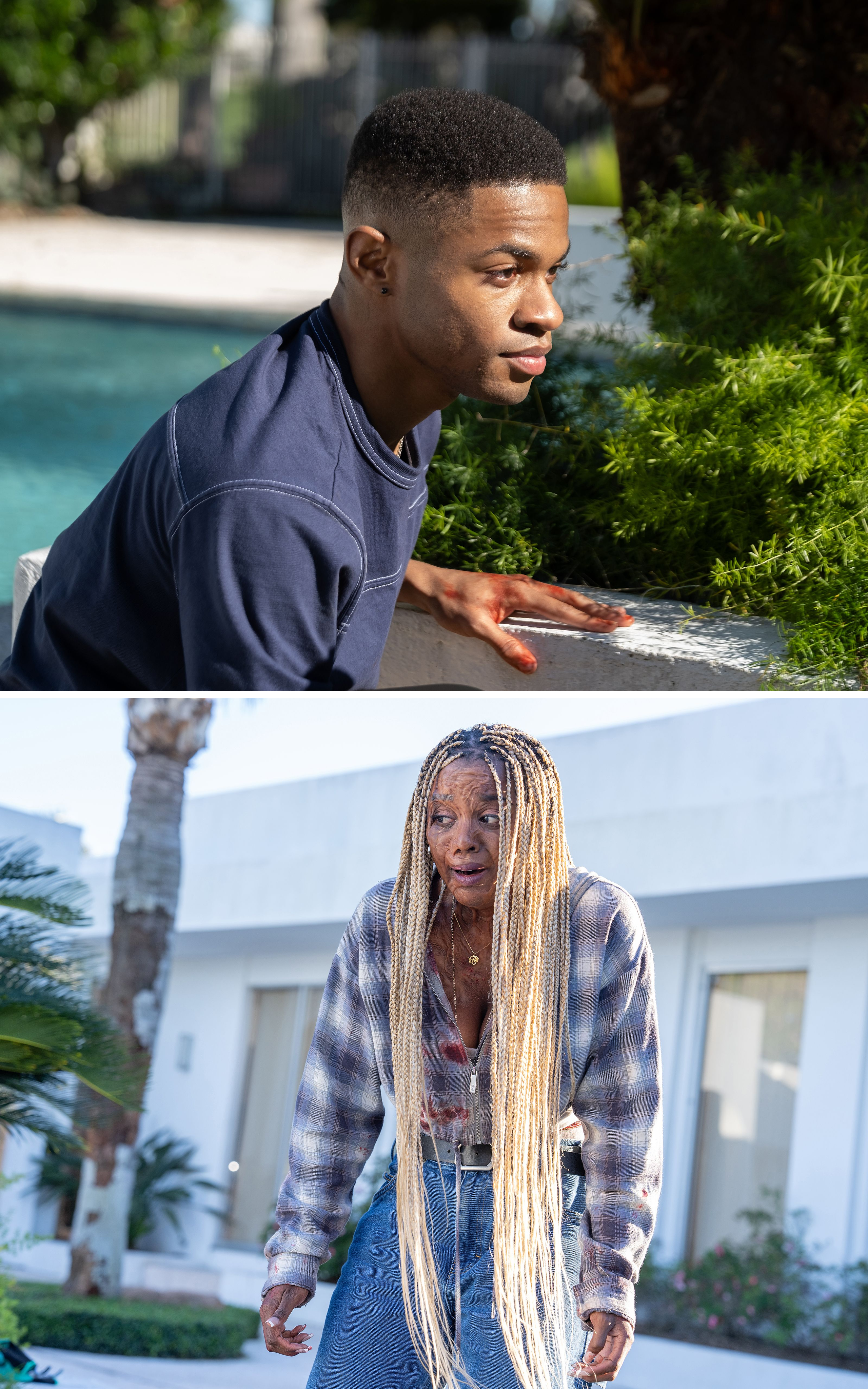
Justen Ross and Mallori Johnson on set.
Killing Thy Brother
Near the end of the film, the violence that simmers through the first half begins to break the surface. After a winding road trip, the twins track down their father at the mansion he shares with his wife, Angie (Janelle Monáe), and two sons. Racine snaps, first killing Angie, then one of the brothers. Then it’s the twins versus the remaining brother, Riley (Justen Ross), in an elaborate fight Harris shot wide to capture all of the action. She liked the juxtaposition of it: “It’s a beautiful day and there was this tremendous violence taking place.”
There was also a second, more meta fight happening: the camera versus the sun. On every set, no matter the scale, losing daylight is a common occurrence. Everything is planned around the sun, something Harris never had to deal with in the dark confines of a theater. While filming this scene, the crew raced to capture the final and (of course) trickiest moment: when Anaia stabs Riley and he falls backward into the pool. His blood instantly turns the water red—“a blooming violence,” as Harris put it.
Because of how long it would take to clear the pool of blood, they only had one shot. Instead of spiraling about the closing window of time, Harris focused on motivating Ross, reminding him of all the little beats he needed to hit. He wasn’t just falling into the pool—he was slowly walking backwards with prosthetic garden shears in his back, holding a hand out to the girls in a melodramatic flourish. “He was so locked in,” Harris said of his performance. “That was one take, and it was perfect. He nailed it.”
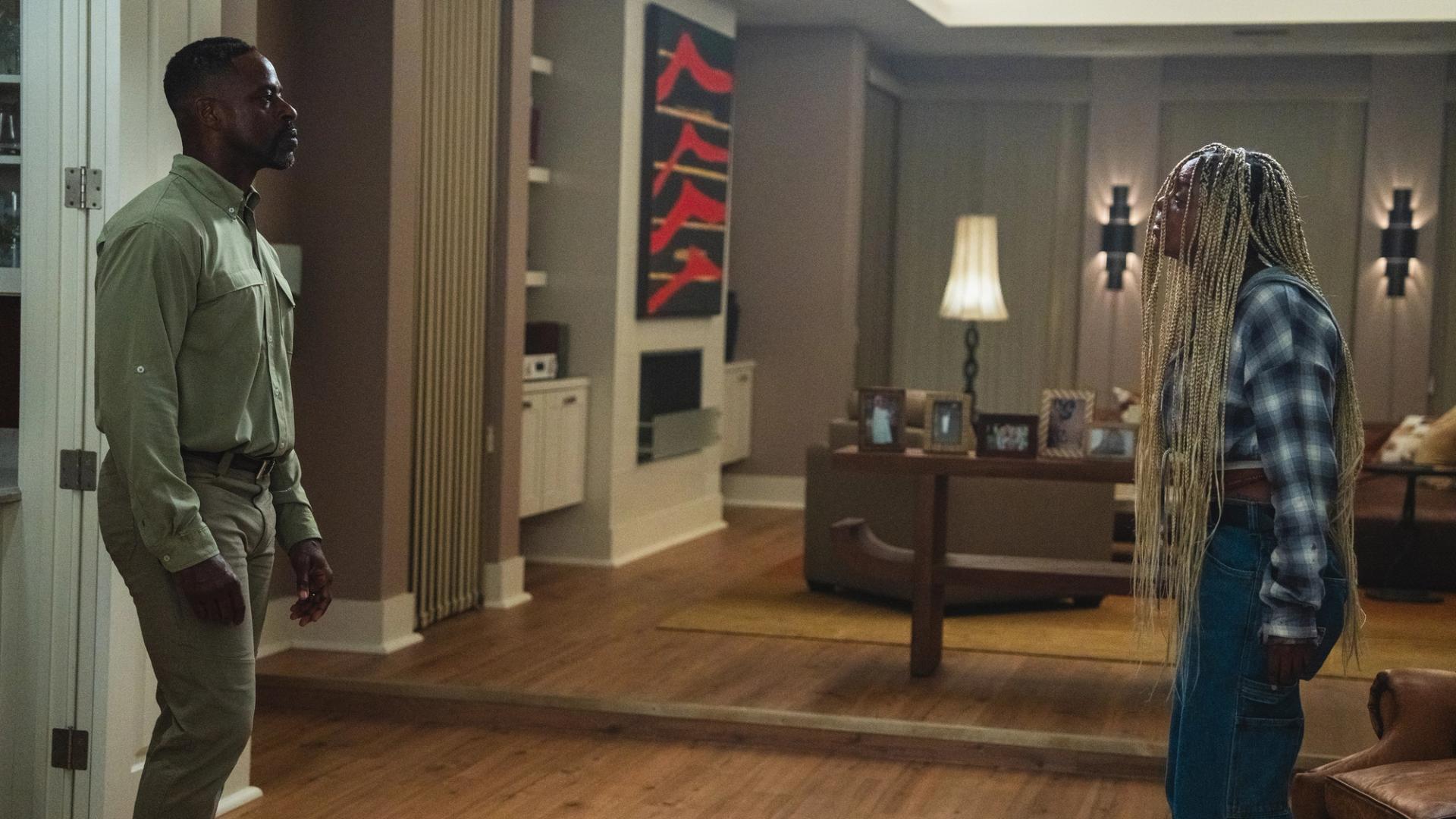
Sterling K. Brown and Mallori Johnson.
Making Daddy Dead
Harris knew she wanted Is God Is to be structured like a spaghetti Western, with a long lead-up to a final showdown. In the film, the climax takes the form of a deadly confrontation between the twins and their father featuring meticulous stunt blocking. (The stunt team for the film overall was composed of 13 doubles and choreographers.) Here, Harris finally opted to show all the brutality as the twins stomp and punch their father to near-death. “I told the fight choreographers that I wanted a moment of tremendous blood, and that’s what we get at the end,” she said.
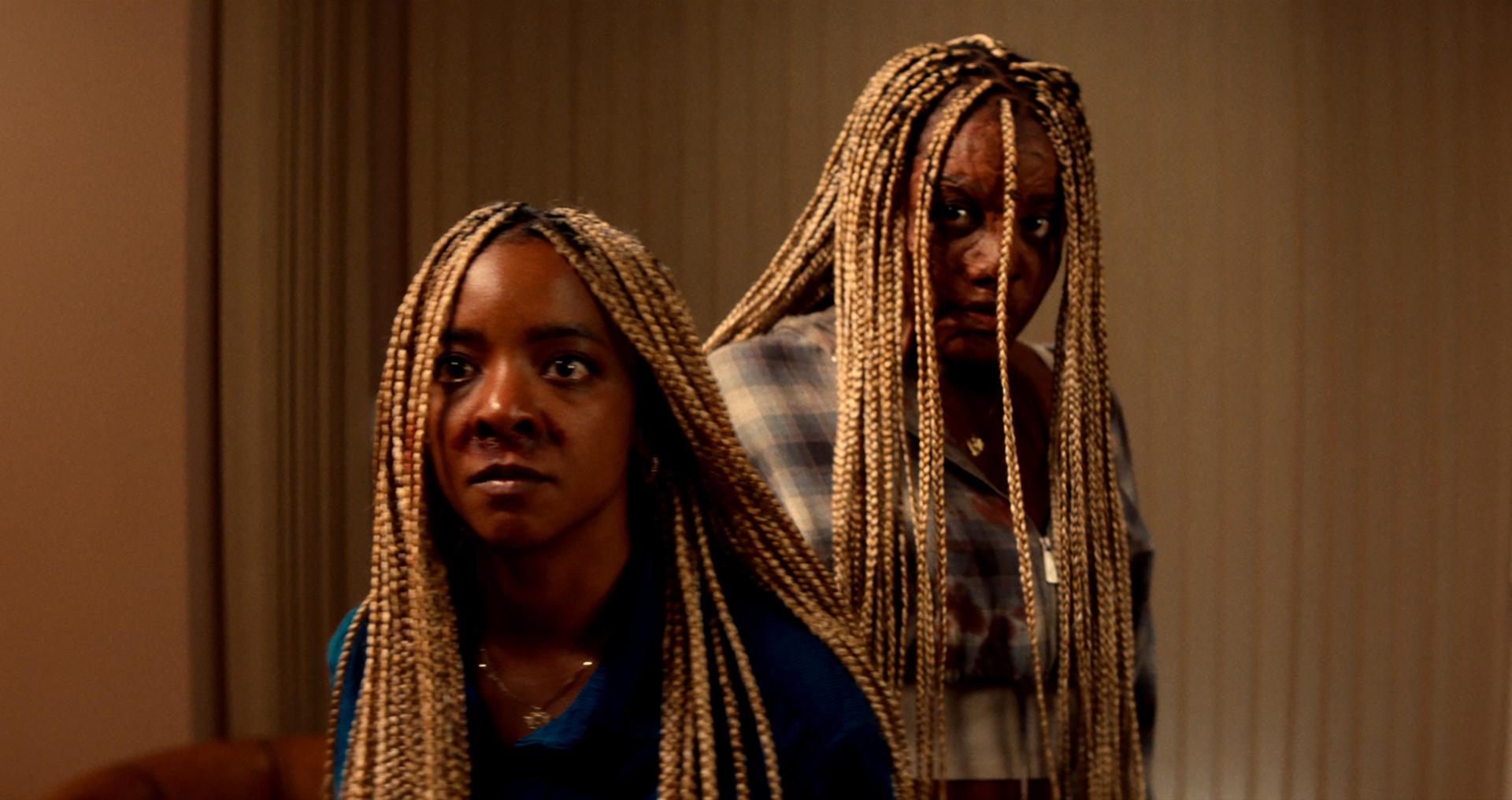
Mallori Johnson and Kara Young.
This scene is also where we see the father’s face for the first time. Harris held back both his face and the violence for most of the film so that this climax would land. At the opening of the film, the assault happens off-screen. During God’s attack, we see it in flashes. Here, the savagery is on full display. “It blooms as the story goes on for people to engage other senses, not just sight,” said Harris. By the time we get to the end of the story, violence is laced into every frame.
“Everybody knows what’s coming,” Harris said of the explosive reversal of familial violence. Yet the viewer hangs on to every satisfying detail of the revenge. “If you put these two women in front of Sterling K. Brown, who’s like a brick, how are they going to take him down? The magic of cinema.”
Is God Is (2026) images courtesy of Amazon.