Melissa Cody Breaks the Pattern on Purpose
The Navajo weaver works without sketches, using her grandmother’s fork and a palette of 140 colors to thread graphic disruptions throughout centuries-old motifs.
November 18, 2026
Amid their otherwise orderly compositions, some Navajo weavings feature an errant line that strays from the central pattern to the textile’s edge, as if trying to break free. Often so thin it’s barely perceptible, the runaway streak may look, to some, like a mistake. But the spirit line, or ch'ihónít'i, as it’s called in the Diné language, is very much intentional. It’s a response to the belief that, in producing a textile, a weaver’s spirit might become entangled in the cloth; the aberration serves as an exit. Think of it as a purposeful metaphysical glitch.
Contemporary Navajo weaver Melissa Cody doesn’t employ spirit lines in her work. But as an artist whose practice is as informed by tradition as it is by digital life, she is intrigued by the idea of the glitch. On a warm Southern California morning in September, she welcomed me into her Long Beach studio, an old downtown storefront cluttered with baskets of bright wool. At each end of the room sat a large, free-standing loom, one paired with a low bench draped in sheep skins. There, a new piece was beginning to take shape, a diamond pattern composed of orange hourglass forms against a deep purple background. From afar, these appeared perfectly uniform, but, up close, they revealed a disruption of sorts: subtle variations in tone.
Such irregularities appear in Cody’s work through both careful planning and spontaneous improvisation. In keeping with Navajo tradition, she doesn’t sketch out her designs in advance, instead holding them only in her mind. “When I’m first sitting down at the loom, I’ll have an idea of where I want the bolder and heavier concepts to land,” she said, “but that can all change as I’m weaving.”
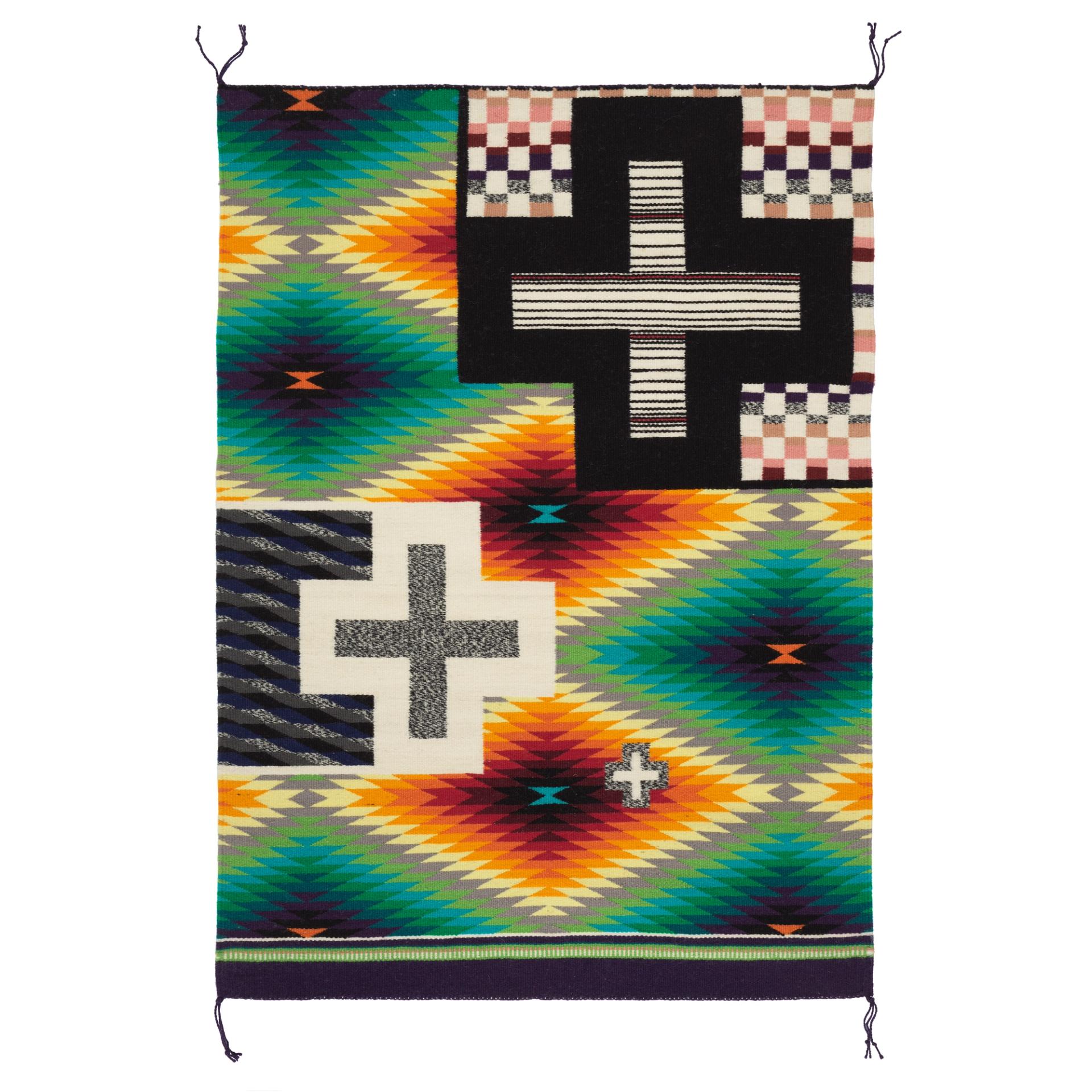
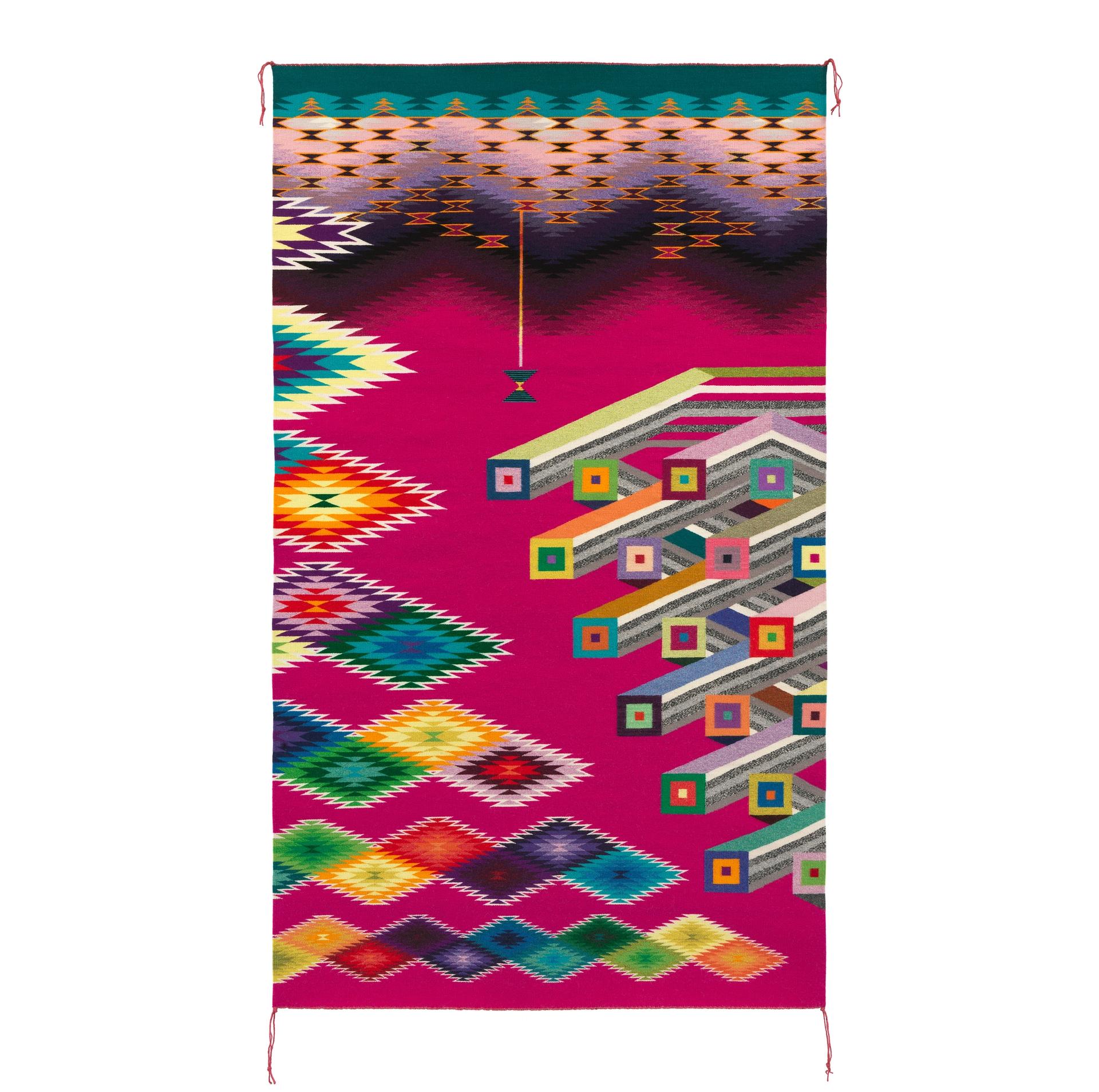
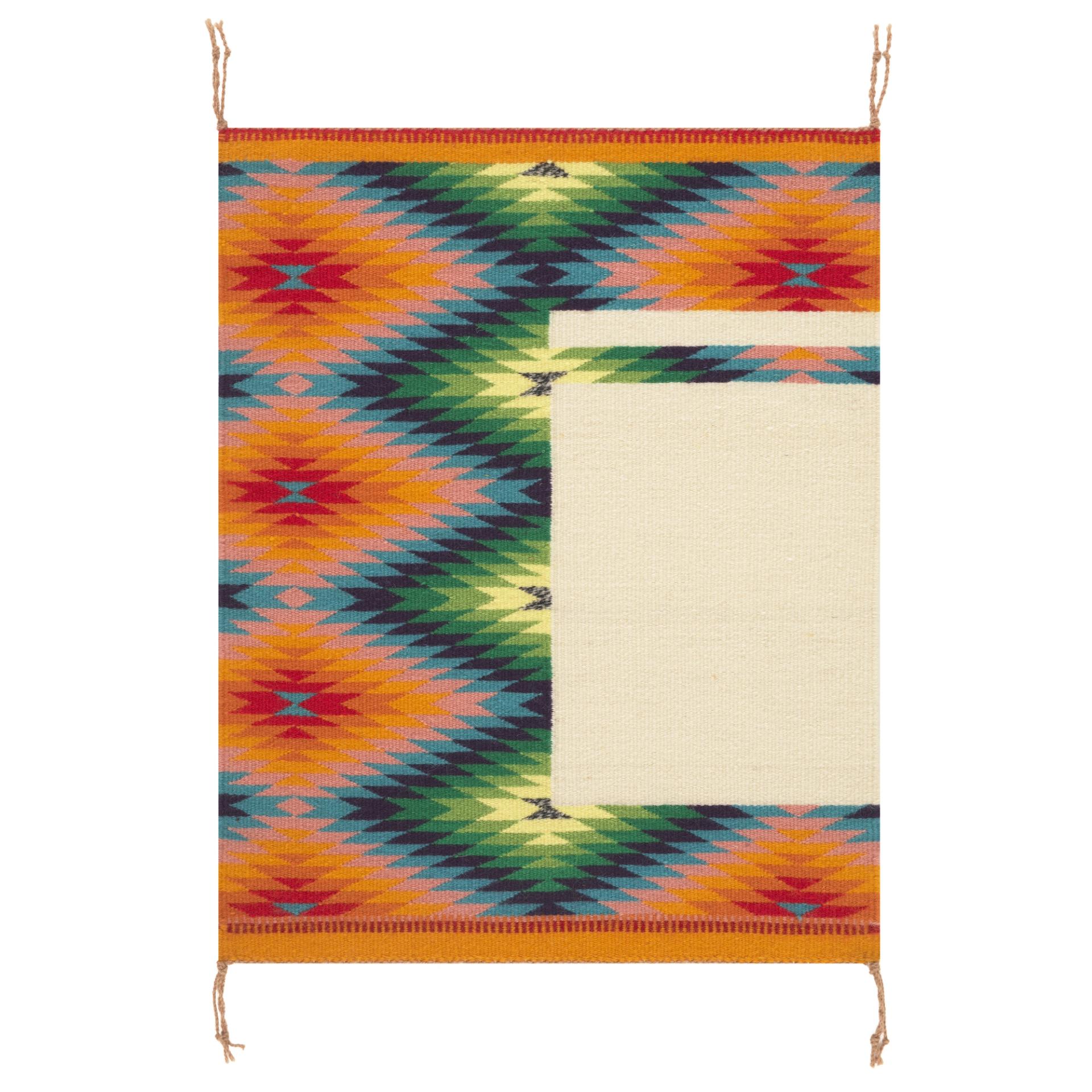
Melissa Cody, Germantown Sampler (2009); Into the Depths, She Rappels (2023); and White Out (2012). Courtesy of Garth Greenan Gallery.
Sometimes she adjusts her palette for technical reasons; if a particular skein of yarn is too thin, say, she’ll swap one color for another. Other times, she introduces an unexpected design element simply to avoid the boredom of continually repeating the same pattern. Most frequently, the variations she inserts into her textiles are planned from the start: The shifting tones of the orange hourglasses will ultimately create an uneven rippling effect.
Born in 1983 in No Water Mesa, on the western edge of the Navajo Nation in Arizona, Cody and her siblings grew up playing video games (opens in new window) to escape the monotony of their time spent on the reservation. Today, she incorporates that pixelated aesthetic into her textiles alongside generations-old Navajo motifs, pulling shapes and palettes from vintage computer graphics and early video games such as Pac-Man and the original Super Mario Kart.
Her 2023 piece Into the Depths, She Rappels, for instance, features a small hourglass figure descending into a canyon of neon pink. The form is framed on one side by repeating eye dazzlers (a traditional Navajo motif resembling a serrated diamond); on the other, unusual tube-like shapes entangle one another, evoking the iconic ’90s Windows “3D Pipes” screensaver (opens in new window). Its colors are a callback to the screaming electric hues of 1980s and ’90s Atari and Nintendo: acid green, sherbet orange, sparkling lemon yellow. (When she began weaving, Cody used about 19 colors; she now uses about 140.)


Cody’s spider rings, designed by the Chiricahua Apache silversmith Neil Zarama, a nod to Na’ashjéii Asdzáá, the Spider Woman, who taught Navajo women how to weave; Cody’s weaving fork and skeins of yarn.
For Cody, these synthetic tones also echo a painful history. After the US military drove the Navajo from their homelands in the 1860s, killing their sheep and imprisoning thousands at Bosque Redondo in present-day New Mexico, weavers made do with whatever they could get. They unraveled government blankets and employed the bright, synthetically dyed yarns that arrived from the mills of Germantown, Pennsylvania—using it all to vivid effect. Cody’s palette is, in part, a tribute to that creative rebellion: “It’s about reinvigorating the cultural knowledge we need to retain.”
In the two decades since graduating from the Institute of American Indian Arts in Santa Fe, Cody has won a string of juried awards at prominent markets for Native art and craft in Arizona, California, and New Mexico. In 2024, she was the subject of a major solo show at MoMA PS1 (opens in new window) in New York (a presentation that originated at the Museu de Arte de São Paulo (opens in new window) in Brazil). Her work has delivered a jolt to the overlapping worlds of Navajo weaving and contemporary art by redefining what an “authentic” Navajo weaving can be and defying the art world’s tendency to frame the work of Native artists as some sort of anthropological enterprise. “Whether it’s in the gallery world or the Indian market or the fine art world, I want us as Navajo people to tell our own stories,” Cody explained. “I want us to have faces and names, not be seen as ethnographical or seen next to dinosaurs and cavemen at the natural history museum.”
Cody began weaving at the age of five under the easygoing tutelage of her mother, Lola Cody (opens in new window), joining a long line of distinguished weavers. Her mother and late grandmother Martha Gorman Schultz (opens in new window) were known for working with traditional patterns such as Two Grey Hills, a style of intricate, bordered diamond designs in undyed natural tones, which they made using wool from their flocks of Navajo-Churro sheep. Her aunt Marilou Schultz (opens in new window) has been weaving acclaimed pieces modeled on the layouts of computer chips since the 1990s. (In June, the Hessel Museum of Art in New York’s Hudson Valley presented Schultz’s first museum survey (opens in new window).)
Cody began experimenting with digitally inspired tones and patterns in the late aughts as a way to process her father’s Parkinson’s diagnosis—something she directly referenced with her 2010 weaving Dopamine Regression, in which bands of eye-dazzler patterns in vivid shades appear to interrupt one another, like a faulty synapse. But she has never stopped weaving in the traditional manner her mother taught her. Using an upright loom, she nimbly runs colored yarns over and under the vertical warps with her fingers, then pushes down the horizontal wefts using a worn wooden fork that once belonged to her grandmother. As she establishes a rhythm, this gesture becomes almost musical, generating an intermittent thumping sound. It’s a process that she has likened to being immersed in a digital world.
Cody sees gaming and weaving as part of a shared lineage of image-making technology. In a video interview (opens in new window) for her MoMA PS1 show, she compared the architecture of a textile to that of an 8- or 16-bit video game. “I map out x- and y-axes for vertical and horizontal lines for symmetry—all of these pixelated and geometric shapes, that idea of stacking and layering, sharp corners, sharp edges, 90-degree angles,” she said.
“The language of creation is similar,” added Ruba Katrib, chief curator at MoMA PS1, in an interview. “She is visually representing glitches or the fuzz of a screen or a pixel or these very new phenomena that do find their ancient origins in the medium that she’s working in.” Cody finds weaving akin to playing Tetris, a puzzle game that requires the constant arrangement of geometric shapes. “Every line has to be filled, every warp has to be paired with a color in order to finish that line,” she said. “A lot of the way that I view my weaving plane is how I played games on the screen.”
While Cody’s weavings have drawn attention for their unusual influences, her aims run deeper than making mashups. It’s the concept of the glitch that gives singular form to her work. In his 2015 essay “Thoughts on Glitch[Art] v.2.0,” (opens in new window) new media artist and theorist Nick Briz wrote that “a glitch isn’t an error in the sense that the computer has done something ‘by accident,’ the machine has done xactly [sic] what it’s supposed to do.” A glitch, he added, “is an unexpected moment in a system that calls attention to that system.” For Cody, a glitch is, likewise, “an interruption, it is a break” that draws attention to the expected norm.
In her 2012 textile White Out, an eye-dazzler pattern in shades of green and peach is obscured by two seemingly arbitrary white rectangles. It’s a wry comment on cultural erasure that also reads like a digital image failing to load. Cliff Dweller, from 2017, offers similar metaphor: a series of cascading parallelograms rendered in gold, brown, and rust evokes the desert landscapes of the Navajo Nation, but the asymmetrical pattern also suggests the flickering horizontal lines of a picture trying to break through on an old television, hinting at realities that remain unseen.
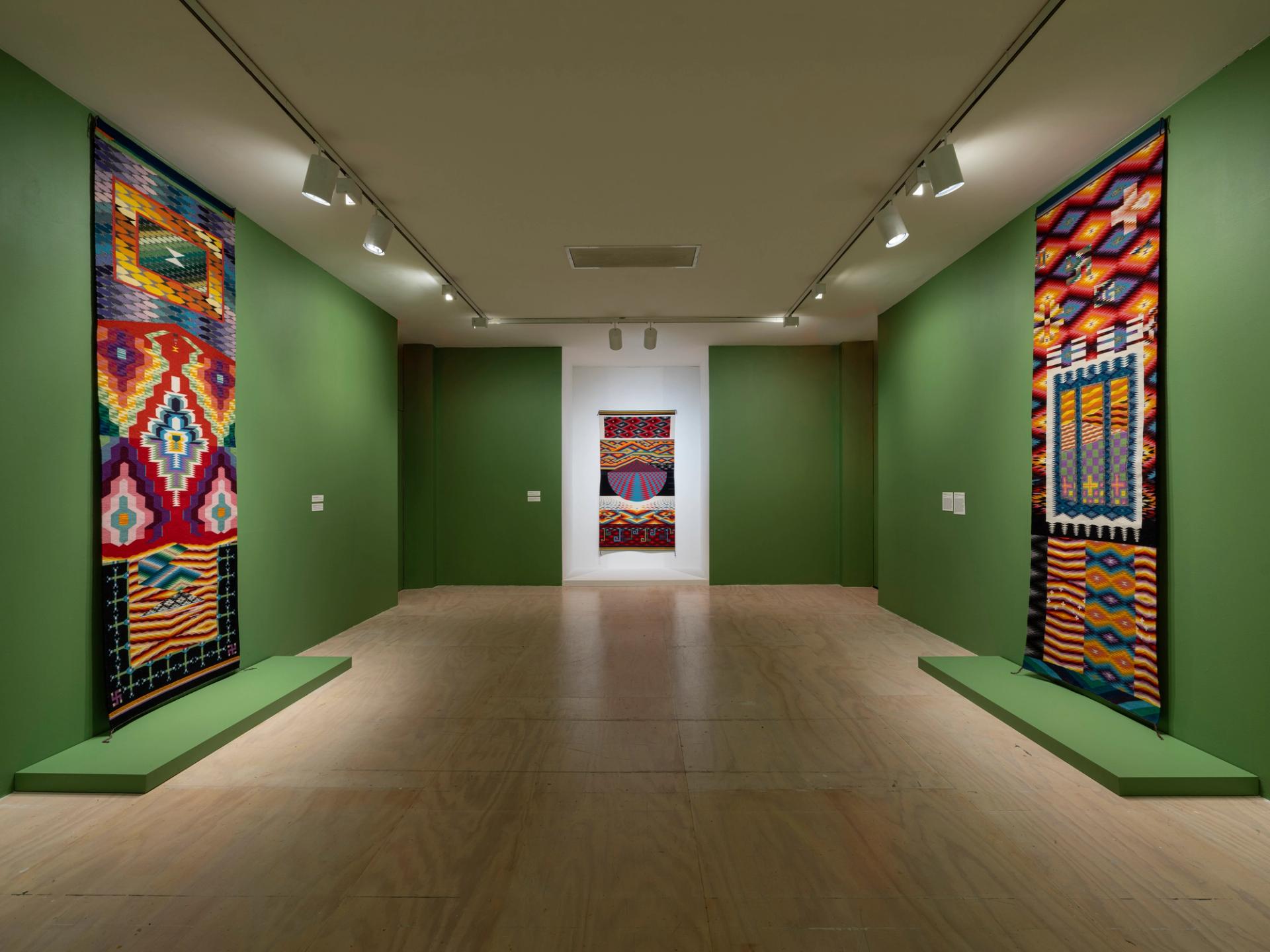
Installation view of “Melissa Cody: Webbed Skies,” at MoMA PS1, 2024.
Credit: Photograph by Kris Graves. Courtesy of MoMA PS1.“Everything I do is off-center,” said Cody. “The line of symmetry is staggered; it’s not where you expect it to be.” Part of her aim is to upend the path the eye is anticipating. “If all four quadrants of the textile are made perfectly and mirror imaged, everything seems right,” she explained. “It’s like, okay, this was made the way it was supposed to be, that’s how Navajo textiles are supposed to look.” By inserting irregularities into the pattern, she forces the gaze to stop and reorient. “I want it to be perplexing,” she added. “So there is a conversation between the viewer and the piece.”
As Katrib put it, the glitch is a “bridge” between the ancient and the new. Like the spirit line, it draws attention away from the surface pattern back toward the system. In this case, that’s the act of weaving itself. Cody’s glitches direct the viewer to her specific decisions: a brilliant color, an unusual shape, a startling layer of pattern—choices that can unsettle or tickle with humor. In glitches, “you are seeing this extra level of consciousness,” said Cody. “People think of a glitch, it’s unintentional, it’s an outlier. But in weaving, everything is intentional.”