Collected

Three New York Fashion Favorites

What we’re obsessed with in craft and culture. This week, three collections that caught our eye in and around New York Fashion Week.

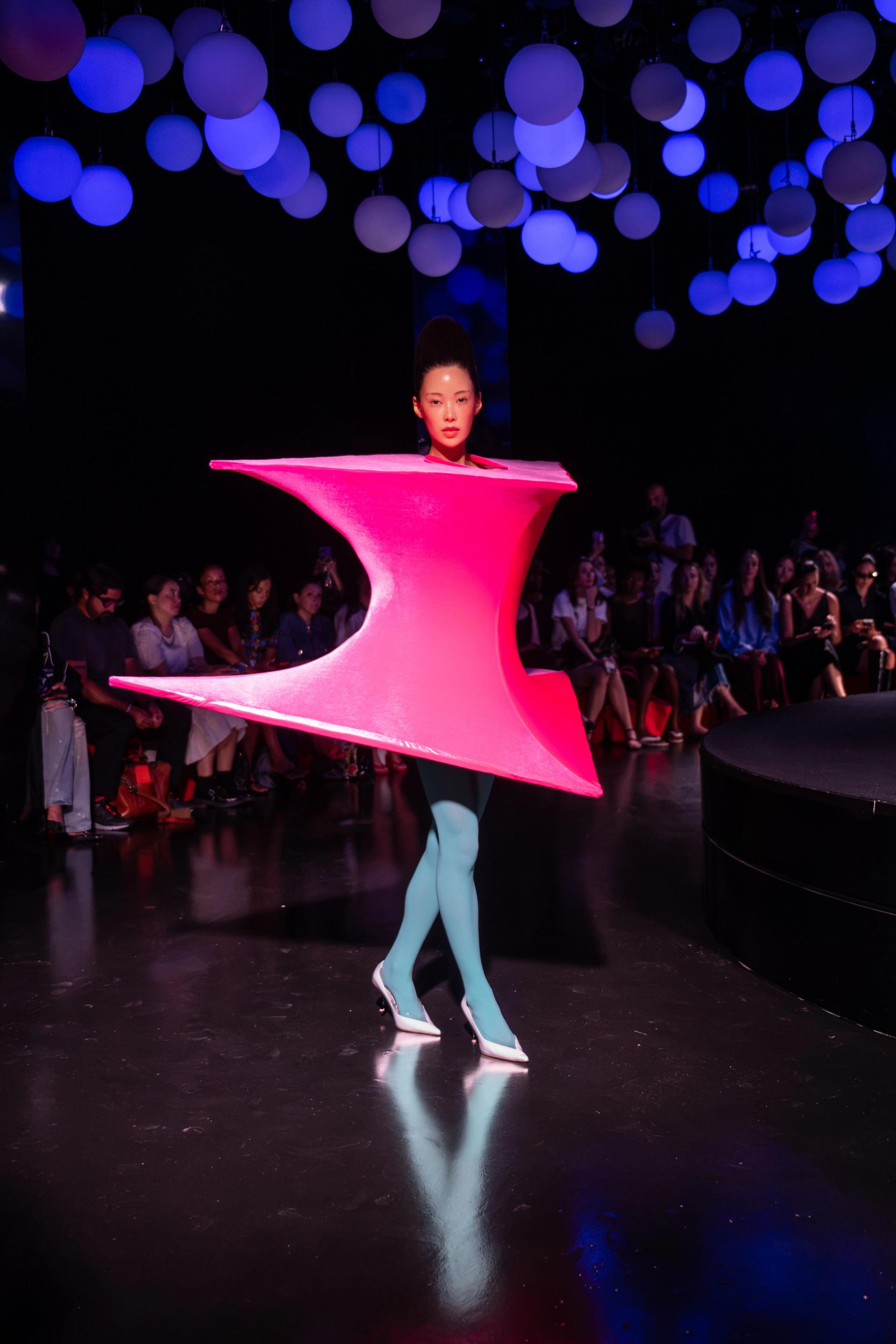
A model walks a darkened runway wearing a sculptural neon pink hourglass-shaped structured garment with teal tights and white heels, beneath a ceiling of glowing spheres
Credit: Photograph by Karla Tomanelli

Whimsy, calculated

You don’t name your line Bad Binch TongTong if you want people to discuss it with a straight face. A sense of play is integral to Terrence Zhou’s work—the Wuhan-born designer started his line in 2021 and has since developed a cult following for his whimsical, surreal pieces that range from an octopus dress (opens in new window) worn on the cover of Vanity Fair by Lizzo to a cascading floral headpiece (opens in new window) worn by Kim Kardashian.

His latest show took the whimsy even further. It was presented with the Balloon Museum, where attendees walked through a room filled with huge green balloons, an inflated maze, and an adult bounce house before sitting down for the runway show. The clothes are grandiose, brightly colored, and often indifferent to the conventional proportions of the human form: an armless orange hourglass styled with purple tights, a dome-shaped dress decorated with plate-sized sequins, and a feathery blue top hat worn as a tunic. They look like dream figures, playful mythological creatures, and decadent desserts brought to life.

As vibrant and uninhibited as the designs are, they are also rooted in precision. Zhou studied math and engineering before transferring to Parsons School of Design, and when he was starting his brand, he got into modernism—specifically the idea, as he put it (opens in new window), that “decoration is excess, clarity is power”—which has informed his signature use of solid color and avant-garde shapes. That tension between the grandiosity of the designs and the meticulously considered geometry underneath is what makes this line so very compelling.—Vrinda Jagota
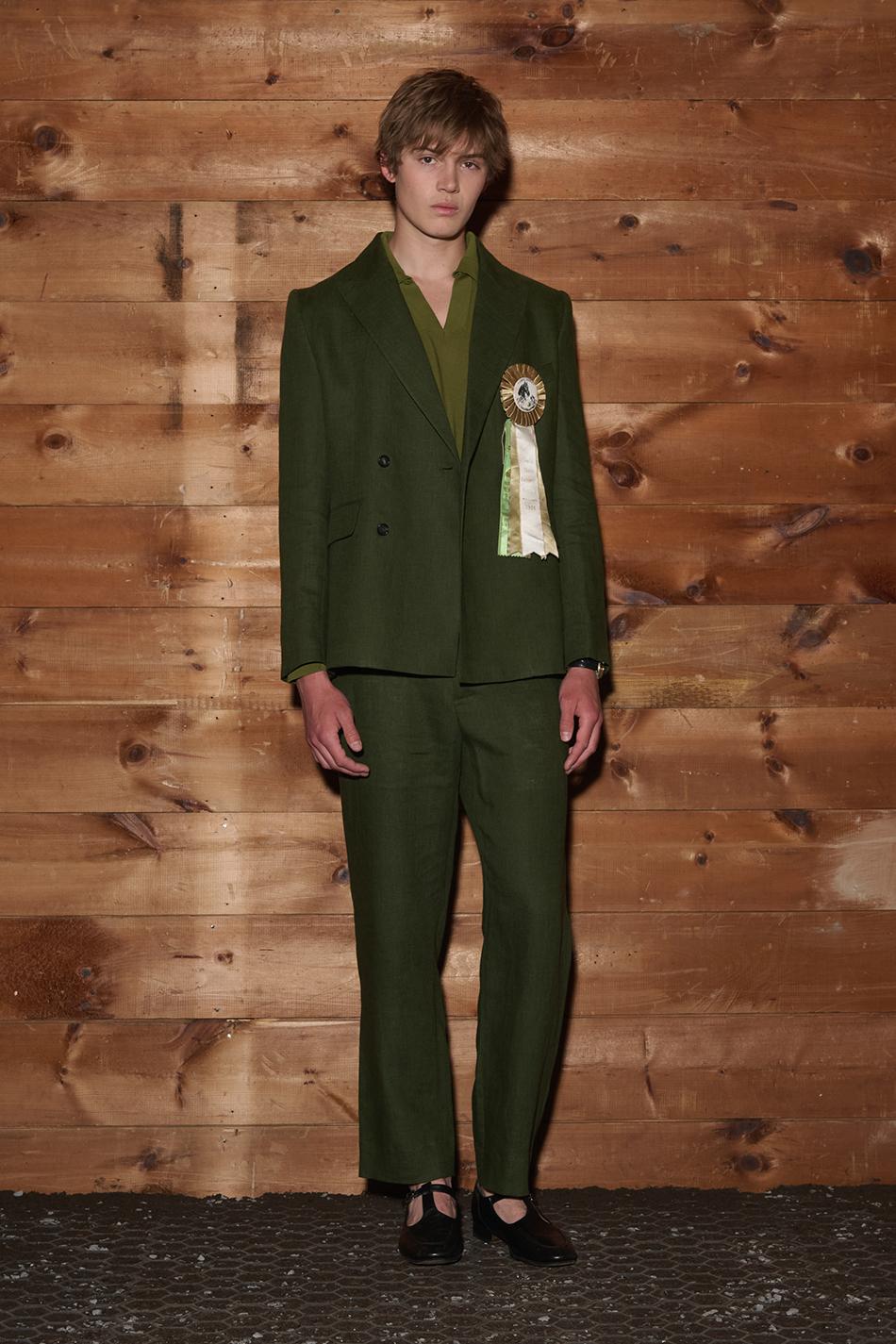
A model stands against a wood-paneled wall wearing a forest green double-breasted suit with a matching shirt, adorned with a decorative rosette ribbon on the lapel
Credit: Courtesy of Bode

On the Bode-wagon

I’m obsessed with Bode. I know, I know—who isn’t? Emily Adams Bode Aujla comes from a lineage of wagonmakers. Her great-great-great uncle, Albert Bode, ran the Bode Wagon Co. out of Cincinnati and built the show wagons for the Ringling Bros. and Barnum & Bailey Circus. That history inspired her spring 2020 collection (opens in new window), which is around when I first became aware of the brand. I grew up in Florida, and I have a soft spot for anything that brushes up against a sideshow or a theme park. As it turns out, the circus used to winter in Sarasota, not too far from where my parents currently live, on the grounds that now house the Ringling Museum. So I may be predisposed to like her work.

But Bode also represents an approach that seems to be disappearing from fashion. With the glut of microtrends, and the way things that are hyped seem to disappear just as quickly, you could write Bode off—there are a hundred copycats doing the patchwork-quilt–jacket thing now, most of them badly. The brand has stuck with me precisely because of its commitment to what it does. Bode sources materials from across the world and cuts them apart to rebuild them into jackets and other garments, and her pieces come with provenance labels that spell out where they came from. That kind of care for honoring origins is becoming harder to find.

Her fall 2026 collection, “Rodeo Bodeo”—a collaboration with Levi’s—is the clearest example of what I mean. It’s dedicated to Checkers, the spotted pony, blind in one eye, that she learned to ride on at a farm outside Atlanta as a kid. The thread carried into her spring 2027 collection (opens in new window), which reaches back into the American West of the late 1800s. The cowboy myth is loaded, but the clothes are beautiful. (By the way, if you want to go down the rabbit hole of where American ideas about rugged, outdoor clothing actually come from, I highly recommend “Gear,” the seventh season of the Articles of Interest (opens in new window) podcast.) I can’t afford anything at Bode’s price point, but it sure doesn’t hurt to look. Fashion moves as fast as we can swipe, but Bode remains steadfast.—Alyza Enriquez

A model walks a runway in a bold multicolored striped knit set — a horizontal-striped top layered over a long-sleeve purple shirt, paired with vertical-striped wide-leg trousers in matching tones
Credit: Photograph by Gerardo Somoza

For the cosmopolitan girls

I’ve been skeptical of artist–luxury brand collabs ever since Louis Vuitton’s cursed Yayoi Kusama robots (opens in new window) first appeared in stores (and my nightmares). But I was nonetheless delighted to see the designer Rachel Comey showing (opens in new window) a spring collection inspired by Rosalyn Drexler, a multidisciplinary artist who made sculptures and paintings in the 1960s and had parallel careers as a novelist, playwright, and, briefly, professional wrestler. Comey’s collection draws on Drexler’s bold, Pop art aesthetic with bright splashes of color and graphic patterns—I especially like a slouchy, stripey turquoise-and-purple look, and an asymmetrical dress that directly references the green floral motif of her 1988 painting Night Visitors. A hooded, robe-like garment and a wide metallic belt seem to allude to Drexler’s wrestling days. To complete their looks, several models were outfitted with copies her novels, including To Smithereens, I Am the Beautiful Stranger, and The Cosmopolitan Girl (which is being reissued (opens in new window) by Hagfish later this month). Comey told (opens in new window) ArtNews that she thinks her customers are “reading types.” Guilty!—Olivia Horn

Join our community