A lesson in miniature
The summer group show is a bit of an art world trope; during the time of year when sales slow down, gallerists fill their walls with a mishmash of works and then set their out-of-office responders and make for Amagansett. But sometimes a little alchemy can happen, and the group show becomes a vehicle for quirky curatorial concepts and unexpected groupings. Such is the case at the Walpole Ontological Lab and Farm (opens in new window) (WOLF)—a project run by the artist Dyer Rhoads out of a farmhouse and repurposed barn in Walpole, Maine, which I visited during a trip earlier this month. This year, WOLF’s annual summer group show includes some 200 artists, many of them affiliated with Spindleworks (opens in new window) and other arts organizations that serve individuals with disabilities. The sprawl of the works and the idiosyncrasies of the installation—sculptures nestled on windowsills, video screens mounted in horse stalls, no wall labels or checklists to be found—piqued my curiosity and made the show feel like something to be sifted through rather than beheld.
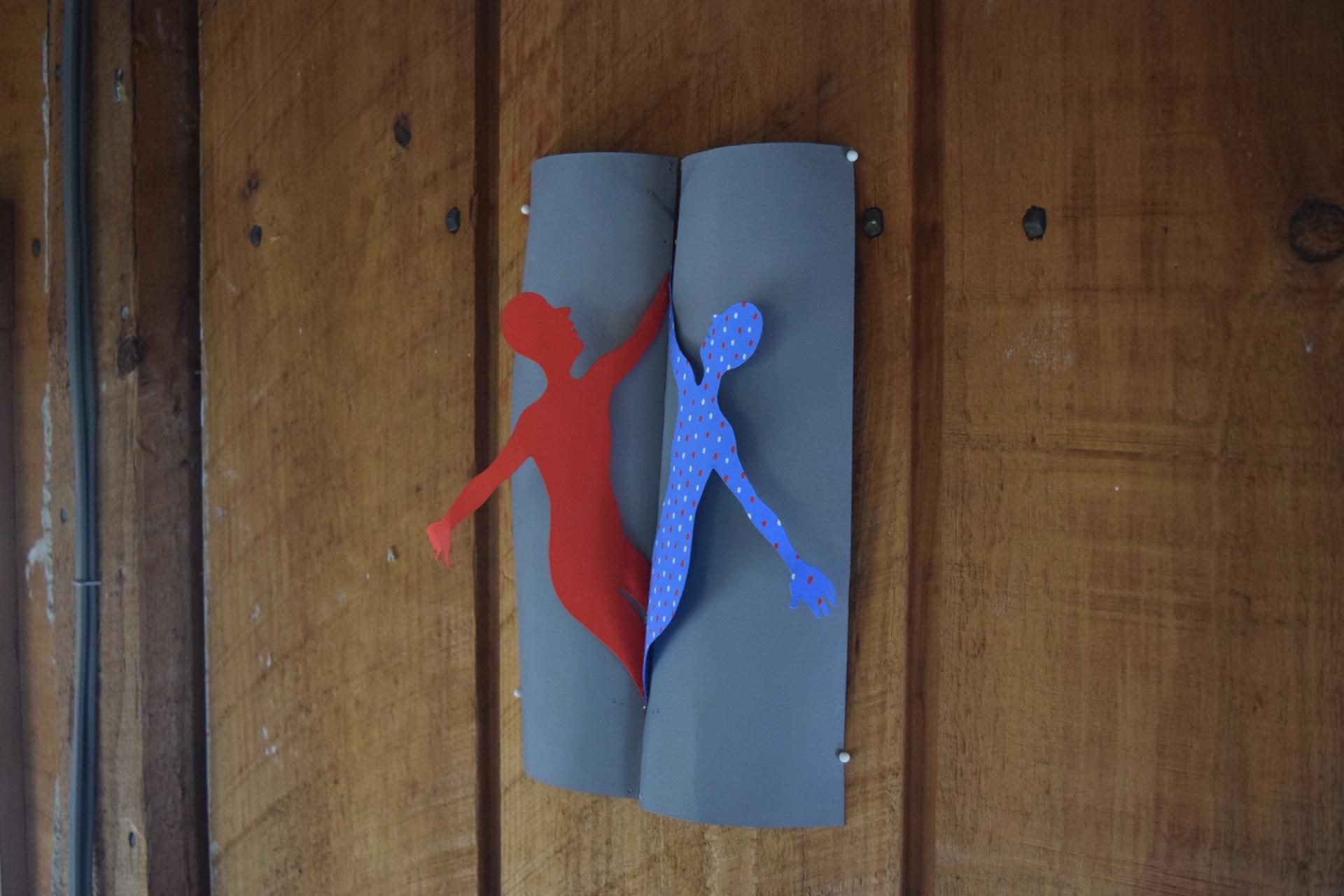
I was especially taken with a handful of works by Sascha Braunig (opens in new window). The artist, who’s based in Portland, Maine, is known for vivid, saturated paintings featuring skeletal or silhouetted bodies, often with motifs evoking bondage or confinement. At WOLF, she’s showing a pair of oil-on-paper paintings of stretched and layered limbs in rainbow colors. I also spotted, pinned to the wall, a small, three-dimensional paper work of hers featuring a pair of cutout bodies that sprout as if from a magazine centerfold.
It turns out that Braunig usually makes maquettes like these as studies for her paintings (this one was for a 2018 painting, Gemini (opens in new window)). The forms—made out of paper, clay, wire, epoxy, and fabric—give the artist a sense of contour and shadow, which translate to more dimensionality in the details of her paintings, like draped fabrics and spindly armatures. “I think that this partial painting from observation lends a crucial graspable quality to the paintings that they wouldn’t have otherwise,” Braunig wrote to me in an email. “There’s also a strangeness that results from translating a small model, often under 15 inches, to a larger human-scale painting.”
I love this inversion of process; normally, I think of maquettes being scaled up into larger sculptural works, rather than compressed back into two dimensions. It reminded me that artistic practice is often much more fluid than it appears—like when a painter becomes a sculptor in order to circle back to painting.—OH