
Collected

Banana-Leaf Lighting, a Sultry Summer Novel, and Sumptuous Art

What we’re obsessed with this week in craft and culture.

Two geometric wall sconces with warm amber light hang above a cream upholstered bench against a textured off-white wall.
Credit: Vy Voi banana leaf sconces. Photograph by Jingyu Lin.

This sconce is bananas!

The New York–based designer and artist Steffany Trần of the studio Vy Voi makes some of my favorite household objects, like handmade porcelain vases (opens in new window) shaped to resemble tropical fruits, finished in smudgy colored glazes with diverting names (“Egg Coffee with Moss, sponged”), and lamps (opens in new window) that look like delicate blimps. Thus far, Trần has specialized mostly in table lamps of various sizes, but recently she debuted a new lighted object: the sconce (opens in new window). Like all her work, it is inspired by a specific aspect of her Vietnamese heritage and draws on Vietnamese material culture. She used dó paper (handmade in northern Vietnam from the bark of the dó tree) to sculpt a series of rectangular, wall-mounted lanterns that take their shape from the banana-leaf parcels, wrapped and tied with string, that are used to cook, keep, and carry food, typically rice and rice-based snacks.

Trần said the sconces came out of a challenge she set for herself one day—to come up with a new design in 30 minutes or less. She wanted it to go in “a different direction” from her existing oeuvre of softer, rounder forms. “The throughline for my work is this idea of finding tenderness in everyday objects,” Trần said in a phone interview. “So even if the sconce is more geometric, there is still that softness that’s very subtle. There’s a little bit of curvature around the edges and the frame itself to give it a softer language.”

Though she often begins a new design by sketching out a rough idea, Trần has found that she makes the most progress in her process in the hand-building phase. “The actual prototyping—when I’m holding up paper, cutting up cardboard, working with clay, cutting up wood, or whatever that might be—that part is more about refinement and actually seeing things 3D,” she said. “That becomes a little bit more ‘A-ha!’ than just pen and paper.”
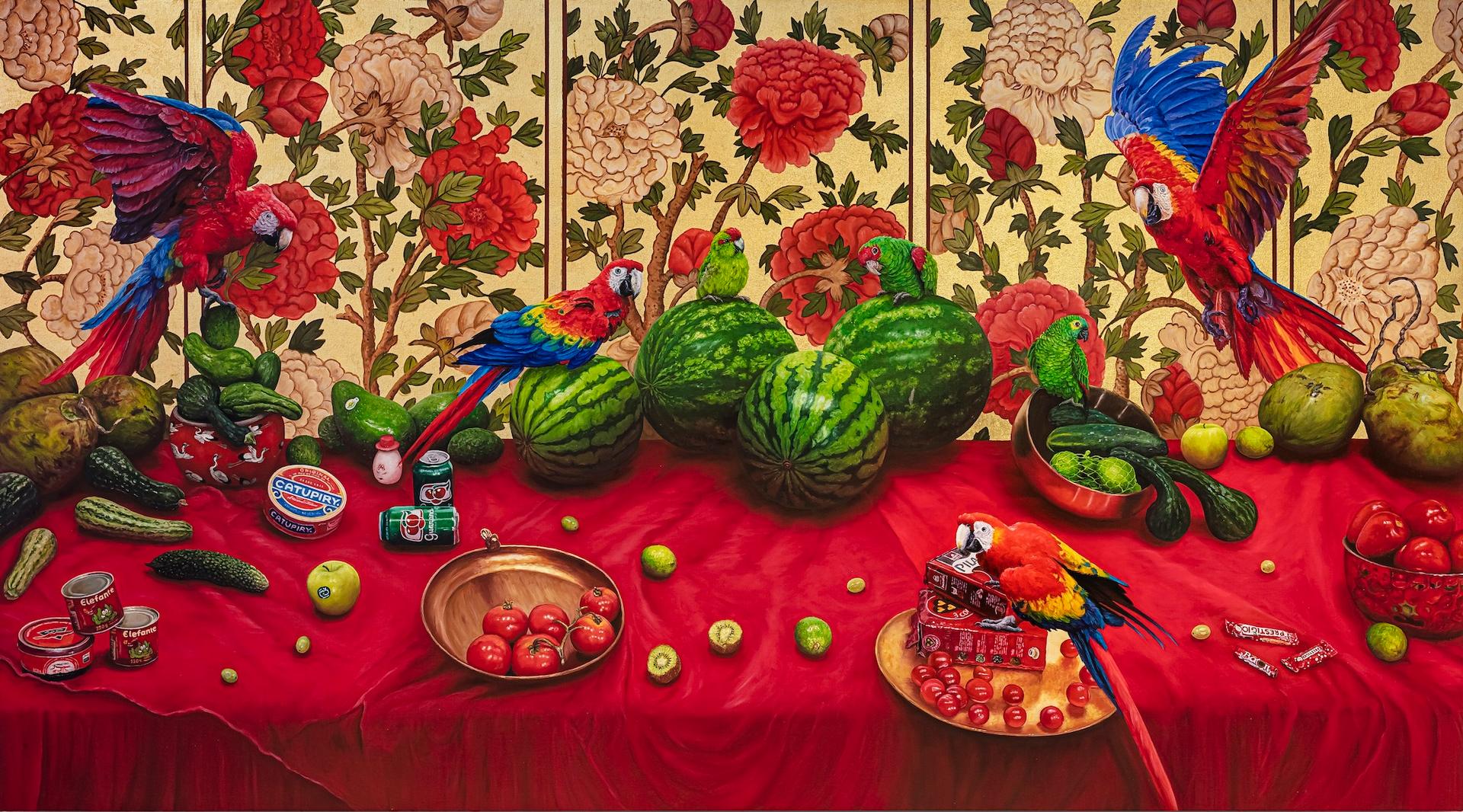

A colorful still life of parrots, watermelons, vegetables, and packaged foods set against a gold floral wallpaper.
Credit: Ana Elisa Egreja, “Red Table with Chinoiserie, Macaws, and Parrots [Mesa Vermelha com Chinoiserie, Araras, e Papagaios]” (2026). Photograph by Filipe Berndt. Courtesy of the artist, Almeida & Dale, and Jessica Silverman.

Still lifes to die for

Ana Elisa Egreja paints the most luscious still lifes. The 15 new paintings featured in “The Flight of Color,” (opens in new window) the Brazilian artist’s first solo exhibition in the US—running until September 3 at Jessica Silverman Gallery in San Fransisco—give the same sense of luxuriant satiation as the food scenes in films like Tampopo and Eat Drink Man Woman, or the costumes and set design in the Elizabeth movies starring Cate Blanchett. Egreja paints elaborately staged tablescapes and cats lounging on silky brocade sofas in deep, rich colors (and 24-karat gold leaf), rendering objects and animals in such detail that they verge on trompe l’œil. As much as I would love to have one of her paintings hanging in my living room, I’d also worry that it would make me hungry all the time.

A black-and-white photograph of a woman in silhouette smoking a cigarette, with the words "Lonely Crowds Stephanie Wambugu" in orange text.

A debut novel about fraught friendship and art

The paperback edition of Stephanie Wambugu’s terrific debut novel, Lonely Crowds, was released this month. The book follows Ruth and Maria, childhood friends whose relationship becomes increasingly complicated as they grow up, go to college together, and then plunge as fledgling artists into the art world of New York in the nineties. I read Lonely Crowds in a sprint last summer, riveted by the fraught and feverish dynamic between the two women and engrossed in Wambugu’s clean-as-a-bone prose and deadpan humor, and then recommended the novel to all my friends. It also has one of the best endings I’ve read in recent memory—indeed, I can recall the final line now, even though it’s been a year since I read it. If you haven’t had the chance yet, pick up a copy now (opens in new window).

Join our community