Collected

Inside Avedon’s Studio, Delightful Design, and Shygirl in Love

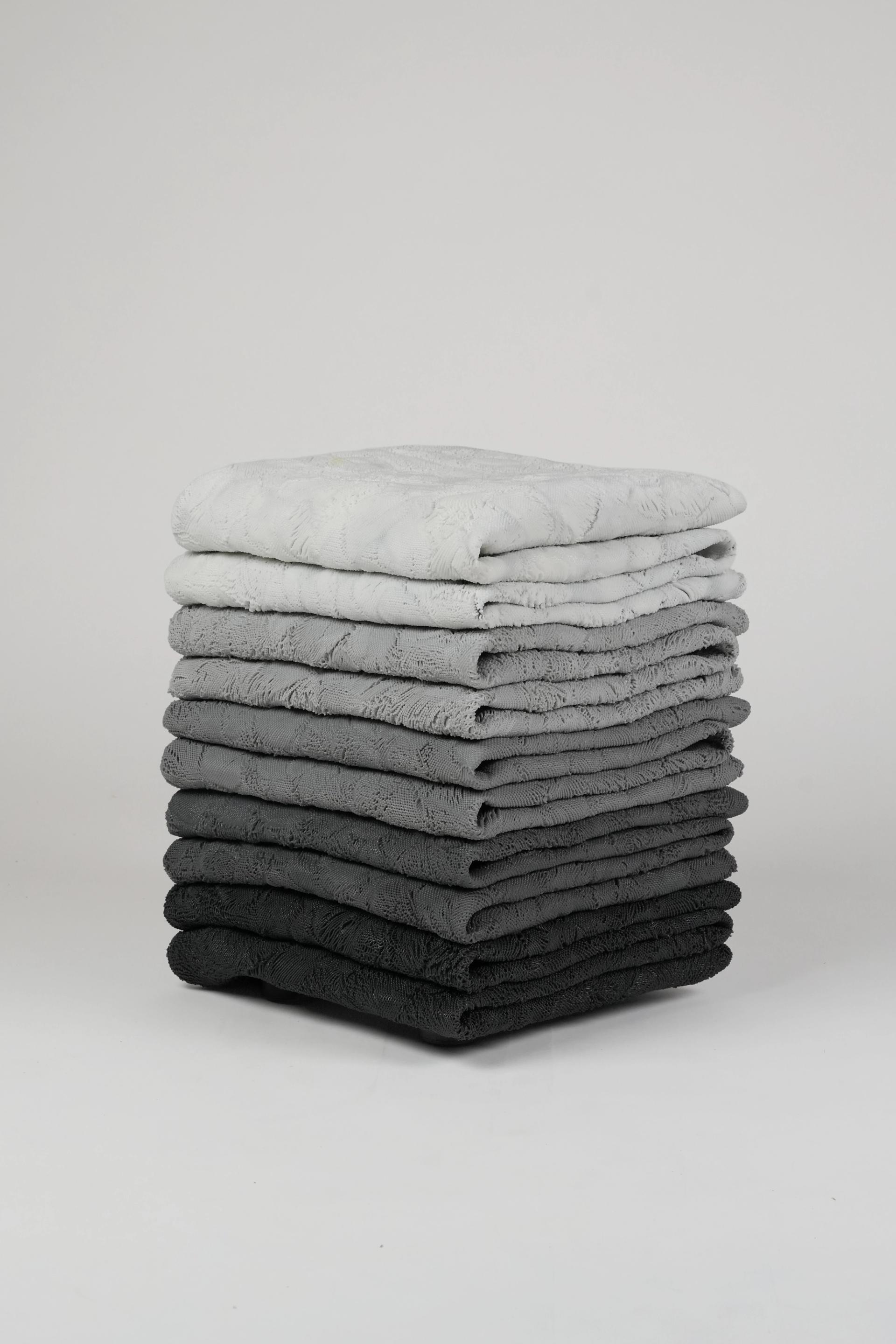
Vertically oriented photograph of a sculpture that looks like a stack of terrycloth towels, arranged in a gradient from dark gray to white
Credit: Laura Dominici and Basil Schu, “Towels” (2026). Courtesy of Laura Dominici.

Plush job

Every year, the Collectible fair brings together some of the most inventive and jaw-dropping furniture and object design from around the world—pieces that blur the line between functional item and art. This year, one of my favorites was also one of the most demure: relatively small and deceptively simple in appearance, but brilliant in concept and execution. The Towel Stool, by Vienna-based Laura Dominici, takes the idea of trompe l’oeil so far that you’re convinced it’s a stack of plush terry towels until you actually touch it. Dominici employs a process of pressing silicone through fine mesh to mimic the fibers, a high-craft version of squeezing Play-Doh through a noodle press. Once the material sets, it’s cut, folded, and sewn by hand, making each piece in the series one of a kind. There’s delight here beyond that of encountering the stool for the first time. This version neatly stacks its monochrome “towels” in shades of gray from lightest to darkest, satisfying not only my outer design nerd but also my inner neat freak.—Rob Vargas

A cracked white eggshell revealing a beige and pink hatchling inside

Heart beats

At its best, falling in love is transformative: Not the melding of two halves into one complete whole, but the alchemy of two already-whole individuals cultivating a secret third thing that can exist only through their connection. Shygirl—best known for her grimy, experimental club anthems—captures this expansive experience of love on her most recent album, SWALLOW! For the British multihyphenate, romantic partnership brings her more deeply into the world around her even as it transports her somewhere beyond. She sings of coming into existence under a lover’s gaze, how being witnessed in the intimate mundane can make you feel more anchored to reality: “If you’re not there, if you don’t know / Where do I go? Who would I tell?” But equally, she stays rooted in her sense of self (“I know what I want from me,” she declares on “Mantra”). The tracks move fluidly between themes of companionship and individuality; taken together, they paint a dynamic picture of interdependence.

SWALLOW! is fixated on the real and the ethereal. Sonically, it is fantastical and resonant, glitchy and grounded. Dark, rich cello cracks open into a thrumming electronic drop on “Alyse,” before the production ebbs away again to expose a brief, soft vocal duet between Shygirl and her real-life partner, George Smale. Soaring vocal lines and the melodic cry of electric guitar run alongside frenzied, industrial percussion, creating a mood that is both gritty and dreamy. With SWALLOW!, Shygirl weaves tonally distinct acoustic and electronic elements into a sound that is more than the sum of its parts, gesturing toward what becomes possible in the “we”—the collectivity that love can catalyze.—Mer Wade

Vertically oriented black-and-white photograph of Richard Avedon, a white man in his early 70s, looking up while holding a film camera with a pair of glasses on it
Credit: Photograph by Bruce Weber. Courtesy of Netflix.

Nothing personal

Before Richard Avedon photographed Paris couture or Marilyn Monroe, he made ID pictures in the merchant marine: “maybe 100,000 baffled faces,” he recalls, posed against a white background. Do thousands of those, he says, and it “begins to be a life view.” In Ron Howard’s Avedon, which is newly streaming on Netflix, those humble origins hum under six decades of prestigious work. That plain, seamless look became his signature, “the existential white,” where “the only thing you see is the geography of the face,” and the career that followed was a long practice of subtraction. “Beautiful lighting, I always find offensive,” he says. “The photographs that move me the most don’t let anything get in the way of what happens between you and the person.”

Made in association with the Richard Avedon Foundation, the film is warm toward its subject and lavish with access: Avedon narrates much of it through archival tape, and the dealer Larry Gagosian, the critic Hilton Als, and a procession of former sitters round out the portrait. Howard is attentive to method, tracing how Avedon traded smaller cameras for an 8-by-10 that an assistant helped him work so he could stand beside the lens and talk to his sitter face to face. His former assistant Sebastian Kim puts it plainly: “He wasn’t at all technical.” What Avedon had was patience and a flair for theatrics. He’d routinely spend the first half hour of an hourlong session idly making chat. When the Duke and Duchess of Windsor smiled through frame after frame, he lied to them that his taxi had run over a dog. “Her face fell and I took it,” he recalls. “She said she would destroy me.” Avedon was after “an exchange of energy” between himself and the sitter, and he often found that the camera hindered more than it helped. His eye was his true instrument. “I don’t think consecutively—I’m anecdotal, I’m instinctual,” he says. “But I can see like a son of a bitch.”—Will Fenstermaker

Vertically oriented photograph of a magenta book cover reading "Sasha Bikoff, High Vibe Design: Redefining Maximalism" in iridescent text

Max-maxxing

Maximalism is not for everybody—but it can be, in small doses. And it helps to have a good guide. There’s no one I’d rather lead me on this journey than Sasha Bikoff, a New York–based designer known for fantastical, whimsical, and glamorous spaces that I find both inspirational and aspirational.

Her new book, High Vibe Design: Redefining Maximalism, is less a manifesto than some gentle and well-informed guidance from an expert in the field. What we think of as maximalist decor isn’t just tossing every color, pattern, texture, and style into one room; for Bikoff, maximalism is, as the title says, vibes. “I always start with a story and a setting,” she writes. “And then I allow my mind to concoct an inspiration that is fantastic, wild, and unexpected.” If the space you desire is, say, Barbie’s Dreamhouse meets Shaker by way of the raucous Victorian interiors of the Gilded Age, arm yourself with Bikoff’s expertise and you won’t be led astray.—Megan C. Reynolds